New Portland Art Museum Pavilion Required Precision Across Three Structures

Portland Art Museum adds a 35,000-sq-ft pavilion between two existing buildings.
It isn’t the size of the Portland Art Museum’s 35,000-sq-ft Mark Rothko Pavilion that is meant to impress—it’s the unification of two separate buildings via the museum’s new front door and glass connector that creates a completely fresh museum experience.
“The museum’s transformed campus is a result of a decades-long vision to better serve our community as the cornerstone of Portland’s downtown cultural district,” said Brian Ferriso, director of the museum, in a press release.
The release notes that the glass pavilion connects the museum’s two historic buildings—the South Wing, designed by Pietro Belluschi, and the North Wing, a former Masonic Temple designed by Frederick Fritsch in1924—creating streamlined circulation across all four floors of gallery space.
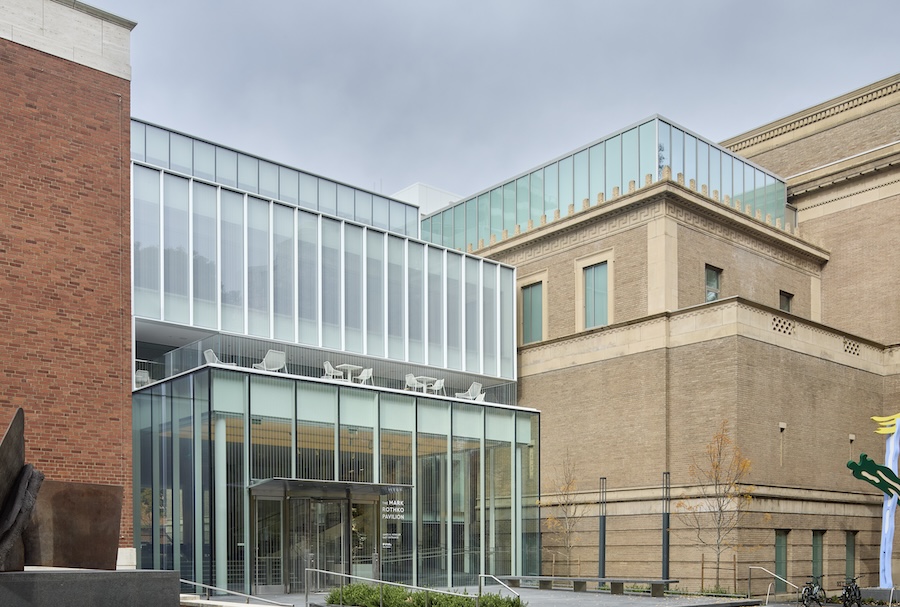 Photo courtesy Jeremy Bitterman
Getting there wasn’t as simple as dropping in a multi-story glass structure. The seismically independent design required Mortensen Construction to touch almost 100,000 sq ft of space across the site to make way for the addition, all while keeping the museum open during the three-year build.
Opened on Nov. 20, the new $116-million pavilion is marked by over 37,000 sq ft of flamed black granite pavers shipped from China—both on the interior and exterior—and 184 pieces of specialized exterior glass fabricated in Spain, with the largest a 28-ft-tall section on the second story.
“There was intentionality around materials and systems aligning and making it a clean, seamless project where the art is the focus,” says Carolyn Sizemore, Mortenson director for Oregon and southwest Washington, adding that the joint lines on the granite pavers line up across the entire site from sidewalk to sidewalk and straight through the building, also matching the stainless steel hand rails, vertical supports, curtain wall and any systems in the ceiling plane. “This is high-class-type museum detail,” she says. “It is something the public appreciates because of the simplicity it emotes without even realizing the craftsmanship.”
Getting there required precision, not only within one system but across all systems. And that proved even trickier by the fact that the three buildings feature 13 different floor elevations across five levels of footprint. Making sure the details played out correctly “was certainly a challenge and needed extreme foresight and planning,” says Sizemore.
Mortenson started on the project planning in 2018, with construction of the Hennebery Eddy Architects and Vinci Hamp Architects-designed project kicking off in December 2022. First, crews needed to reposition all the MEP systems from an existing underground tunnel located in the pavilion’s new footprint, requiring the team to enter 18 different museum spaces to reroute systems. They built the museum a new loading dock and a new gallery above it, along with below-grade conservation spaces.
“It is like open-heart surgery on a live human,” Sizemore says. “The museum never shut down.” While opening the two existing buildings, the team used laser scanning and 3D modeling to track where the new systems would go.
Coordination continued—from Mortenson syncing calendars with the museum to share the loading dock and schedules, to changing the language used on the project so the museum could understand when spaces became “staff-ready, art-ready and public-ready.”
Making precision more challenging was the 25 different exterior intersections and 35 interior intersections between the new space and existing buildings. Each one is different. The largest joint is 15 in wide, and the smallest is four. “There is nothing standard or repetitive about joining two existing buildings with one in the middle,” Sizemore says.
The new Rothko space, which Sizemore says builds connection and allows the museum to flow in new ways, is four floors above grade and one below, all seismically independent to create the most straightforward way to deal with the existing structures. Sizemore says the needs of the museum for large open spaces required creating, through the work of KPFF Engineers, a proprietary box system with cantilevers to connect the spaces.
“For me, I always knew that individual projects develop their own culture and team dynamics, but this one was especially necessary and meaningful when talking about building a legacy project in Portland,” Sizemore says. “The construction workers were stewards of art. We were protecting the collection. That became part of our daily work. The pride and culture built on this project was foundational to its success.”


