2025 Mountain States Best Projects
Award of Merit, Office/Retail/Mixed-Use and Sustainability | Excellence in Safety: 1900 Lawrence
1900 Lawrence
Denver
EXCELLENCE IN SAFETY; Award of Merit, Office/Retail/Mixed-Use; and Award of Merit, Sustainability
Submitted by Hensel Phelps
Owner Riverside Investment & Development
Lead Design Firm Goettsch Partners
General Contractor Hensel Phelps
Civil Engineer Martin/Martin Consulting Engineers
Structural Engineer Magnusson Klemencic Associates
MEP Engineer MTech Mechanical
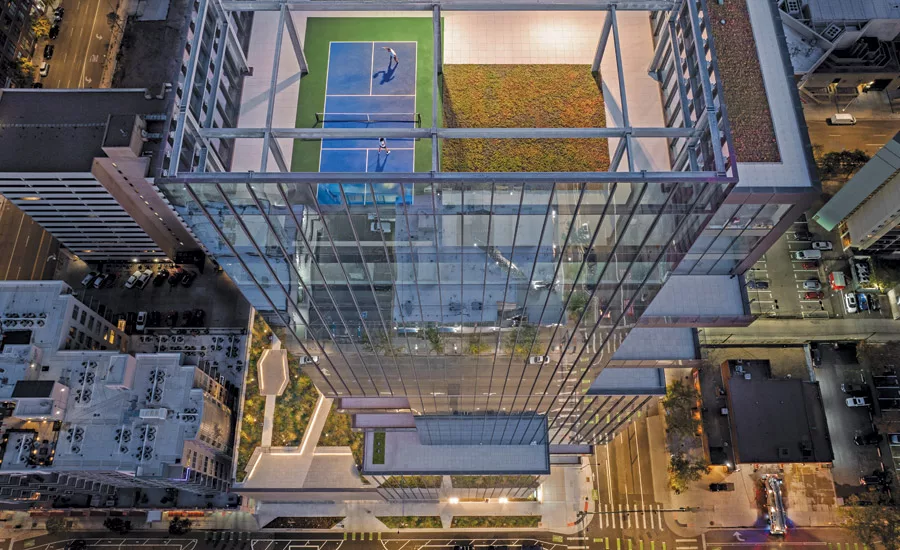
As the first Denver office tower designed and precertified to LEED, WELL and WiredScore Platinum certification, this project aimed to merge functionality with aesthetics. Rising 32 stories and 428 ft, the building offers 700,000 sq ft of workspace across 24 floors. The building features advanced mechanical systems, including floor-by-floor fresh air, destination dispatch elevators, frictionless access controls, 5G connectivity and high-performance facades.
To manage the risk of fluctuating prices and ensure the project stayed within the owner’s expected budget, the team completed 94% of the buyout before breaking ground, securing major materials and equipment early.
Building the helical ramp for the parking garage required meticulous planning to ensure its structural integrity. The team leaned heavily on 3D modeling, lift drawings and coordination with the structural design team to simplify the design and make the desired profile constructible within the tight site constraints.
Lean construction methods enabled the team to reduce the steel scope by $6 million while still adhering to strict structural parameters, strategically minimizing steel usage without compromising integrity—even adding additional support at the facade to meet wind load requirements.
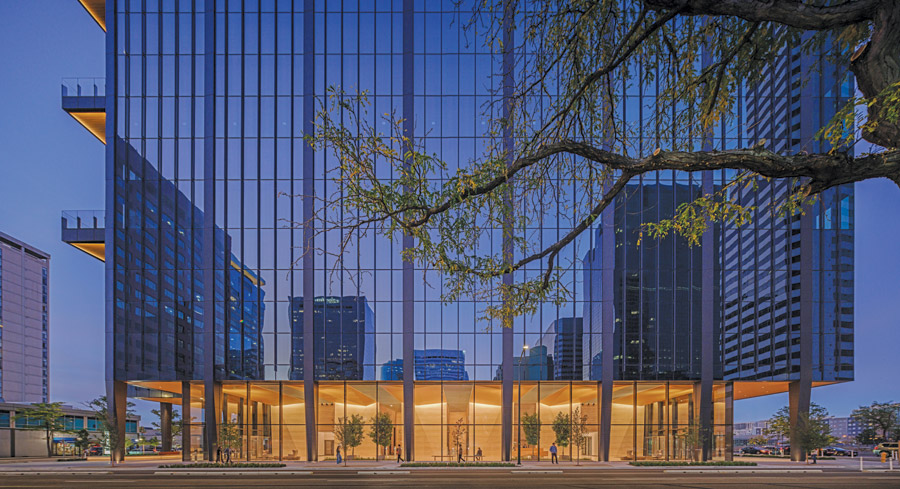
Photo courtesy Jason O’Rear
The building’s comprehensive sustainability strategy includes water-efficient fixtures that save more than 45% of indoor potable water usage, saving an estimated 5,021,400 gallons annually. Efficient irrigation design and the use of native and adaptive plants result in additional savings of 66,467 gallons of outdoor water use each year, representing a 66% reduction in irrigation demands.
The building also operates as a fully electric structure, including the boilers, with natural gas only used for the seventh floor fireplace. Hospital-grade ventilation systems with isolated HVAC system returns are located on each floor, ensuring no occupied floors share air.
As part of a comprehensive safety program, the project included the trade partner safety initiative, which communicated all the different safety measures for working on a high-rise project. Safety training sessions were tailored to each trade’s specific work, ensuring that all trades were well-versed in safety protocols and empowered to take ownership of their safety practices.
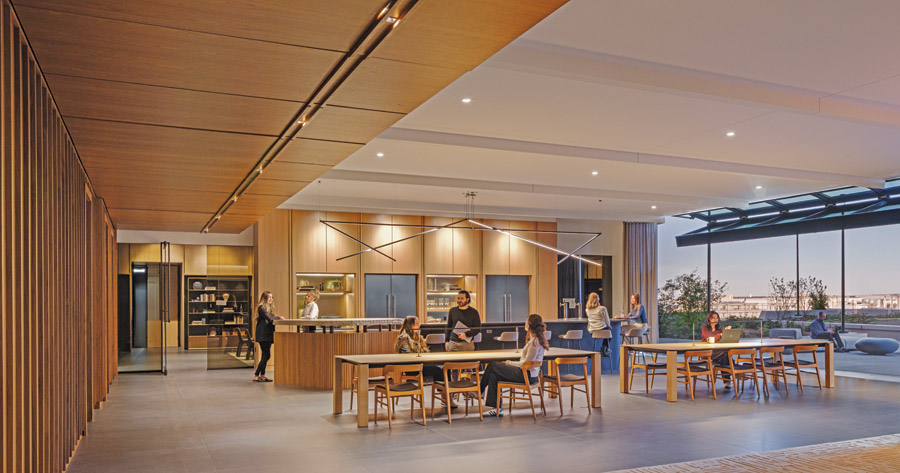
Photo courtesy Jason O’Rear
Setting up a concrete pump next to an earth retention system posed structural and safety concerns when crews set out to place the project’s 40,000 cu yd of concrete. To address this, the team installed 8-in. by 6-in. by 1-in. steel angles at each pump location to stop the outrigger in case someone hit the pump.
While working on the high-rise, the team prioritized safety through proactive measures, including safety netting, tool tethering and cordless tools. With limited air rights and a tight site with zero lot lines, the team utilized a tower crane and a crawler crane on the structure and facade.
Additionally, a hydro crane was also rented for eight weeks to secure an optimal location for the crawler crane. The team developed a comprehensive crane logistics plan to place and operate the cranes, ensuring the safety of both workers and the public in a highly constrained environment.