2025 East Best Projects
Best Water/Environment: U.S. Naval Academy Seawall Repairs of Farragut Field and Part of Santee Basin
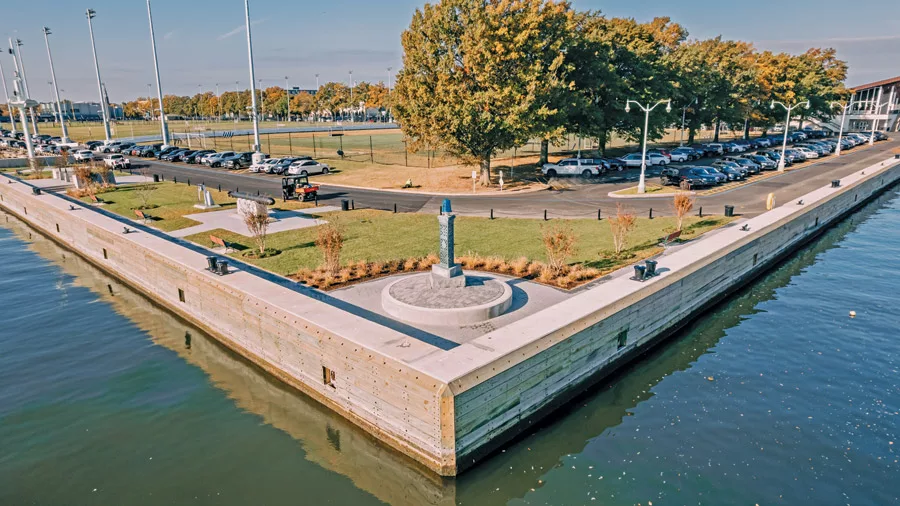
U.S. Naval Academy Seawall Repairs of Farragut Field and Part of Santee Basin
Annapolis Md.
BEST PROJECT
Submitted by Cianbro Corp.
Owner: Naval Facilities Engineering Systems Command (NAVFAC)
Lead Design Firm: Marine Solutions Inc.
General Contractor: Cianbro Corp.
Engineering Consultant: Whitman, Requardt & Associates
Originally constructed in the early 1900s using materials recovered from dredging operations in nearby waterways, the seawall supports Farragut Field—a multipurpose outdoor space—as well as waterfront Brown Park.
Corrosion and degradation of the original sheet pile had resulted in the loss of seawall material, contributing to flooding and numerous sinkholes throughout the area.
As part of the Naval Academy’s Installation Resiliency Plan, the $37.1-million project aims to provide flood protection and mitigate the effects of sea level rise for another 75 years.
The project scope included a complete structural rehabilitation of the seawall, including a new sheet pile wall constructed outboard of the existing one. A new tieback system constructed inland of the existing structure provides added stability.
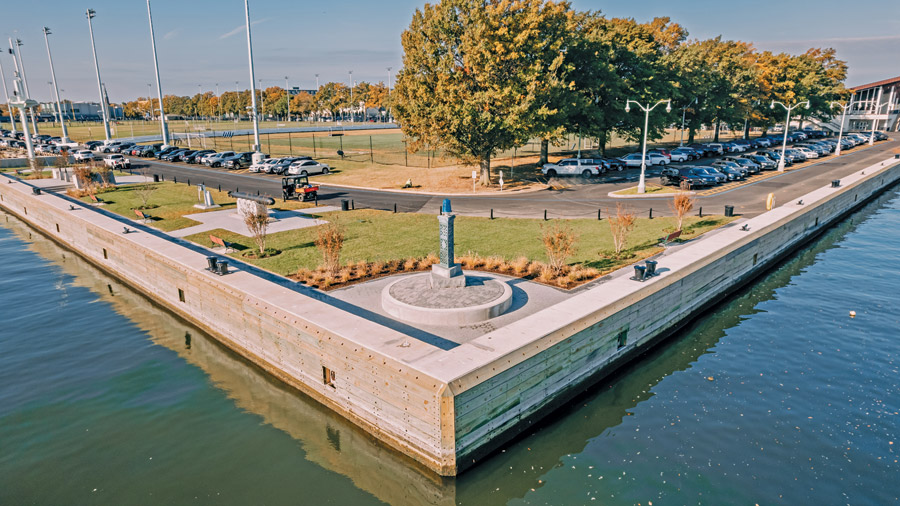
Photo courtesy of Cianbro
A confined work area, unstable ground and limited space made traditional land-based operations difficult. To adapt, the team developed an efficient approach that utilized two water-based cranes alongside a land-based crane. Carefully sequencing operations and maintaining access from key points ensured a smooth pile-driving operation and minimized the risk of disruptions.
Other project innovations included pile-driving templates that allowed for rapid placement of batter piles. A cantilever formwork system used for the cast-in-place concrete seawall supported the weight of a full-depth pour without support piling in the waterway. A similar approach was used for casting of the pile cap, with two sets of formwork, allowing simultaneous progress on two sections.
As the project progressed, the team worked together to safeguard historical monuments along the seawall honoring U.S. Navy service members that have inspired generations of sailors. The team developed plans to either remove and reinstall monuments post-construction or protect them in place throughout the project.
The team’s commitment to cultural preservation was reflected in their detailed coordination and thoughtful approach, which contributed to the project’s on-time and at-budget completion.