2025 Midwest Best Projects
Project of the Year, Best Project, Airport/Transit: Damen Green Line Elevated CTA Station
Realizing one of Chicago’s newest train stations required embracing multiple outside-the-box design and construction strategies
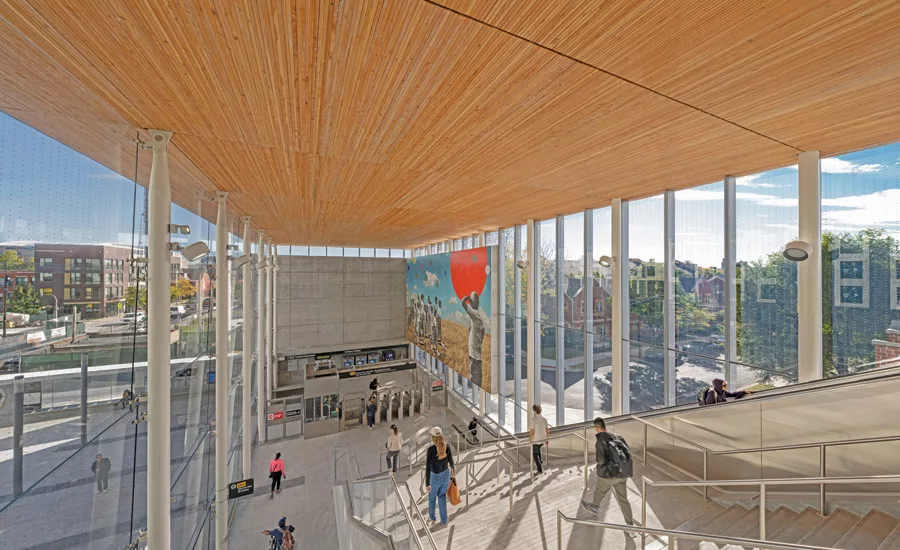
A view of the station house interior facing south. The project’s honest expression of materials and sweeping transparency aimed to elevate the passenger experience.
Damen Green Line Elevated CTA Station
Chicago
BEST PROJECT, AIRPORT/TRANSIT
Submitted by F.H. Paschen, S.N. Nielsen & Associates LLC
Key Players
Owner Chicago Dept. of Transportation
Lead Design Firm Perkins&Will
General Contractor F.H. Paschen, S.N. Nielsen & Associates LLC
Civil Engineer and MEP Engineer Milhouse Engineering & Construction
Structural Engineer Simpson Gumpertz & Heger
First built in 1893, the original Damen Station shut down in 1948 before being demolished the following year. But in the decades that followed, the station’s absence created a 1.5-mile transportation gap between the Ashland and California stations for Chicago’s Near West Side neighborhood, exacerbated in recent years by pedestrian traffic to and from United Center just a few blocks away.
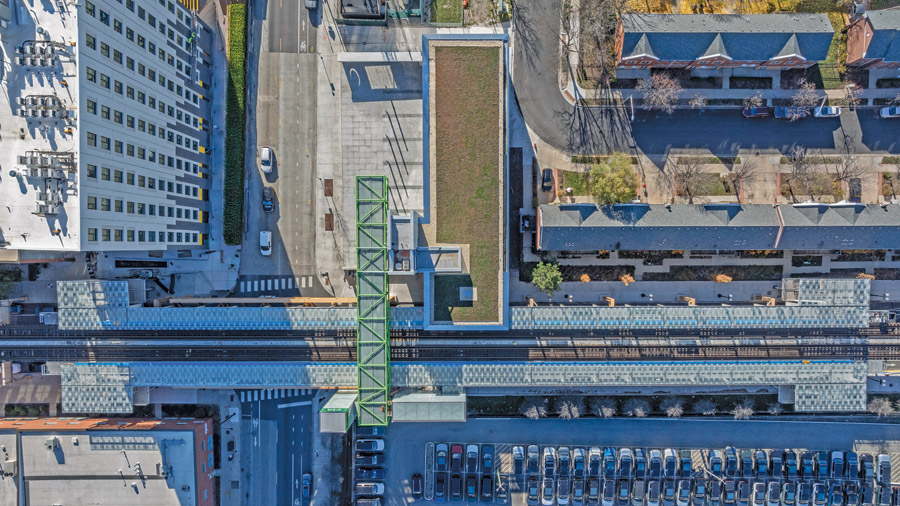
Finally, in August 2024, the Chicago Dept. of Transportation (CDOT) closed that gap with completion of the $80.5-million Damen Green Line Elevated Chicago Transit Authority (CTA) Station. This multimodal station features a three-story, 8,700-sq-ft station house, an iconic pedestrian bridge and a new plaza.
“CDOT really prioritized uplifting the passenger experience, bringing unique materials for the system into the station, such as the mass timber roof deck, because the client really wanted to promote a sense of well-being and bring some warmer materials to the passenger experience,” says David Rader, a project architect with Perkins&Will. “They really encouraged the team to push the design envelope to create something that was really iconic and memorable within the system itself.”
General contractor F.H. Paschen (FHP) immediately partnered with Perkins&Will after winning the project in 2021. “Having a strong working relationship with the Perkins&Will team was a must from the moment of award onward. The complex design required give and take on both sides so that we could meet the design specifications while addressing the real-world construction challenges of the design,” says Jeremy Seyller, vice president at FHP. “Our teamwork with Perkins&Will led to the ultimate success of the construction.”
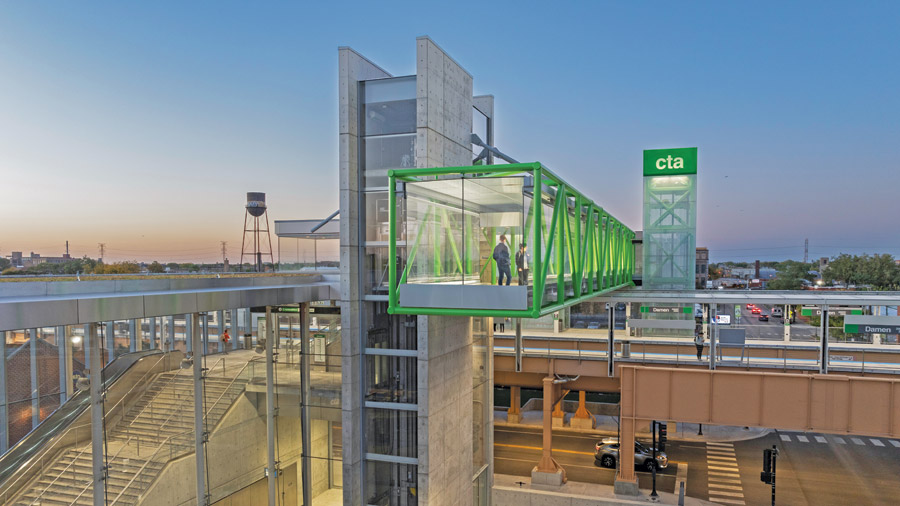
The $80.5-million Damen Green Line Station features a three-story, 8,700-sq-ft station house, a pedestrian bridge and plaza.
Photo by James Steinkamp Photography, courtesy of Perkins&Will
Impeccable Coordination
Throughout the nearly three-year project, it was critical that CTA operations continued uninterrupted, says Patrick Wright, FHP’s project manager.
“But this was a significant challenge because the scope of work required the replacement of the existing columns supporting the track structure,” Wright continues. “We could not shut down the active Green Line tracks during this work, so the tracks had to be shored, existing columns demolished and the new columns installed all while trains were passing by above.”
Key to this approach was reversing the support column construction process; after crews reinforced the track structure with shoring towers and removed the existing columns, the new columns were hung from the existing track girders. After moving them into place, the team placed pile caps and piers up to the new column base plate rather than installing caps and piers before the columns.
“Safety was the highest priority, so months of intensive planning and coordination with CDOT, CTA and our subcontractors took place prior to any work in the field,” Wright adds.
This approach also helped ensure that there would not be any alignment issues when connecting the new columns to the existing track girders. After testing the new concrete’s design strength specifications to ensure strength, crews transferred the load to the new columns and removed the shoring towers.
“Coordination between disciplines was really critical during the design phase because the finished surface of almost all the architectural elements is the structural surface,” Rader says. “All the necessary services at the station house ... are tucked into the columns. And we coordinated that during the design phase.”
As a result, architecturally exposed concrete (ACON) and architecturally exposed structural steel (AESS) were used extensively throughout the project.
“All the necessary services at the station ... are tucked in the columns.”
—David Rader, Project Architect, Perkins&Will
“On the east side, the up and down lights are coordinated to have the conduit running inside the columns from the base so that when you are in the station house, all you see is columns,” Rader continues. “It doesn’t belie the complexity of the systems that are happening. And that’s true in other parts of the station as well, but those elements were probably the most carefully considered because of the sightline concerns.”
BIM was used throughout construction not only for utility coordination but also for the project’s glazing, nail laminated timber (NLT) and metal panel systems, as each one had custom details that required careful coordination among multiple trades.
The NLT structure at the station house ceiling also acts as the structural roof deck, which required extensive planning as well. “NLT was selected because it was the most low-tech option,” Rader explains. “It’s made of dimensional lumber that is nailed together and then sort of assembled into panels, finished and then routed to contain the lighting elements. And so all of those panels had to be 3D modeled first, coordinated with different services and structural attachments and then installed and adjusted on site.”
This material provided both structural performance and aesthetic appeal for both exposed and hidden portions of the station house ceiling while offering the strength and durability needed to support not only the structure but also the green roof installed above the NLT ceiling, according to FHP.
“We wanted to keep it local, but really there is no local CLT. It’s usually from quite far away. To my knowledge, it’s the only NLT in the city—at least at the time. So it was a learning process for the trades too,” adds Bryan Schabel, design director of Perkins&Will’s Chicago office.
The Damen Green Line Station site was previously home to another station that closed in 1948.
Photo by James Steinkamp Photography, courtesy of Perkins&Will
A Massive Move
One of the station’s iconic structural elements is a glass-enclosed cantilevered bridge that connects inbound and outbound train platforms, accented by green steel trusses in honor of Chicago’s historic bascule bridges.
Fabricating and installing the pedestrian bridge required a different approach, as the trusses required AESS Level 4, which is intended for showcase elements and features a flawless surface.
“The bridge itself was a really key design element. It connects the two halves of the track,” Rader explains. “The station has a single point of access on the southern side, so anyone going up to the outbound side of the platform is going over that bridge. And it was designed to be fabricated in two pieces and then reassembled and installed on site. Because of the amount of available staging area on the site, we knew that it wouldn’t be built in place. And so FHP came up with a really unique delivery solution because the bridge was too tall to be transported via truck.”
After the bridge pieces were fabricated on the south side of Chicago, they were loaded onto a barge that traveled up the Chicago Sanitary and Ship Canal to the South Branch of the Chicago River. Crews unloaded the bridge at The 78, a former railroad property along the South Branch of the Chicago River, and placed both sections onto a pair of flatbed trucks for the final 4.5-mile journey to the site.
For the installation, the FHP team used tandem cranes to pick the bridge from the south side of the site and lift it over the tracks, landing on the north tower to be bolted into place and then anchored to the southern tower with tension rods and additional seat angles, Rader says. With a combination of welded connections and Cast Connex Diablo connectors, crews spliced the two pieces together into a complete structure.
The project’s only track shutdown occurred during this installation—a 52-hour weekend closure.
“As FHP says, they quadruple checked all the measurements ahead of time to make sure that it would land exactly where it needed to. And it was an incredibly smooth and spectacular process to witness,” Rader adds.
Damen Green Line Station’s envelope strategy was different too. “The curtain wall is basically just glass attached to the superstructure. And it also is essentially a wind block that allows fresh air. We did not want to have mechanical systems where we didn’t need them,” Schabel says. “So what we call a shingled facade is something that we sort of made up on the way. And it really is something that’s really special and allows for maximum transparency while still doing its job. The whole bridge and the back wall have similar details—but really trying to use as few materials and pieces as possible to maintain transparency and be as prudent with the amount of materials we’re using—but having that feel was a big goal on the project.”