2025 West Best Projects
Best Higher Education/Research, Excellence in Sustainability: Caltech Resnick Sustainability Center
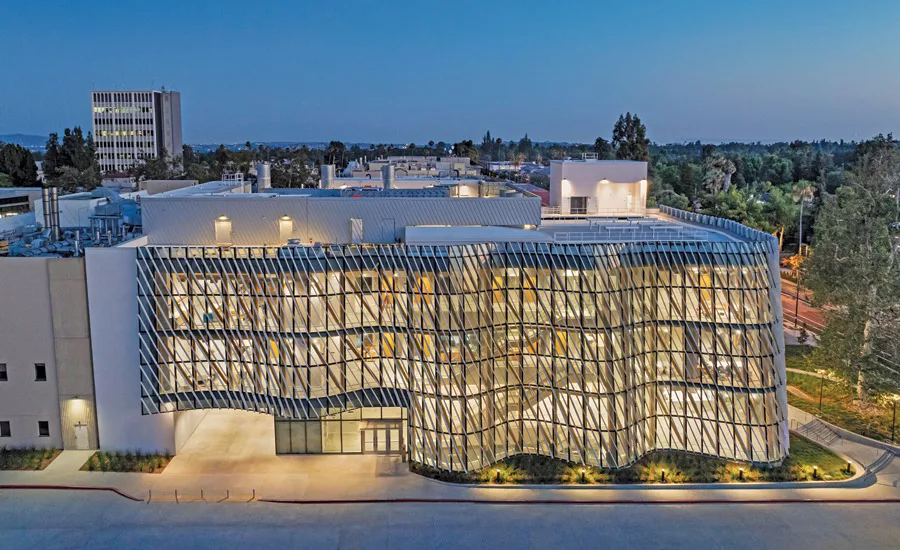
Caltech Resnick Sustainability Center
Calif.
EXCELLENCE IN SUSTAINABILITY and BEST PROJECT, HIGHER EDUCATION/RESEARCH
Submitted by Hensel Phelps
Owner California Institute of Technology (Caltech)
Lead Design Firm Yazdani Studio of CannonDesign
General Contractor Hensel Phelps
Civil Engineer KPFF Consulting Engineers
Structural Engineer Saiful Bouquet Structural Engineers
MEP Engineer Affiliated Engineers Inc. (AEI)
Curtain Wall Enclos
Lab Equipment/Casework ISEC
Dedicated to advancing research and education in climate science, energy and resource management, the Resnick Sustainability Institute’s new central hub features four levels of research laboratories, collaborative spaces, teaching facilities and high-performance computing infrastructure.
Certified LEED Platinum, the $133-million facility boasts a high-performance and sustainable design, with a cold-warped glass curtain wall facade and mass timber framing, along with rooftop photovoltaic panels, low-flow water fixtures, stormwater management systems and a highly efficient HVAC system that harvests condensate.
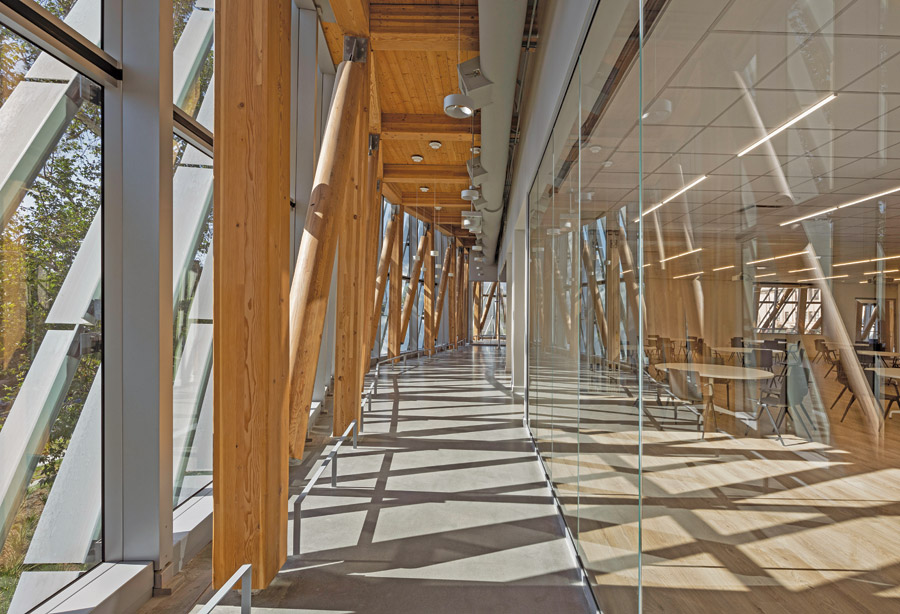
Photo by Tim Griffith
Extensive use of prefabrication and mock-ups helped improve precision and reduce waste. Sharing 3D models and virtual walkthroughs with lab users allowed them to provide feedback throughout the design process.
Given the stringent environmental controls, specialized equipment and high energy loads that laboratories require, balancing those needs with sustainability benchmarks required careful coordination. Part of the project’s sustainability strategy is connected to its innovative structural system. The building's core, housing sensitive laboratories, utilizes concrete to meet stringent vibration criteria that mass timber could not accommodate. Then in non-laboratory spaces, such as the north and west elevations, crews installed a mass timber gridshell composed of Douglas fir glulam beams and cross-laminated timber panels. By placing mass timber in non-laboratory spaces, the team was also able to save concrete for laboratory zones that required enhanced vibration dampening.
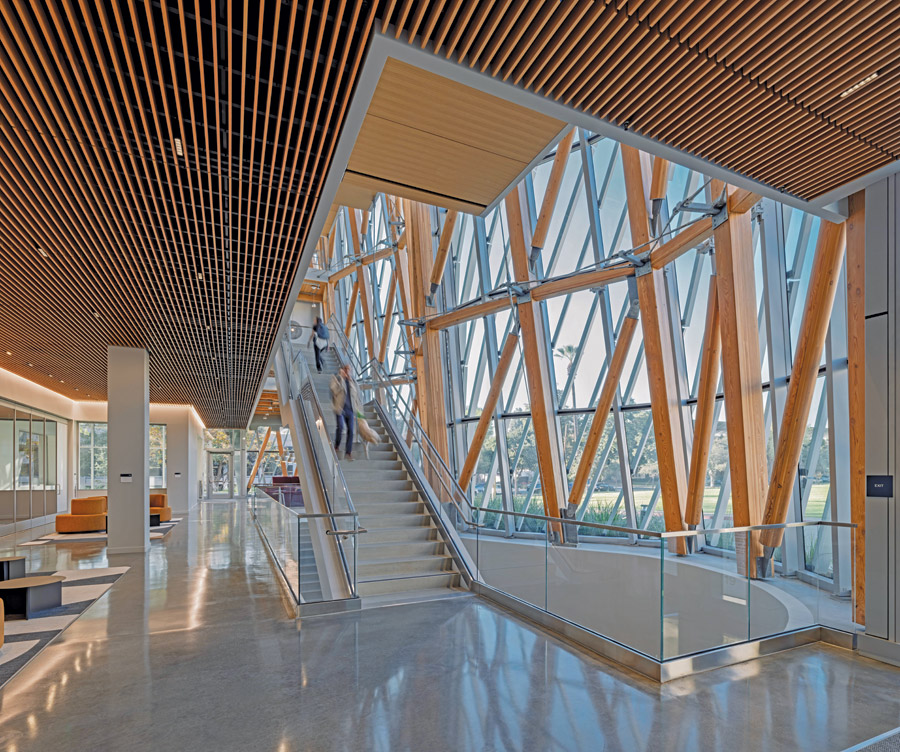
Photo by Michael Moran
Installing the complex cold-warped glass curtain wall facade required a fully coordinated digital model integrated with the structural systems, including mass timber, steel and concrete. This ensured proper installation on even the most intricate geometries, eliminating the need for costly field adjustments. These twisted panels offer an organic aesthetic while optimizing energy performance. Solar shading fins reduce heat gain and a fully glazed north atrium maximizes natural daylight inside.
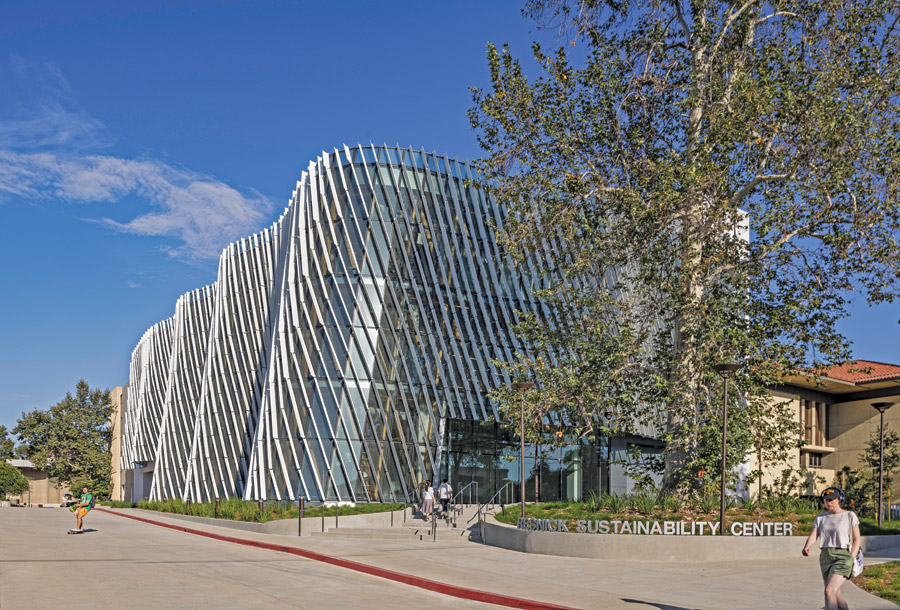
Photo by Michael Moran
Rooftop photovoltaic arrays generate onsite renewable energy, and the building is equipped with a cooling system that recycles condenser water for use elsewhere on campus. Water conservation strategies used across the facility include low-flow fixtures and drought-resistant native landscaping. To manage stormwater, the design also incorporated dry wells, which reduce runoff and promote groundwater recharge.