2025 West Best Projects
Project of the Year, Best Sports/Entertainment, Excellence in Sustainability, Safety, Award of Merit: Intuit Dome
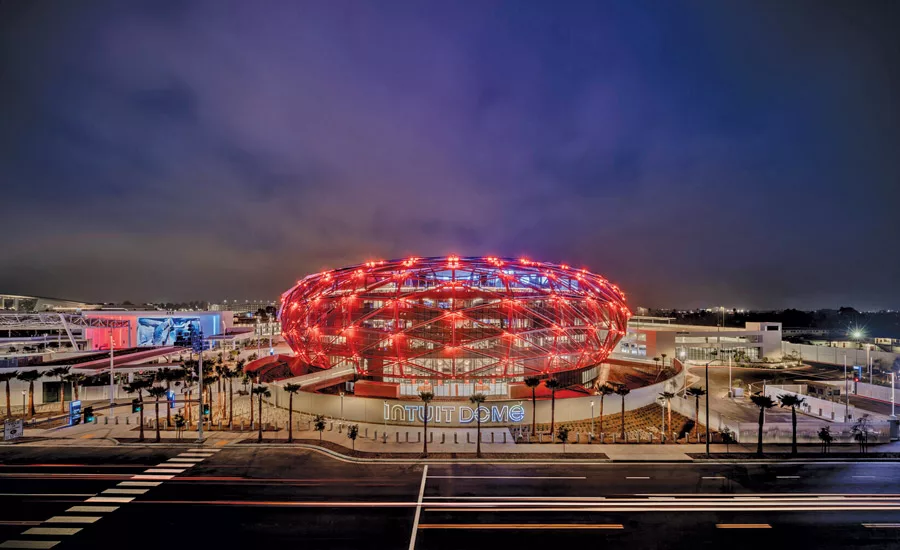
Intuit Dome’s digitally optimized cladding panels, made of ETFE, PTFE and laminated PTFE, manage solar gain, airflow and rain protection. At night, color-changing LEDs animate the open cladding and reveal interior activity, creating a glowing presence that connects the venue to the city.
Intuit Dome
Calif.
BEST PROJECT, SPORTS/ENTERTAINMENT; EXCELLENCE IN SAFETY and Award of Merit, Sustainability
Submitted by AECOM Hunt-Turner JV
Key Players
Owner LA Clippers
Lead Design Firm AECOM Technical Services Inc.
General Contractor AECOM Hunt–Turner JV
Civil Engineer D & D Engineering Inc.
Structural Engineer Walter P Moore
MEP Engineer Henderson Engineers
Owner’s Representative CAA Icon
Not many stadiums have an outward design so clearly inspired by the sports hosted within, but Intuit Dome is one of the few that does, with a 2,700-ton diagrid structural steel frame on its exterior that’s inspired by a basketball net. But beyond its iconic look, the 1.1-million-sq-ft multipurpose arena in Inglewood, Calif., is a landmark in sustainable design and is outfitted with cutting-edge, fan-focused technologies—from a 360-degree sound system to an industry first 40,000-sq-ft video display.
“Intuit Dome isn’t just an arena—it’s a defining project for what construction can achieve in shaping lasting sustainability and community impact,” says Craig Bojda, vice president at AECOM Hunt. “From the outset, the Clippers challenged us to build the most innovative and energy-efficient sports venue in the world, and we are proud to say our team put the best of their skill, innovation and collaboration to meet that challenge head-on.”
The largest-ever double-sided 4K Halo oval display spans 40,000 sq ft and has a quarter billion LEDs.
Photo by Tim Griffith
A Green Standard
Throughout the three-year construction effort, the team tackled multiple obstacles. An early challenge involved removing a roadway that bisected the project site. Before excavation could start, the team had to identify and remove unknown utilities under and above the street. To mitigate possible delays, crews coordinated work after hours and on weekends, coordinating closely with trade partners to recoup the schedule.
Post-pandemic price escalation proved particularly impactful, so the team turned to several strategies to mitigate potential adverse effects. One such decision was to purchase critical electrical gear and micro-grid components directly, saving $6 million.
Strong supplier relationships also helped ensure on-time delivery of all major electrical infrastructure, including an upgraded power system to support 11 MW of battery storage and 6 MW of standby generators, essential to the project’s carbon-free footprint. Combined with 260 rooftop solar panels, the battery storage system can power the fully electric stadium also off grid for up to seven hours.
“Despite global supply chain disruptions, numerous complex challenges associated with logistics, schedule and cost and an unforeseen issue that required utility lines to be relocated, we forged ahead, creating thousands of local jobs and delivering an industry-leading LEED Platinum-certified facility. Throughout the entire process, we kept true to the project’s vision and timeline,” Bojda says.
Intuit Dome is the first NBA arena to achieve LEED Platinum certification and is one of the first projects in California to require supply-chain-specific Environmental Product Declarations (EPDs) for all concrete mixes used on the project. As part of a zero-waste effort, an onsite materials management plan established collection bins, a 6,000-sq-ft material sorting room and a sorting team.
Other carbon neutral strategies included the use of all-electric equipment and 100% LED lighting, along with efficient HVAC and building automation systems. To conserve water, the facility is equipped with low-flow fixtures and reclaimed water systems.
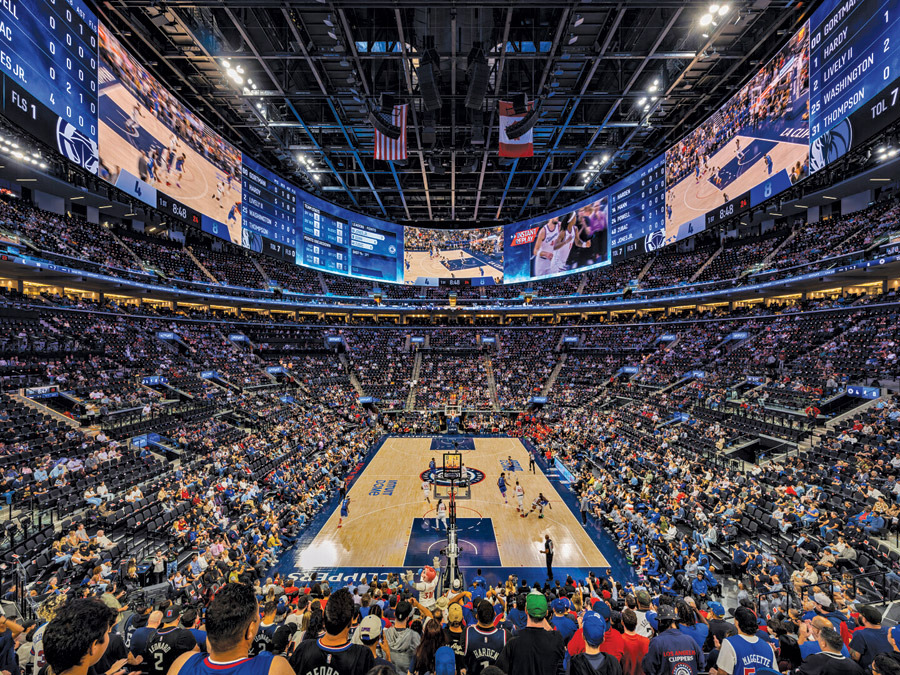
Complementing the completed Halo board is a 360-degree sound system that calibrates audio according to each individual seat—another first-of-its-kind feature in a sports venue.
Photo by Tim Griffith
More Than Looks
Global procurement strategies resulted in substantial savings as well. Building upon the JV’s previous partnerships established during its work on nearby SoFi Stadium, the team sourced the structural steel diagrid from China, remaining structural steel from Mexico and fabricated the PTFE/ETFE roofing and sunshade systems internationally as well.
“Our jobsite culture prioritized care and account-ability at every level.”
—Craig Bojda, Vice President, AECOM Hunt
The stadium’s diagrid structural steel frame is composed of pipe radial, diagonal members and complex nodes and is supported by the primary arena structural frame rather than the foundation. That frame is clad with 228,700 sq ft of PTFE and 11,400 sq ft of ETFE panels, while PTFE panels also clad a secondary 871-ton structural steel frame that connects to the diagrid. The digitally optimized cladding panels manage solar gain, airflow and rain protection as well.
“The iconic diagrid shell that envelops the superstructure demanded special attention in terms of structural design, particularly regarding its seismic behavior and its interaction with the primary superstructure,” Ryan Anderson, Walter P Moore principal and managing director, told ENR in 2023 (ENR Calif. & Northwest 10/9/23 P. CANW62) . “Instead of serving as the primary structural element for seismic resistance, the diagrid shell was intended to function as a roof and facade component. Consequently, it was essential to securely attach it to the primary structure while allowing for significant movement during an earthquake.”
So, the structural engineer developed a toggle brace connection for the diagrid shell at Levels 4 and 7.
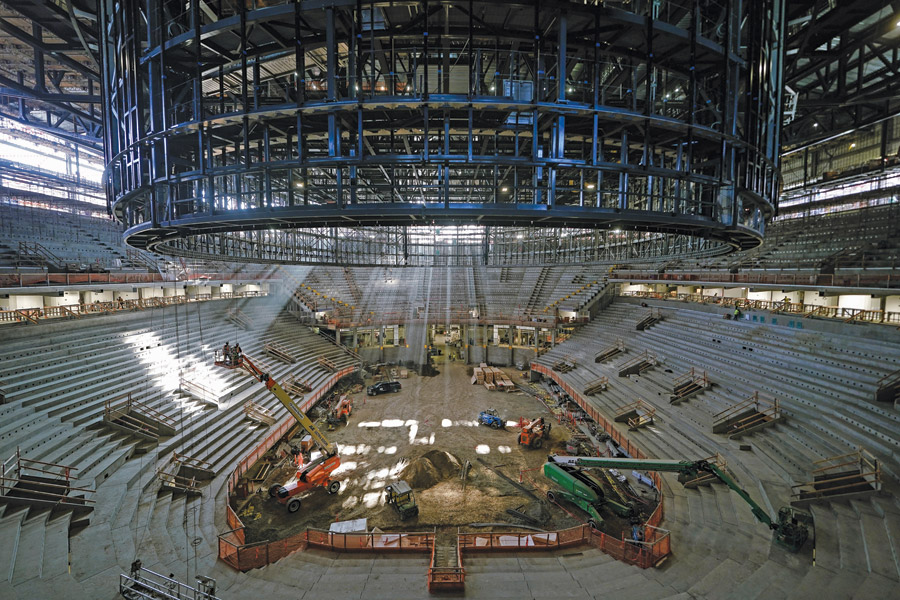
Seven 120-ton primary trusses support the venue’s 2,784-ton roof. But crews erected steel from within the bowl in a carefully coordinated effort using two Liebherr LR-1300 lattice boom crawler cranes rather than tower cranes.
Safety Prioritized
“Thanks to the commitment of more than 6.5 million labor hours, 7,000 workers and over $200 million awarded to local contractors, we not only delivered the Intuit Dome on time, we also set a new bar for what’s possible in modern sports construction,” Bojda says. “And with zero lost-time injuries and VPP-C safety recognition from Cal/OSHA, our jobsite culture prioritized care and accountability at every level.”
A comprehensive set of training and safety programs ensured a safety-oriented mindset at every level of the workforce. Pre-project start meetings between project leadership and safety representatives from each subcontractor allowed for collaboration on job hazard analyses and safety submittals. Permitting programs also helped crews manage high-risk activities. With only 14 recordable incidents across the millions of work hours, the team logged an OSHA recordable incident rate of 0.43.
Intuit Dome’s impact goes beyond the sporting and other events that it now hosts. Since construction began in 2021, unemployment in Inglewood dropped to 5.5% from 17%, and the arena’s 80,000-sq-ft multipurpose plaza now provides an expansive and inclusive community hub.
“Intuit Dome stands as a model for how major construction projects can be built smarter, safer and more sustainably. We’re incredibly proud of our work that will live on to serve the community for generations to come,” Bojda says.