2025 West Best Projects
Project of the Year Finalist (NorCal), Best Specialty Construction: 301 Mission Perimeter Pile Upgrade
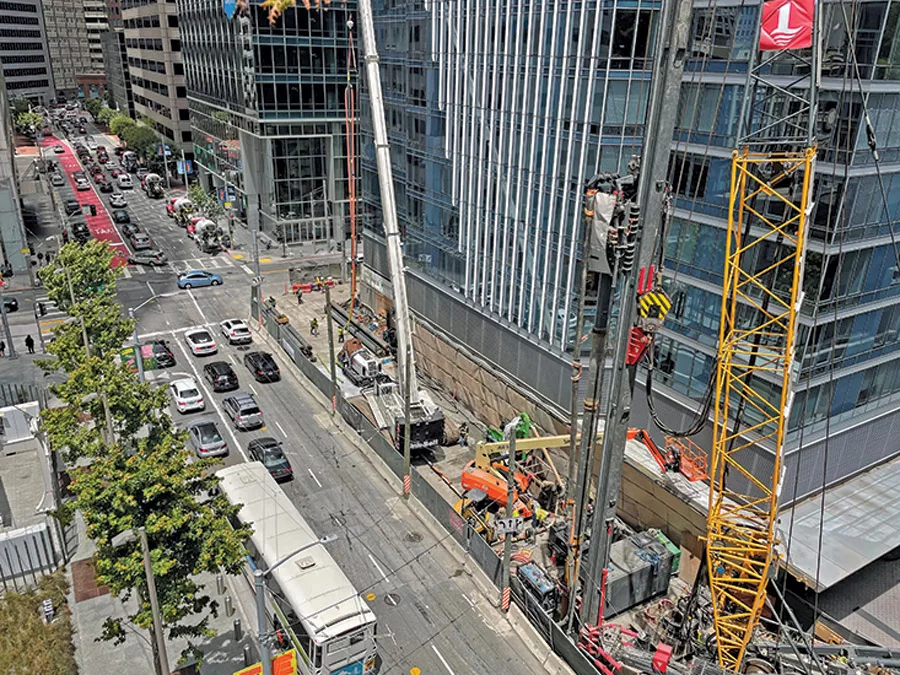
301 Mission Perimeter Pile Upgrade
San Francisco
PROJECT OF THE YEAR FINALIST and BEST PROJECT, SPECIALTY CONSTRUCTION
Submitted by Shimmick Construction Co.
Owner: The Millennium Tower Association
Lead Design Firm/Structural Engineer: Simpson Gumpertz & Herger (SGH)
General Contractor: Shimmick Construction Co.
Civil Engineer: Carlson, Barbee & Gibson Inc.
Geotechnical Engineer: Slate Geotechnical Consultants
San Francisco’s Millennium Tower, a 58-story luxury high-rise at 301 Mission Street in the city’s financial district, began sinking and tilting soon after its 2009 completion. By 2016, the 645-ft tower had settled about 18 in. and leaned roughly 24 in. toward its northwest corner. While the city never declared the building unsafe, its reputation and property values were under siege. The Millennium Tower’s Homeowners Association turned to Simpson Gumpertz & Heger (SGH) and principal engineer Ronald Hamburger, a National Academy of Engineering member with decades of forensic and design experience.
Initial proposals called for more than 300 micropiles drilled through the building’s 10-ft-thick basement mat, an option that was enormously expensive and logistically fraught. Hamburger proposed a different approach: underpinning the tower from the outside.
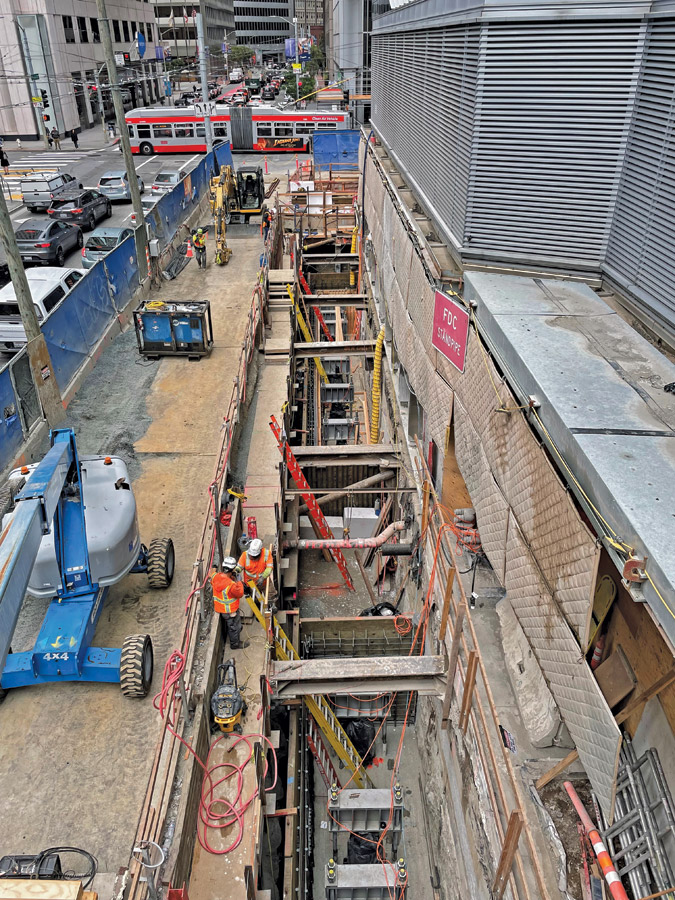
Photo by Jack Bevan
Working only along Fremont and Mission streets, SGH designed the perimeter pile upgrade for the sides of the building that were listing the most. The plan called for drilling 24-in. piles down 300 ft to bedrock and tying them into the mat foundation through a new slab extension. Hydraulic jacks installed at each pile would then gradually transfer loads from the tower’s failing friction piles to the new deep foundation. General contractor Shimmick began work in late 2020. The site footprint was barely 26 ft wide—just a sidewalk and one traffic lane—forcing meticulous planning for every crane movement and spoil haul.
“It was like Broadway choreography, just construction style,” says Shimmick project manager Jack Bevan. “We were drilling 3 feet, 8 inches from the building’s face. Everything had to be coordinated.”
He says excavation crews encountered landfill debris dating back to the 1906 earthquake before advancing through Old Bay Clay to bedrock. Once the mat slab was exposed, workers cut a keyway into the existing foundation, coupled new reinforcing steel to the old and cast a slab extension to anchor the new piles. Spoils from the 300-ft shafts were piped by reverse-circulation drilling to a containment system across the street, one of several site adaptations that made the project feasible.
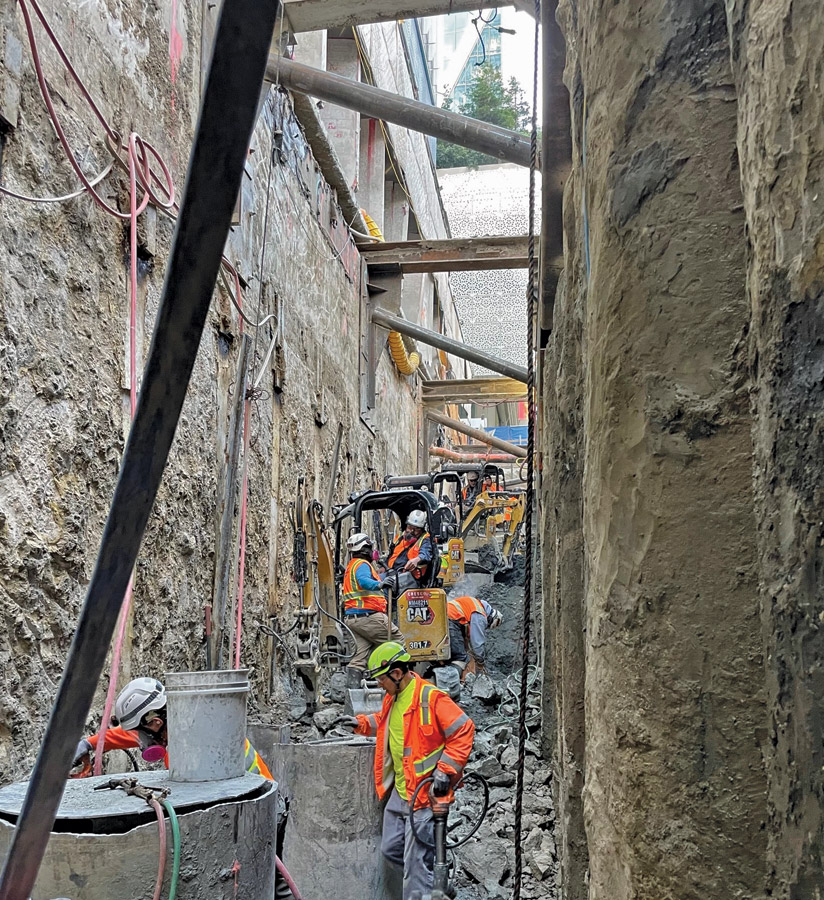
Photo by Jack Bevan
The high-stakes effort faltered early when the first six piles caused unexpected settlement, forcing a three-month pause. Engineers studied drilling methods, adjusted the approach and eliminated the adverse effects.
By then, litigation-funded repair dollars were burning quickly. After recalculating, SGH and geotechnical consultants determined that 18 piles—each designed to carry 1 million lb—would be sufficient. During the load-transfer phase, all 18 piles were jacked simultaneously in 100-kip increments while surveyors and engineers monitored the structure in real time. In February 2025, after more than 179,000 worker hours, the $75-million project finished on schedule and on budget. By completion, monitoring confirmed that settlement had stopped and tilt had already been reduced by nearly 2 in. Long-term gauges remain in place to track performance for the next decade. “Never have I had such a cohesive unit between all three parties,” Bevan says of the owner, engineer and contractor. “We were unified in one goal: to stabilize the building and prove people wrong.”