Digging Deeper | Higher Education/Research
Sound Footings to Unlock Quantum Conundrums
Vibration and sound isolation, historic considerations and extensive below grade work are among the challenges in building Caltech’s quantum sciences hub
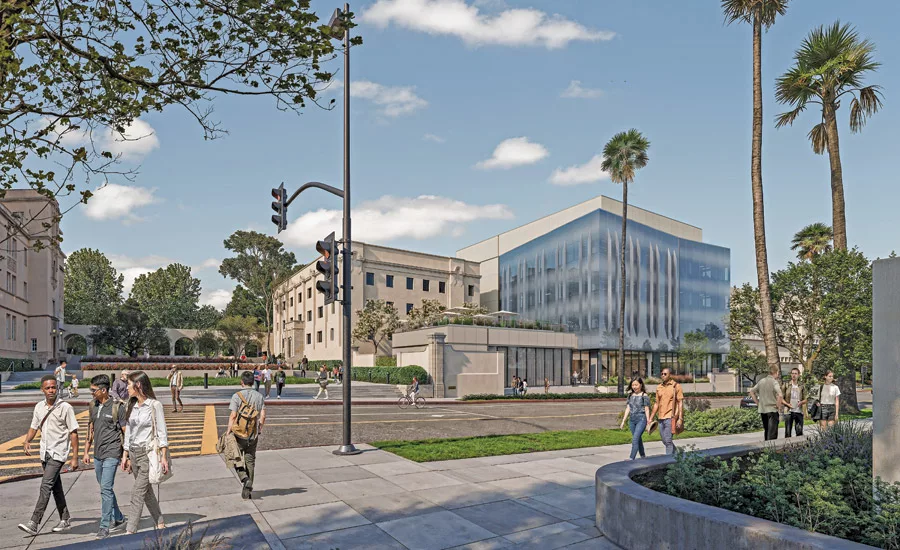
Located on the north side of California Boulevard, the Ginsburg Center will house Caltech’s entire quantum sciences group in a single location when complete in fall 2026.
From cryogenics to lasers, vacuum chambers to superconductors, some of the most advanced research equipment available is necessary to explore quantum phenomena. But creating a dedicated building for such highly sensitive, cutting-edge research into the nature of space and time requires advanced planning, design and construction. That’s happening now at the California Institute of Technology (Caltech) in Pasadena, Calif., where the Dr. Allen and Charlotte Ginsburg Center for Quantum Precision Measurement (GCQPM) is on its way to becoming the first facility that will bring together researchers to explore quantum physics and phenomena across all scales.
“From the beginning of the study phases, the project has drastically evolved to what it is now programmatically,” says Eugene Kim, team lead for planning, design and construction at Caltech. But the idea of a collaborative building that would be the hub of all things quantum solidified in 2020 and 2021, with groundbreaking following in 2023 on the 70,000-sq-ft facility. Its scope includes a four-story building and an expansive basement area that runs west under the historic campus entrance on the north side of California Boulevard. Nearly half of that square footage is below grade, says Adaeze Cadet, design principal at HOK and lead designer on the GCQPC. The basement level goes under the existing plaza space, far exceeding the original site’s footprint. The project has about 24,000 sq ft of lab space and 40,000 sq ft of office space. It also features extensive multipurpose spaces and collaboration areas.

More than 31,000 cu yd of dirt had to be moved to make way for the Ginsburg Center’s expansive basement level.
Photo courtesy of Charles Pankow Builders
“It’s a mixture of the experimental and theoretical, so experimental in the basement labs and then the experimental scientists up in the levels above,” Cadet explains. “It’s really one of their last big infill projects. The campus is getting really tight at this moment. We had to toe that line between innovation and preserving the historical context.”
The building itself sits on a compact site where an older physics building was demolished in 2016, right between Linde Hall and the Downs-Lauritsen Building. Being wedged between these existing structures—and connected via a new bridge and tunnel—this new space will act as a linchpin to help tie these existing buildings together and help with cross-pollination of ideas and innovation between those three major divisions within the school, Cadet says.

Along with the 36-in.-thick slab on grade, the basement walls are 30 in. thick and required 2,000 cu yd of shotcrete.
Photo courtesy of Charles Pankow Builders
Coming Together
While quantum buildings and labs aren’t new for Caltech, their relatively scattered nature across campus was part of the reasoning behind bringing everything under a single roof.
Since the project sits in Caltech’s historic core, it also required extensive city review, following U.S. Secretary of the Interior’s guidelines for historic buildings and removal and in-kind replacement of any historic elements.
“It’s really one of [Caltech’s] last big infill projects. The campus is getting really tight at this moment.”
—Adaeze Cadet, Design Principal, HOK
“We used fiber cement panels to kind of represent the cement plaster of the historic buildings to give it a little bit of weight,” Cadet says. “That was a way to keep it modern but still give that solidity. And then where we passed the historical buildings, we used that as an opportunity to have this inflection point with these prisms and fins that had the rhythm of the old building but in a new material. So it feels like it belongs, but it still feels new and distinct.”
When architect-of-record HOK won the project, the GCQPM was a traditional design-bid-build job. After schematic design, the delivery changed to design-build, at which point Charles Pankow Builders joined the team as contractor. “In light of such a collaborative-natured center for research, the project naturally warranted ... a collaborative delivery method [for itself],” Kim adds.
Researchers played a vital role in the facility’s design—and even inspired some creative elements. “They really talked about some major themes around the science, so we were able to represent this idea of quantum entanglement with prisms on our two major entries on the southwest and northeast corners,” Cadet says. Fins on the glass curtain wall also form a pattern that subtly references Caltech’s double-slit experiment, which demonstrated that light and matter can exhibit the behavior of both classical particles and classical waves.

The Ginsburg Center sits on a compact site on Caltech’s Pasadena campus. It features multiple design concepts that add to the facility’s amenities and visual impact.
Rendering courtesy of HOK
Impossibly Sound
Creating basement laboratories with impeccable air temperature control and stability, low vibration and limited noise would be critical to accommodate highly sensitive quantum measurement equipment.
“What’s challenging about this site is how close we are to California Boulevard, which is one of the most traffic dense areas in the city, let alone the campus,” Kim says.
And since the facility will be supporting science for the next 75-plus years, “the building’s framework needed to be flexible and stable enough for the current specialized equipment while still being able to accommodate future, unknown equipment,” explains Charles Iacuaniello, senior project manager at Pankow. “This stability was achieved through a comprehensive electromagnetic interference [EMI] and vibration mitigation strategy.”

Crews floated existing utilities (encased in green pipe) when working on the tunnel to prevent disruptions.
Photo courtesy of Charles Pankow Builders
One example includes an adjacent electrical room that couldn’t be relocated. As a result, that equipment had to be shielded to contain EMI. To do that, crews lined the electrical room’s floor and walls with fully welded ¼-in. aluminum and ⅛-in. steel plating. “This combination of plating mitigated the 60 Hz AC magnetic field generated by the nearby electrical transformer,” Iacuaniello says.
To limit vibrations, a 36-in.-thick slab on grade was placed on the basement level. “The increased mass and stiffness from the thick concrete slab provided a significant benefit for reducing vibration, particularly due to traffic on California Boulevard,” Iacuaniello notes.
“In light of such a collaborative-natured center for research, the project naturally warranted ... a collaborative delivery method [for itself].”
—Eugene Kim, Team Lead, Planning, Design and Construction, Caltech
Basement walls are also 30 in. thick and required 2,000 cu yd of shotcrete, while 1,300 tons of reinforcement steel run throughout the building.
Much of the research equipment going into the basement labs is installed directly on the slab to keep it stable, Cadet adds. “Then we have traditional waterproofing because of sensitive equipment down there,” she says.
To create space for the expansive basement, crews excavated more than 31,000 cu yd of dirt, giving the basement labs a clear height of nearly 23 ft. But with a site that has more than a century of history, the team also faced extensive utility relocations and unforeseen conditions.
Building the below-grade tunnel, for example, required working underneath a live electrical ductbank. In response, the team created a specialized support structure to “float” the existing utilities around the site, keeping them out of the way from ongoing work and preventing disruptions to the existing buildings during construction on the basement, Iacuaniello explains. As for the bridge, which sits above the tunnel, the connection required tying into the Downs-Lauritsen Building—a decades-old, occupied space—demanding additional precision engineering and sequencing.

The facade’s frit pattern references a famous experiment proving that light and matter can act as both particles and waves.
Photo courtesy of Charles Pankow Builders
With such complex basement lab requirements, the Pankow team conducted extensive trade sequencing during preconstruction to avoid conflicts with framing, ductwork, piping and finishes, which also allowed significant wall and ceiling work to be installed before MEP systems without rework. Concurrent installation of curtain wall and exterior framing systems also sped the schedule along.
As part of the push toward LEED Gold certification, one of the sustainability strategies for this concrete moment-frame structure included a reduced carbon concrete mix.
While construction continues on time and within budget toward its fall 2026 completion—halfway complete as of September—Kim foresees the commissioning process being particularly challenging.
Engineering the building has been demanding, “but seeing how you actually maintain 0.1 degree Fahrenheit stability in all your labs when there’s 10,000 things that can go wrong,” that is the challenge, he notes. “Once we get the systems energized, this particular building is going to be one for the ages from an engineering, commissioning, testing and balancing standpoint, just because of how sensitive and how precise these environmentals need to be.”