2025 Texas & Southeast Best Projects
Best Renovation/Restoration: Navy Yard Charleston
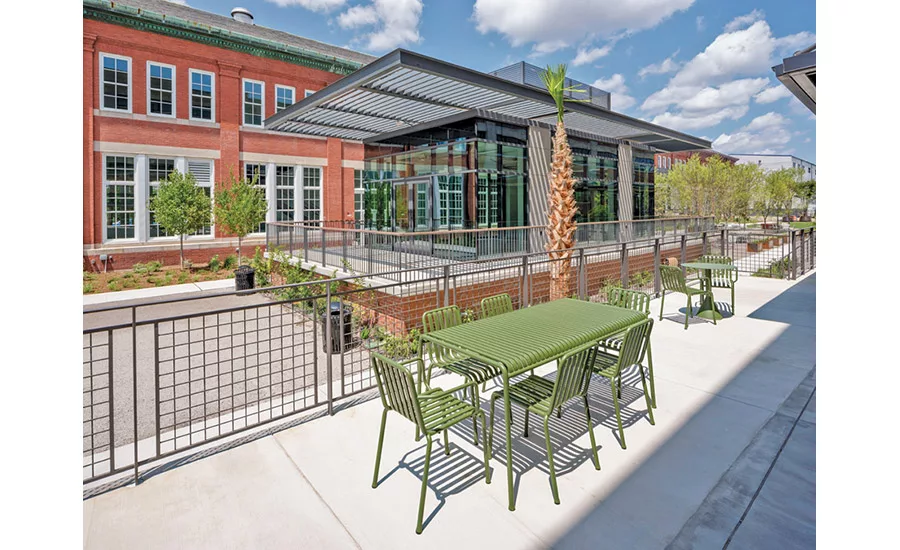
Navy Yard Charleston
Charleston, S.C.
BEST PROJECT
Submitted by Edifice Construction
Owner Navy Yard Charleston
Lead Design Firm Post Loyal
Construction Manager Edifice Construction
Civil Engineer Cypress Engineering
MEP Engineer Molnar Jordan & Associates
Since its decommissioning in 1996, this site has evolved to accommodate a variety of businesses while preserving the spirit of its naval heritage.
The Navy Yard Charleston project paid careful attention to preserving the historic architecture of U.S. Navy-built Storehouse 8 and Storehouse 9 while introducing modern design elements and amenities. Storehouse 8 is a two-story brick shell, steel structure built in 1908. Storehouse 9 is a four-story building with a brick shell and concrete structure built in 1918.
The renovation scope included preservation of existing brick exterior walls; restoration of historic slate roofing; installation of copper gutters; cornice restoration; preservation and repair of existing interior plaster walls; and brick repair, repointing, tuck-pointing and installation of new brick to match the original.
The preservation and restoration of the exterior brick walls at Storehouse 9 posed a significant challenge due to their historical significance and unique construction. Built approximately 106 years ago using a barrier wall system—a method designed to deflect water at the surface without internal drainage—the walls reflect historical construction practices that complicated modern renovation efforts.

Photo by Peter Bretlinger
In accordance with State Historic Preservation Office guidelines, any enhancements to water resistance had to preserve the original exterior appearance. The project team developed a comprehensive solution that included repointing deteriorated mortar joints, installing a specialized cove joint sealant around each brick panel and applying a compatible siloxane/silane water repellent.
Undocumented in official records, crews discovered a maze of unknown utility conflicts that required flexibility. On the courtyard’s east side, the team found a steam chiller line that was historically used to transport water from the Cooper River to cool turbines in the power house. As a result, the water quality unit had to be relocated. Additionally, discovery of an active storm sewer along Hobson Avenue led to a full reconfiguration of the site’s drainage system.

Photo by Peter Bretlinger
The project’s proximity to the active Palmetto Rail line, which serves the South Carolina Ports Authority, added a layer of complexity. Located 10 ft from the eastern property line, the rail line required that all construction activities, deliveries and parking be confined to the site’s west side. Edifice staff maintained oversight to ensure compliance with safety regulations and to prevent subcontractors from encroaching on the railroad’s right-of-way.
Restoration of Storehouse 8 presented a series of challenges, particularly in sourcing and replicating historic materials. In addition to repairing brick and cast stone, approximately 20% of the slate shingles were replaced with material sourced from a Virginia quarry to ensure a seamless match. One of the most demanding tasks was the replacement and repair of the copper gutters and downspouts. Replicating the historic profile required more than 24 breaks and a series of intricate curves. After completion, the new copper began to develop a natural patina that will eventually blend with the existing metalwork.
The 17-month project was delivered on budget and on schedule with no recordable incidents and no lost-time accidents.