2025 Texas & Southeast Best Projects
Best Interior/Tenant Improvements: Memorial Hermann Texas Medical Center Children's Heart Institute Renovation
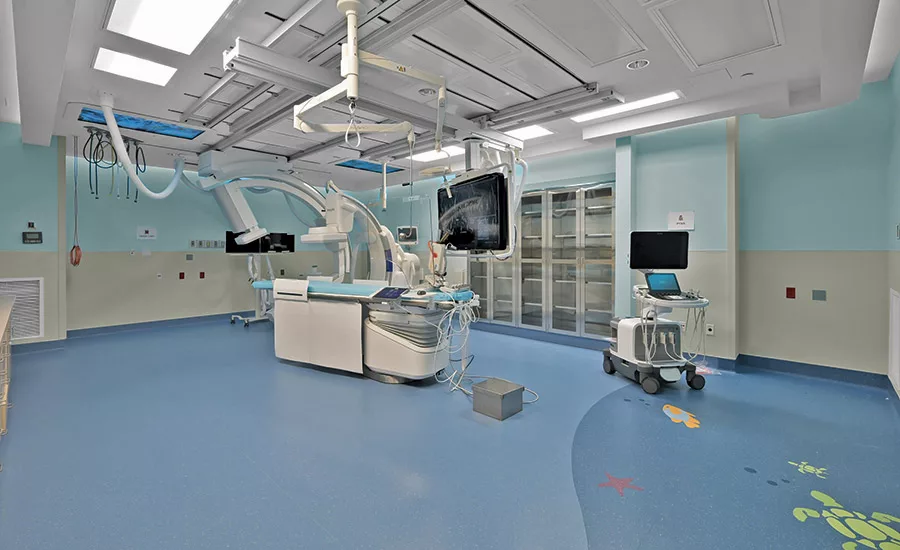
Memorial Hermann Texas Medical Center Children’s Heart Institute Renovation
Houston
BEST PROJECT
Submitted by Kitchell Contractors Inc.
Owner Herman Health System
Lead Design Firm Page Southerland Page Inc.
General Contractor Kitchell Contractors Inc.
Civil/MEP Engineer Smith, Seckman & Reid
Structural Engineer IMEG
An $11.7-million, 67,500-sq-ft multifloor renovation enhanced the pediatric care capabilities at Memorial Hermann Children’s Heart Institute and transformed outdated hospital spaces into a cohesive, patient-centered environment that prioritizes comfort, efficiency and family support.
Multiple areas fell under the project’s scope, including the pediatric imaging suite and the dialysis, infusion and oncology clinics. The second floor of the Cullen Building, built in 1925, was transformed into a pediatrics dialysis and infusion unit. Existing ground floor spaces in Hermann Pavilion were renovated to add two MRIs and an interventional radiology room. An observation unit was repurposed into a prep and recovery space for pediatric imaging.
Complicating the build-out was Cullen Pavilion’s historic nature and its multiple previous renovations. Unrecorded structural columns and outdated piping systems, which weren’t included on century-old drawings, required design modifications. To manage these challenges and ensure open dialogue for problem-solving, weekly design-construction coordination calls began early in the process.
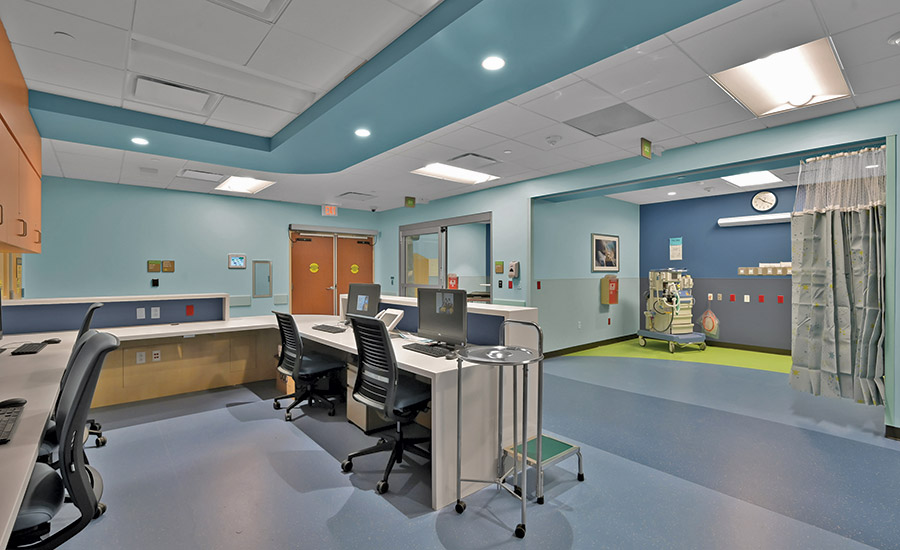
Photo by Slate and Stone Photography
When it came to installing two state-of-the-art MRIs into the basement of Hermann Pavilion—one weighing 9,000 lb and the other 14,000 lb—the team faced multiple logistical challenges. The project was deep within the basement of a fully operational hospital, where traditional delivery methods were not feasible due to weight and access limitations.
The contractor used advanced laser scanning to map existing conditions and precisely overlay the MRI dimensions to chart the most efficient delivery route. Because the MRIs were too heavy for the elevators, the team engineered a custom delivery by placing a gantry in the hospital’s atrium to lower the units to the basement.
Crews widened doorways and removed railings to accommodate the machines, and even prepared utility connections in advance. Almost a year after the laser scanning began, the MRIs were successfully installed with minimal disruption to hospital operations.