2025 Texas & Southeast Best Projects
Best Government/Public Building: F-35A Flight Simulator Facility and F-35A Squadron Operations/Aircraft Maintenance Unit

F-35A Flight Simulator Facility and F-35A Squadron Operations/Aircraft Maintenance Unit
Navy Air Station Joint Reserve Base, Fort Worth
BEST PROJECT
Submitted by: Conti Federal Services LLC
Owner: NAVFAC Southeast
Lead Design Firm/Civil/Structural/MEP: Burns McDonnell/Johnson-McAdams
General Contractor: Conti Federal Services LLC
Spanning 33,729 sq ft, this $28-million, two-story structure supports mission planning, flight execution and aircraft sustainment for the U.S. Navy. A 20,000-sq-ft flight simulator facility is equipped with four full mission simulators so pilots can rehearse real-world combat scenarios. It was built with reinforced concrete and structural steel framing, split-face masonry and anti-terrorism/force protection-compliant features.
Multiple unforeseen challenges arose during construction. One of these was a suspected tornado that hit the project site in March 2023, destroying the in-progress flight simulator facility and a 70-ft section of the squadron operations building. The contractor assessed damage and developed a plan at no cost to the owner. The storm also caused the simulator steel structure to fully collapse and severely damaged the foundation and anchor bolts. The team reengineered the foundation system, expedited procurement of a preengineered metal building and resequenced work packages to align with other ongoing site activities.
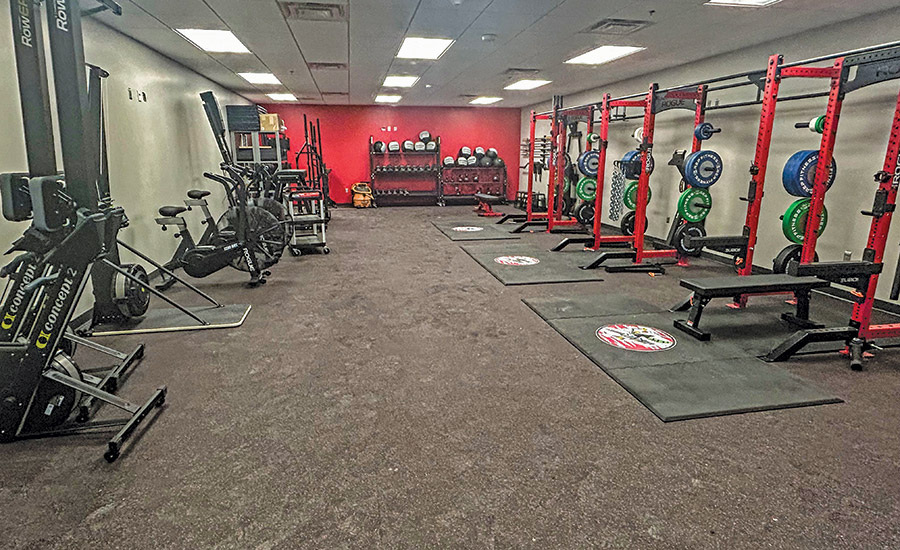
Photo by Ian Moon, Project Engineer, Conti Federal
Although the project’s secure spaces required compliance with ICD 705 and a government-supplied construction security plan (CSP), the CSP was not issued until after notice to proceed. The initial CSP mandated the use of U.S. citizens for all construction roles, potentially increasing the cost of the project by $18 million and extending the schedule by a year due to the lack of local U.S. citizen trade workers. The contractor worked with the Navy to revise the CSP, proposing to allow U.S. persons in construction roles, while restricting work on site access controls and inspections to U.S. citizens. A visual vest system streamlined identification on site. This change cut projected costs by more than $15 million and reduced schedule delays by six months.
To maintain airfield integrity and safety during construction near active flightline operations, the team installed dust and foreign object debris barricades and coordinated closely with base personnel. FAA crane permits had to be secured before steel erection, and 3D lift modeling ensured precise crane operations with zero airspace intrusions.