Three Partnerships Are Invited to Vie for NYC Path Improvement
East River Park adjustments will accommodate one end of a bridge carrying bikers and walkers over a too-narrow path
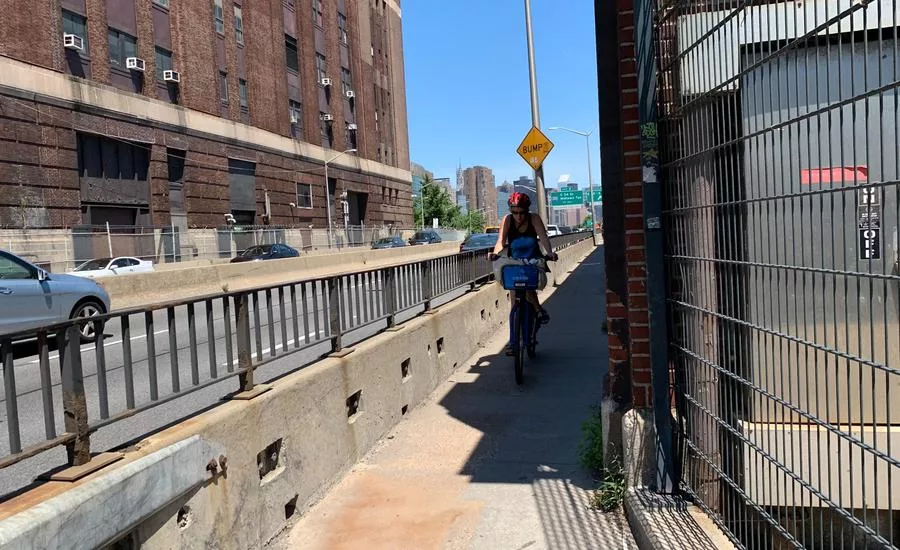
New York City plans to renovate a narrow corridor on Manhattan’s east side.
New York City is making progress on its goals to build out car-free walking and biking paths, announcing renovations to a particularly narrow corridor on Manhattan’s east side.
The city Dept. of Design and Construction recently invited three design-build teams to submit to work on what the agencyan estimated $163-million project the agency calls the East Side Greenway 14th Street Connector. The final structure will essentially be a bridge providing a less constrictive alternative to walk from the tip of the East River Park to the south end of the Capt. Patrick J. Brown Walk.
The paved strip currently between the destinations is only about four feet across in places and cannot be widened due to nearby Con Edison equipment, said Ian Michaels, a DDC spokeperson. “People have been complaining about this for years, long before the DDC existed.”
The connector should offer two-way lanes for bikers and walkers.
After reviewing replies to a Request for Qualifications, DDC shared late in July that three partnerships will respond to its Request for Proposals—joint ventures of Skanska USA Building Inc. and Claire Weisz Architects LLP; Walsh Construction Co II and Jacobs Civil Consultants Inc.,; and Weeks Marine Inc. and Kiewit Engineering Corp. The department expects construction on city capital project to start in fall 2027 and be substantially completed early in 2030.

Rendering courtesy the New York City Dept. of Design and Construction
Construction plans connect with a handful of other renovations the city is undertaking. DDC is lifting the entire East River Park eight to 10 feet higher than its existing elevation as part of the East Side Coastal Resilience Project. Meant to reduce flood risk along a 2.4-mile stretch, construction will eventually offer proper footing for the southern end of the Connector, said Michaels.
The planned bridge is also one of 114 capital projects in the recently-released New York City Greenway plan. City departments, advocacy groups, as well as industry firms WXY and WSP USA contributed to the document, the first of its kind in over 30 years to detail where spaces that accommodate biking, walking and greenery can be widened and connected across the five boroughs.
“The 14th St pinch point has long been a barrier to safely accessing the Manhattan Waterfront Greenway, and alleviating it will create opportunity for New Yorkers of all backgrounds, ages, and abilities to access our waterfront and safely walk or bike around the city,” said Sofia Barandiaran, New Jersey & New York Greenway manager for the East Coast Greenway Alliance and steering committee member for the New York City Greenways Coalition, which contributed to the published plan. “The newly released Greater Greenways Plan helps to identify crucial barriers and gaps like this one so that we can create a seamless and intuitive greenway network,” she added.
“It's great that the city is moving to eliminate the pinch point," said Jon Orcutt, another coalition steering committee member and director of advocacy at Bike New York."Ironically, it will then create the East Side's next pinch point along the Captain Brown Walk. That's not nearly as narrow, but it's still substandard for a busy multi-use path.”

