ENR Mountain States & Southwest Top Contractors: Competition Remains Stiff as Contractors Navigate Turbulence
Sixty-six Mountain States and Southwest firms reported $33.42 billion in regional revenue for 2024
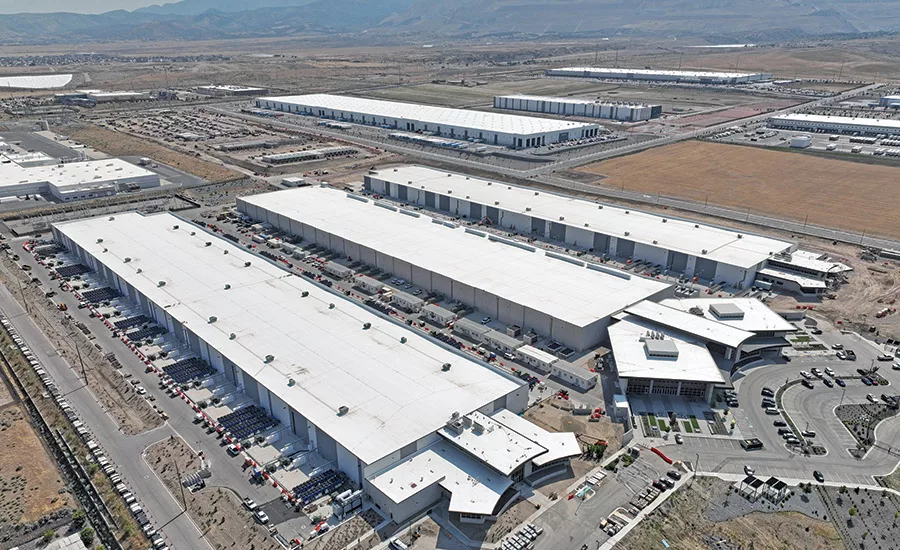
Construction continues on the campus expansion at NOVVA Data Centers in West Jordan, Utah.
Related Link:
ENR Mountain States & Southwest 2025 Top Contractors
The regional construction market, like the broader economy, is facing uncertainty with continued resilience. Contractors say that competition remains stiff, even as firms maintain a heightened awareness of economic shifts, material costs and labor. “Tariffs, to date, have had a measured impact on pricing, which has been offset by subcontractor competitiveness as they seek to secure a viable backlog. In short, we’re holding pricing thus far on our projects,” says Justin Cooper, president of Saunders Construction.
“We are staying focused on what we can control,” adds Charlie Robben, regional vice president of Hensel Phelps. “We’re also being smart about the work we chase—looking for the right fits with the right clients. Economic shifts and material costs are always something to watch, but we’ve built strong relationships with trade partners and suppliers that help us stay ahead.”
ENR’s regional contractor rankings look different this year after consolidation of multiple regional magazine editions into five new ones: Mountain States & Southwest, East, Midwest, Texas & Southeast and West. In the inaugural Mountain States & Southwest contractors survey, 66 firms reported $33.42 billion in revenue for 2024.

Chart by ENR
Labor Woes
Labor shortages are top of mind for Saunders as well, and Cooper notes that success relies on its trade partners’ ability to manage and invest in their workforce while remaining competitive. “These two factors are coming into balance following the post-pandemic surge, but they remain a key factor in how we select our trade partners and even how we choose our projects,” he adds.

Denver’s 32-story 1900 Lawrence building includes 702,000 sq ft of core and shell office space, 376,000 sq ft of parking across seven levels, 10,000 sq ft of ground-floor retail and an outdoor plaza with amenities.
Photo courtesy Jason O’Rear
“Another workforce dilemma we are experiencing centers around a lack of mobility, particularly among Gen Z and millennial talent,” says Mike Fratianni, regional operating officer for Salt Lake City-based Big-D Construction.
“The willingness of core project talent to go where the work is as a means of advancing career opportunities has become increasingly difficult,” and subcontractors are confronted with the same root challenges, especially in high-demand markets, he adds.

Chart by ENR
Doing More With Less
Big-D is adapting technology to bring greater efficiency to its people in order “to do more with less,” Fratianni says. “We also emphasize talent development and training programs that provide a more consistent, well-skilled pool of professionals. We actively seek out trade partners with shared values to form long-lasting, mutually beneficial relationships in key regions and markets. Together, we are only as good as our last job.”
“We are staying focused on what we can control.”
—Charlie Robben, Regional Vice President, Hensel Phelps
A power-supported technology boom has been moving through the Southwest and pushing upward into the Mountain States over the past couple of years. Additionally, the region’s recreation and public safety sectors continue to show strong demand, along with workforce housing and intermodal transportation projects across Colorado’s mountain resort communities.
“K-12 education is also a strong sector based on recent voter referendums across the Front Range,” says Cooper, while office vacancies continue to reduce demand for both new construction and tenant improvements. “With 30% vacancy in downtown Denver [coupled with] landlords handing the keys back to lenders, it will take years for this submarket to return.”
Saunders is focusing on how to make the construction process more efficient, eliminate the surprises and find ways to “leverage our experience to optimize the construction process, including aligning the design with the budget early on and utilizing our collaborative project planning process to achieve buildable design documents before commencing construction,” Cooper says.

The Amble will house 42 all-electric luxury residences across the street from Colorado’s Steamboat Ski Resort.
Photo courtesy Saunders Construction
“Local knowledge really matters right now,” Robben contends. “Understanding how to work with city permitting offices and local jurisdictions can make or break a project timeline. Clients want builders who know how to get things done—not just in the field, but in the preconstruction phase as well.”