Digging Deeper | Residential/Hospitality
Team Erects 460-Ft.-Tall Tower on Tight Manhattan Site
Faced with tight timelines and site constraints, the team crafted a strategy to keep critical concrete pours on a consistent schedule
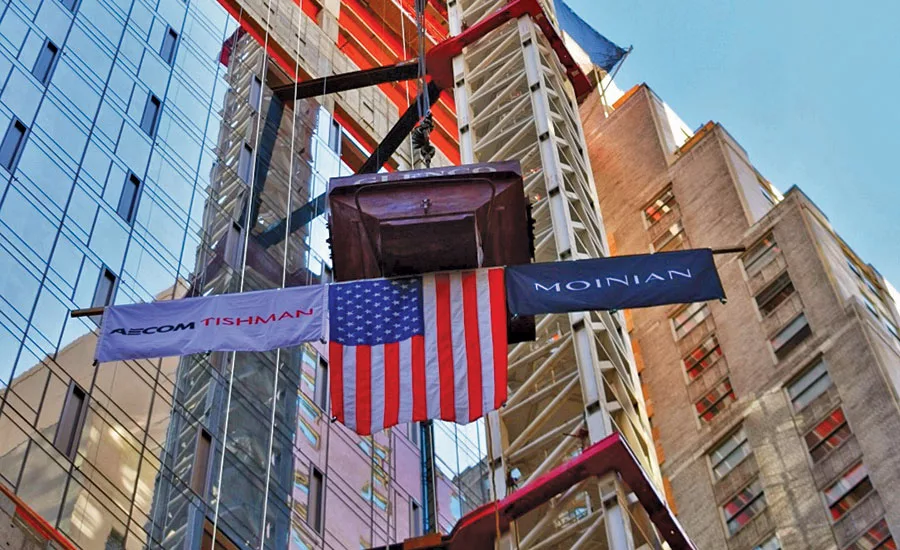
A tight site forced the team to position the crane close to the building and secure it through temporary openings in the facade.
Image courtesy of The Moinian Group
Set to open early next year, the Moinian Group aims to offer a new spin on development in New York City’s historic Financial District with ARIA 7 Platt—a 38-story combined residential and hotel structure. As a project that includes luxury apartments with some affordable housing units, it faced strict deadlines that challenged the design and construction team to develop a plan that would help speed ARIA 7 Platt to market.
The design and construction team have been engaged on the project since 2018. Ultimately, the plan landed on a 250,000-sq-ft, 38-floor tower with 250 apartments, including 75 affordable-housing units and 175 market-rate units. The project also includes a 172-room hotel, located within the seven-story podium. The 30-story tower above the podium, which tops out at 460 ft above street level, houses the residential portion of the project.
Led by Titanium Construction, foundation work was well underway in 2023. The timing allowed the Moinian Group to take advantage of New York City’s 421-a program, which provided tax breaks to multifamily housing projects that include affordable housing units. The program expired in 2022, making ARIA 7 Platt one of the last in the program.
“Upon its completion, ARIA 7 Platt will deliver an unparalleled living experience to New York’s most historic neighborhood, blending the region’s rich architectural nuances with luxury units and accompanying amenity spaces,” Joseph Moinian, founder and CEO of the Moinian Group, said in a statement. “As the last project of its kind to be carried out under the 421-a program, this 250,000-sq-ft building brings 250 luxury residences to the FiDi [Finanical District] community, a region that continues evolving into a highly sought after residential market.”
The building’s design team was led by Hill West Architects and Rockwell Group. Hotel interior design was led by Fogarty Finger. Ting Huang, associate at Hill West, says the project aims to respect the context of New York City’s Financial District while recognizing that the neighborhood is evolving.
“The Financial District is famous for office buildings, but in recent years, we started to integrate a lot of residential development within the Financial District,” she says. “The architectural design is residential use, so we would like to have the building not compete with the commercial office building look. Instead, we try to soften it. We try to make it more residential friendly and hospitality friendly.”
The curtain wall facade of the residential tower both maximizes natural light while connecting to the neighborhood’s commercial buildings. However, Huang says, “some playful metal panel shifting patterns give a little bit of a dynamic [that conveys a] residential feel.” The podium features fritted glass for added privacy as well as extruded metal panels that Huang says evoke more of an industrial feel than a commercial one.
To segregate the residential and hospitality users, separate entrances were created at Platt Street. Huang says the entrances were both placed on the Platt Street side because it faces a small, pedestrian friendly plaza that is surrounded by cafés and restaurants. On John Street, which is the opposite side of the building, the neighborhood has a more commercial feel, so retail spaces were placed at the ground level.
Each entrance features a double-height lobby with separate elevator cores for residents and hotel guests. To help provide more “light and air,” Huang says hotel rooms were designed around a four-story courtyard, measuring roughly 36 ft wide by 46.5 ft long.

The glass tower rises 38 stories and will include 250 rental residences and amenity spaces.
Image courtesy of The Moinian Group
Concrete Considerations
The reinforced concrete structure is comprised of cast-in-place concrete flat plate floors supported by reinforced concrete columns and shear walls. This creates a combination of reinforced concrete shear walls and the frame action between the flat plates and columns. To provide adequate lateral stiffness and minimize architectural impact, high strength concrete of 12,000 psi was used on the lower levels and 9,000 psi was used on the upper levels. An outrigger and belt system occurs at the 24th floor.
After Titanium Construction completed the foundations and brought the structure to the ground floors, AECOM Tishman assumed construction duties in October 2023. Given the constraints of a tight site in a busy area of Manhattan, concrete work presented some of the greatest challenges on the project, says Mike Pritula, senior project manager at AECOM Tishman.
“We would like to have the building not compete with the commercial office building look.”
— Ting Huang, Associate, Hill West Architects
During concrete pour days, crews had to close Platt Street and feed all concrete trucks on the Platt Street side. Materials, such as reinforcing and formwork, were picked from a loading dock area on John Street. Up to 300 cu yd of concrete was poured per floor, served by up to 30 concrete trucks. Column and sheer wall pours could require roughly a half-day of street closures, while floors required full-day shutdowns from 6 a.m. to 6 p.m. There were no partial-floor pours. Typical floor plates were poured on a three-day cycle. No overnight activities were required.
Due to space constraints, the concrete contractor was unable to set a stationary pump inside the building. Instead, the team used a concrete placement boom and a mobile pump. The pump could be set up in the street on pour days and dismantled and stored in a blocked lane on non-pour days. The strategy enabled the team to free up logistical space and the delivery area on non-pour days.
“The concrete contractor did a phenomenal job of creating a temporary tented structure so that the sidewalk to the south of Platt Street could stay open,” Pritula says. “They would completely wash it down. There were never any issues with concrete splatter. The goal was always that by the end of every day, [pedestrians] would have no idea that we’d been there.”
The tight site offered no laydown area, so the concrete contractor used terraces on the seventh floor, above the podium, to temporarily store rebar and create rebar cages.
Concrete work was completed in a nine-month span from February 2024 to November 2024. A total of 13,900 cu yd of concrete was poured on the project.
Because of the tight logistics on John Street, the loading dock had to be extended into the interior of the building on a massive temporary platform, which was shored off the low ground floor slab elevation. The dual hoist had to be positioned in-board off John Street because of the lack of logistical space on the John Street sidewalk. The placement required the team to coordinate temporary openings in the podium slabs. The tower crane also had to be positioned closer to the interior of the building, since there was not enough space to place it on the sidewalk on Platt Street. The tower crane placement required temporary openings through the third floor.
As the structure took shape, curtain wall installation got underway, which also followed a roughly nine-month schedule. Pritula says the team had to focus on closing in the residential tower portion before the podium due to time constraints associated with 421-a requirements.

The 250,000-sq-ft project features a seven-story hotel topped with a 250-apartment tower.
Image courtesy of The Moinian Group
Stacked for Success
Pritula notes that one of the biggest advantages of the project’s design is that most of the floors stack with identical floor plans. At the upper floors, apartment floor plans get larger. Within the podium, there is more variation, including some larger amenity spaces.
“Where the apartment tower stacked on top of the podium tower, a 10-ft-deep transfer beam is used, and structural elements carry through the structure down to the ground,” Pritula says.
“The goal was always that by the end of every day, [pedestrians] would have no idea that we’d been there.”
— Mike Pritula, Senior Project Manager, AECOM Tishman
From a logistics standpoint, Pritula says one of the more challenging days on site was coordinating delivery of machines and motors for the elevators during the week of the crane takedown. “That was a situation where we would risk having to potentially dismantle and erect these motors on site if we did not get them there by the time the whole the crane came down,” he recalls. “Fortunately, everything worked out scheduling wise.”
With the tower closed in, Pritula says the team is focused on finishing the podium and fitting out the residential tower. In addition to the apartments, crews will complete indoor resident amenity spaces such as a fitness center with a rock-climbing wall, a library, work pods, lounge spaces, private dining spaces with outdoor terrace access, a gaming and virtual reality area, laundry facilities and a communal kitchen for entertaining. The building’s outdoor amenity spaces include a rooftop sundeck, a movie lounge, barbecues, dining areas, outdoor fitness equipment, an outdoor coworking space and a golf putting area.
Pritula notes that the team has managed to successfully maintain the schedule since joining the project in 2023 and is currently on target for substantial completion by the end of the year. “There’s a ton of work still to be done,” he says. “We’ve had roughly 250 workers on site daily for the past three or four months. So we’re pushing hard.”