Transportation
Asheville Airport Races To Accommodate Growth With $361M New Terminal
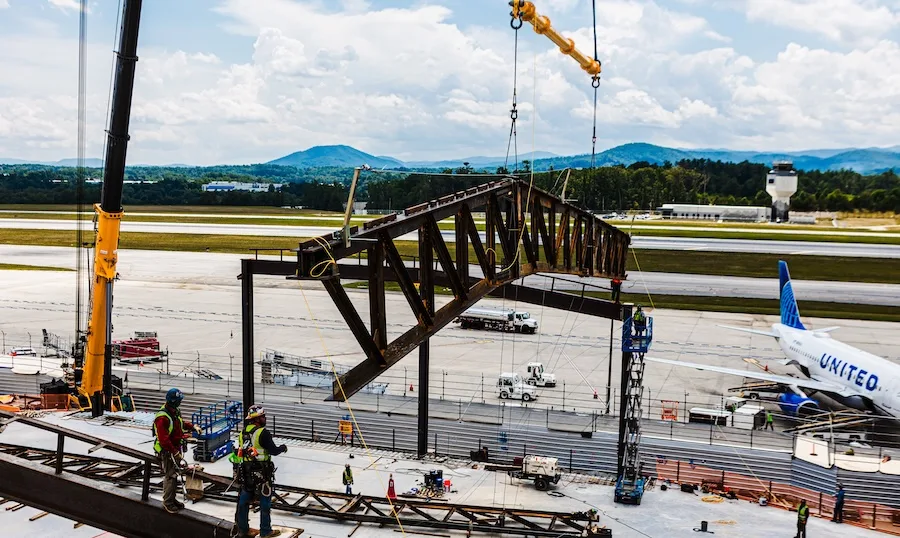
A new terminal is slated to open in 2027 to handle Asheville airport's fast-growing passenger traffic.
The August 2023 groundbreaking for Asheville, N.C., Regional Airport’s $361-million terminal modernization program couldn’t have come soon enough for one of the nation’s fastest-growing aviation facilities.
In 2018, the airport for the first time topped one million passengers annually—a milestone that planners hadn’t projected to occur until 2035. Only briefly slowed by the pandemic, Asheville’s double-digit growth trend quickly recovered, regularly surpassing two million passengers over the past several years.
While Asheville’s popularity was growing, however, its aging 1960s-era 115,000-sq-ft terminal and support infrastructure were falling further behind in both capacity and resources to support the demands of modern-day air travel.
According to Lexie Farmer, the airport’s chief operations officer, the airport’s original plan to simply expand what was already in place would not have been sufficient for a growth curve that was trending ever upward, in both passenger numbers and aircraft types.
“We’ve gone from a lot of regional jets to full-size Group III aircraft” such as Boeing 737s and Airbus A320s, says Farmer, who previously served as operations director for Charlotte, N.C., Douglas International Airport. “The airport’s leadership decided to rebuild everything, and it was definitely the right call.”
Set for completion in late 2027, the two-phase upgrade, designed by Gresham Smith and built by construction manager-at-risk Hensel Phelps, expands and modernizes the existing single-story, seven-gate terminal into a 362,500-sq-ft, 12-gate facility that includes an upper-level concourse, eight-lane security screening checkpoint and additional airside parking. A new 7,500-sq-ft central energy plant is also being built to support the new terminal building and its eventual expansion.
Schedule-controlling Control Tower
While preserving operations is fundamental to most every major airport project, Asheville’s program carried a special consideration—the need to keep the terminal’s rooftop legacy control tower fully operational until it could be replaced by a new $55-million tower, built as a separate project by J. Kokolakis Construction. Delayed by the pandemic, the new tower was not expected to be ready until 2026, complicating a terminal construction schedule that had been developed around a south-to-north phasing strategy.
“Because of the existing terminal’s orientation, we would’ve been unable to erect high trusses, as they’d block the tower’s view of the airfield,” explains Hensel Phelps operations manager John Baumeister. “It also impacted the start of the south airline ticketing and offices areas, and the central checkpoint.”
Rather than risk substantially scaling back terminal construction for several months until the legacy tower was no longer needed, the project team reversed the phasing strategy. They kept the existing south gates operational with a temporary checkpoint while demolishing the existing north side and starting work on the new 136,000-sq-ft two-level concourse, as well as the north portion of airline ticketing area, the south portion of the baggage claim and the central energy plant. Hensel Phelps also worked with the Federal Aviation Administration to permit erection of a 150-ft-tall tower crane to aid with south concourse construction once the legacy tower was taken out of service.
What might sound like a simple solution proved quite complicated, particularly with the challenge of maintaining the project’s original milestones. Working closely with the airport and Gresham Smith, and using 4D BIM and augmented reality tools, Hensel Phelps developed a “microphasing” strategy that would have enough of the new seven-gate north concourse and ticketing area ready to handle passengers by June 2025.
“It was a huge effort to get all the contractors aligned with phasing plan,” he says. “We didn’t reach all of our of original phase one milestones, but the north concourse was operational on schedule, and we’ve since gradually moved airlines into their new gates as they’ve been completed.”
Farmer credits teamwide buy-in and collaboration for facilitating out-of-the-box thinking that helped resolve the legacy control tower obstacle.
“It not only got us back on track, but also allowed us to expand our checkpoint—another issue we had to address during design due to the airport’s growth,” she says.
Carolina Gateway
With the new air traffic control tower commissioned last summer, construction on the new terminal’s second phase accelerated following demolition of the legacy tower. Plan call for all of the new terminal’s central checkpoint, ticketing and concession areas to be completed this fall, with the south side’s five gates to open in 2027. The program’s final step will be converting the temporary TSA checkpoint into a new loading dock.

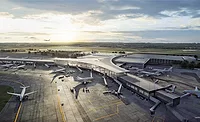
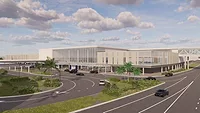
The new terminal will feature upgraded amenities and serve as a gateway to Asheville. Rendering courtesy Gresham Smith
Brad Sucher, Gresham Smith’s senior vice president for aviation, says passengers and visitors can look forward to an accommodating ticket lobby that supports emerging technologies, expanded gate holdrooms and other amenities, with materials, finishes and color palette that express the airport’s role as a gateway to North Carolina. They include wood ceiling beams, portals of stonework and metal and a terrazzo floor reminiscent of mountain streams. Complementing the new terminal's floor-to-ceiling windows, a signature curtainwall-clad 1,200-sq-ft western exposure is fitted with electrochromatic glazing to automatically tint glass and reduce glare.
“There are also plans for a living wall in the baggage claim area that will help bring greenery inside the building,” Sucher says, adding that while the terminal’s front-of-house features stand on their own. “The back-of-house is what makes the airport run, which is why the operational space is intentionally designed and organized to make the terminal efficient as possible.”
Farmer has high praise for the communication that has helped the terminal modernization program successfully navigate its complicated path toward completion. Of particular importance, she says, was a monthly meeting of the project team’s high-level leadership.
“We talked through everything in a very collaborative environment,” she says. “It really helped keep us on track from a financial and schedule standpoint.”
Sucher admits to having lost count of how many iterations and concepts the design and construction teams worked through to move the project along without compromising airport operations.
“The flexibility we built in to the design made it possible to audible midstream with the phasing change, and tackle any challenge that arose,” he says. “It speaks well of the collaboration.”