New York Contractor Tackles Mega Projects with Deep Bench
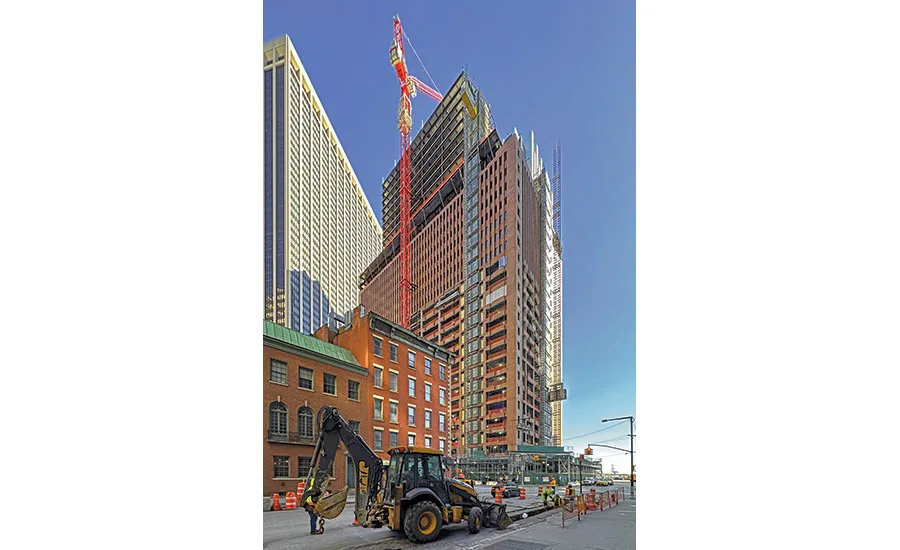
STO Building Group built SoMA at 25 Water St. in New York City. One of the largest U.S. office-to-residential conversions, the 1.1-million-sq-ft redevelopment includes a full renovation, modernized facade and a 10-story vertical expansion.
STOBG Building Group — 2025 Revenue
$4.60 billion – Construction management at-risk
$2.93 billion – New York statewide work
$2.52 billion – Commercial revenue
$927.4 million – New Jersey statewide revenue
$723.58 million– General contracting
1,888 – Number of regional employees
0.055 – Experience modification ratio
New York City-based STO Building Group has several of its regional brands in the same office building or in nearby states when employees of one unit need to tap another for expertise. The ability to contract independently or merge the appropriate mix of talent from city-headquartered Structure Tone and Pavarini McGovern—which share a building with a branch of LF Driscoll and are across the water from New Jersey-based RC Andersen—makes STO Building Group well-suited for megaproject work in the region, says Jim Donaghy, executive chairman of the parent company.
The collaborative workplace is also fostered by ownership opportunities for every employee. Donaghy’s father, Patrick, co-founder of the group’s flagship contractor Structure Tone, advocated for a business culture that invested in its employees since the firm’s beginning in 1971. Today, the company ranks fourth on the ENR East Top Contractors ranking with $5.33 billion in revenue, a 13.4% increase from last year’s No. 5 ranking with $4.7 billion in revenue.
Jim Donaghy spoke with ENR about the themes STO Building Group sees in some of its latest projects, its newest approaches to workplace safety and some of the work that contributes to the more than 1,700 hours its employees have invested in volunteer activities in 2025. This Q&A has been edited and condensed.
STOBG Building Group’s top projects include:
SoMA at 25 Water St., New York City: One of the largest U.S. office-to-residential conversions and a landmark adaptive reuse project in Manhattan’s financial district, the 1.1-million-sq-ft redevelopment includes a full renovation, modernized facade and a vertical expansion that will add 10 new stories.
Christie’s NY, New York City: Structure Tone is CM for this multi-phased 373,000-sq-ft renovation for the auction industry leader. The Rockefeller Center project is renovating office spaces, front-of-house auction areas, back-of-house facilities and critical infrastructure.
Columbia University, Vagelos Innovation Laboratories, New York City: The all-electric purpose-built biomedical research facility will have high-performance facade systems, collaborative interior spaces and energy-efficient strategies to reduce energy use intensity by 30% compared with existing standards.
What are clients looking for in offices?
We’re seeing an increase in contractors’ design-assist work. Cost per square foot has been pressurized, and likewise, there’s an increase in scrutiny to ensure dollars are being spent the most productive way. Clients interested in an integrated design and build team approach potentially don’t have authorization to change the way they contract, so they ask the contractor to come in earlier for a longer preconstruction period. We set the tone for the project through a detailed budget and schedule. Companies are competing with folks who might consider working in other locations, and there are more clients investing in employees who themselves are working longer days, possibly three or four days per week, versus the traditional five days, so they want spaces to be commensurate with what’s being asked of their employees.
Because the cost for rent has gone up, they’re also finding ways to create more value from their real estate. There are staircases that double as meeting spaces or mezzanine-level structures that double as atriums. We’re seeing more large-scale conferencing areas that double as auditoriums for food and nighttime entertainment. These clients want to entertain their staff, their clients and the industry. They’re using their spaces for more than just work.
How is STOBG suited for adaptive reuse?
“You become familiar with landmark and historical properties in New York City.”
—Jim Donaghy, Executive Chair, STO Building Group
If you’re an interiors contractor, as Structure Tone has been for decades, you become familiar with landmark and historical properties in New York City. These buildings are targeted for conversion because clients occupying the largest headquarters are seeking brand new commercial systems and spaces. We have a deep bench of knowledgeable MEP structure and architectural superintendents who specialize in older buildings. It also helps to have a long following of the right subcontractors. Because tenants are not going to get the same feeling of a modernized building, you offset that with a beautiful restoration of old materials. We bring back some of the old surfaces with grinding and polishing, whether it’s brick, old floors, stone or concrete.
Additionally, older properties are inherently difficult to work with. There is rebuilding of staircases and new bathroom layouts—expanding the use of the space often requires new walls alongside old walls. We put as much of the MEP behind the walls and above the ceilings as we can, but we’re dealing with limited space. There are also old shaftways. Upgrading all the elevators is a common facet, and sometimes equipment rooms are not where we need them to be. We can’t probe enough holes to eliminate every surprise. Your team has to be comfortable solving problems on the fly. At 25 Water Street, there was a lot of trust built on that project. Our goal is that when we uncover surprises, we solve them in a way that people feel that there’s trust. Often, we get to do the next job.
Talk about your best-ever safety record
We continue to invest in specific training and ensuring that it’s a continuous learning environment inside STO Building Group. We’ve also leveraged new technologies and certain AI features that help us monitor the sites and avoid mistakes. We’ve ratcheted up our gloves policy—expecting all tradespeople on our sites to wear gloves, and we want the hardhat chin straps on. Those policies are not as widely adopted in the New York City area as elsewhere, but the city is fast coming along to be as good as many other major markets. We’ve also built a superintendent roundtable group inside STO Building Group for which we have brought together some superintendents and project managers with our safety teams to collaborate and strategize on what to invest in, what did not work well and what needs to change.
We really do try to treat our people as they are, which is that they are our only asset. Without the safety of our trades being guarded, it’s hard to invest in other aspects of your business. Even when agreeing to a schedule and deciding which projects we might work on, safety is a major factor in those decisions. We go into every year with robust planning and a strategy for how to do better and how to do more around safety as a core value.
What accounts for the firm's best-ever safety record last year?
It's a journey we've been on for many years, building a safety culture. We continue to invest in specific training, and ensuring that it's a continuous learning environment inside STO Building Group. We’ve also leveraged new technologies and certain AI features that help us monitor the sites and avoid mistakes. We've ratcheted up our gloves policy—we expect all tradespeople on our sites to wear gloves, and we want the hardhat chin straps on. Those policies are not as widely-adopted in the New York City area as much as some other parts of the world, but the city is fast coming along to be as good as many of the other major markets. We’ve also built a superintendent roundtable organization inside STO Building Group, where we have brought together some of superintendents and project managers with our safety teams to basically collaborate and strategize on what to invest in, what didn't work well and what needs to change.
We really do try to treat our people as they are, which is that they are our only asset. Without the safety of our trades being guarded, it's hard to invest in other aspects of your business. Even when agreeing to a schedule and deciding which projects we might work on, safety is a major factor in those decisions. We go into every year with robust planning and a strategy for how to do better and how to do more around safety as a core value.
Of the different charities your firm is involved in, do you have a favorite?
I feel a little guilty picking a favorite. We have a major event we do for United Way every year—we love that charity—but I've been the chairman of the Explorer program in New York City for close to two decades now. The basis of the program is that companies commit their resources and train high school kids for a dozen or so nights a year, exposing them to the different industries in New York City. At the Structure Tone office, we provide what they call an Explorer “post” for roughly 40 kids in the spring and 40 in the fall. We teach them estimating, we walk them through jobsites, and we have a friendly competition at the end of their sessions.
They walk out of these posts with something to put on their resume and better insights as to why they may want to be part of our industry. Many of them have never been inside a Class A skyscraper before—it’s really eye-opening for them. Being a leader in an industry like construction, I feel it's kind of an honor to help and open doors for these kids.