Top Contractors | MidAtlantic Firm of the Year
MidAtlantic Municipalities Rely on Vermont Contractor
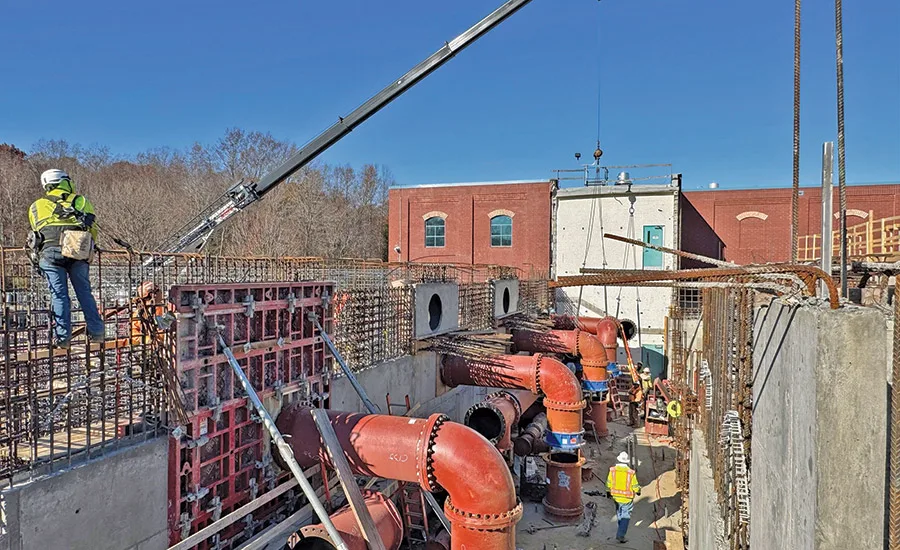
PC Construction is working on the Motts Run Water Treatment Plant Expansion and Rehabilitation Phase 2 and Raw Water Pump Station in Fredericksburg, Va. The project is slated for completion in early 2027.
PC Construction—2025 Revenue
$197.01 million – Construction management at-risk
$83.73 million – General contracting
$58.48 million – Virginia statewide revenue
$35.03 million – Health care work
$32.01 million – Water supply projects
$26.20 million – Sewage-solid waste
526 – Number of worldwide employees
315 – Number of regional employees
0.81 – Experience modification ratio
Since breaking into the MidAtlantic market in 1972 to service strategic water and wastewater infrastructure needs, PC Construction has delivered more than $4.5 billion worth of work, including more than $500 million in design-build work at the nation’s largest wastewater treatment plant—utility DC Water’s Blue Plains advanced facility—and at the Piscataway, Md., wastewater recovery bioenergy project for utility WSSC Water. The South Burlington, Vt., firm anticipated the region’s need for progressive design-build and construction management at-risk delivery for municipal infrastructure projects and implemented the team and systems to meet those needs, resulting in a 75% increase in design-build contracts. ENR MidAtlantic’s 2026 Contractor of the Year placed No. 53 on the ENR East Top Contractors rankings with $292.87 million in 2025 revenue—up 45.11% from the $201.83 million it collected to rank No. 78 in the prior year.
PC’s community contributions include exceeding by $3 million the firm’s estimated $40-million subcontracting goal for minority and women-owned businesses and small and local businesses on the recently finished wastewater bioenergy project in Accokeek, Md. PC attracts craftworker talent and maintains a leadership development program. It supports more than 100 nonprofit community groups each year via time, pro-bono services and sponsorship activities. Dan Stromberg, PC construction executive, shared the firm’s business approach with ENR in the following Q&A that has been edited and condensed.
PC Construction’s notable projects include:
Motts Run Water Treatment Plant Expansion and Rehabilitation Phase 2 and Raw Water Pump Station, Fredericksburg, Va.: Construction is underway on the long-planned expansion of the plant, the sole source of drinking water for the city. Totaling $142.1 million, the project will double treatment capacity to 24 million gallons per day from 12 mgd.
Arlington Re-Gen Biosolids Upgrade, Arlington County, Va.: This progressive design-build project is the county’s first use of this delivery method. Expected to cost about $256 million, it will modernize solids handling facilities and incorporate cutting-edge technology for the county water pollution control plant in the Crystal City section of the city of Arlington to sustainably transform wastewater into a renewable energy source and Class A biosolid, a nutrient-rich soil amendment.
Piscataway Water Resource Recovery Facility Bioenergy Project, Accokeek, Md.: The $269-million progressive design-build project, recently completed, is the largest and most technically advanced that utility owner WSSC Water has constructed in its 106-year history and one of only seven facilities in the country to incorporate an advanced thermal hydrolysis process to transform biosolids.
Why are you successful in the region?
[Our] track record built over more than five decades … reflects the trust our clients have placed in us. I’ve been working in this region most of my career. After college I went through PC’s leadership development program and eventually made the decision to settle in Leesburg [Virginia] and raise my family. That’s actually a big part of what we’re about—we want our people to put down roots and build careers without having to constantly relocate. In 2010, we deepened our regional commitment and really built out the team and office infrastructure to support long-term sustained growth in the MidAtlantic region. The whole idea was to make sure our project teams were working close to home. That’s always a win in construction—for the people, for the quality of the work and for the relationships you build with clients.
How did you build trust with utilities?
When PC first entered the MidAtlantic, the industry was almost entirely design-bid-build for municipal projects, and we came in through that traditional path—hard-bidding work and earning our place. But what set us apart from the beginning was that even in a competitive bid environment, we approached our work collaboratively. We weren’t just trying to win jobs; we were trying to build relationships. PC Construction has built our entire book of business on reputation and referral. We’ve been a water and wastewater contractor for nearly 70 years, and the reason clients keep coming back and recommending us to others is because we do what we say we’re going to do. That transparency around cost, schedule, safety and quality has been something our owner partners have consistently pointed to when they talk about why they want us on a project. As the market evolved from design-bid-build to collaborative delivery models, we were already in a strong position because of our industry and client relationships that were foundationally built on trust, not just on price.
“[Our] track record built over more than five decades ... reflects the trust our clients have placed in us.”
—Dan Stromberg, Construction Executive, PC Construction
How did you build teams and systems?
We were aware of the market shifting toward collaborative delivery, so we made a conscious decision to build teams specifically to meet its future demands. That meant investing early on in Design-Build Institute of America certification across our project management and preconstruction teams. We learned in our first design-build projects that this isn’t simply a different contract type. Collaborative delivery requires a fundamentally different team structure and mindset—the way you approach preconstruction, the way you integrate with design partners, the way you make field decisions are all different. If you try to run a design-build project the same way you run a hard-bid job, you’re going to struggle. Our preconstruction department, specifically dedicated to CMAR and design-build work, has multiple specialized functions that advance collaborative delivery. Our construction teams have built what I’d call the most enviable collaborative delivery résumés in the industry. They’ve worked on complex, technology-forward projects alongside top-tier design firms, and that experience compounds over time.
How was the bioenergy job challenging?
The Piscataway bioenergy facility is a landmark project. [It took] 7.5 years from detailed design through commissioning. It is one of only seven U.S. facilities to incorporate a thermal hydrolysis process to efficiently transform biosolids. The facility is expected to generate $4 million annually in revenue, save WSSC Water customers $3.4 million per year in operating costs and meaningfully reduce greenhouse gas emissions.
We’re incredibly proud of it. One big challenge was that the craftworker shortage was real and forced us to get creative. We leaned heavily into lean construction methodology and pull planning, ensuring every subcontractor made thoughtful time projections and held to commitments. This kept work flowing and maximized trades’ efficiency. We also decided to build off site wherever possible. The solids dewatering building was constructed using precast panels fabricated off site and assembled on site. The sidestream deammonification tanks used precast post-tensioned concrete panels and was completed in under six weeks—work that would have taken 6 months by conventional means. We also prefabricated the electrical power distribution centers in a climate-controlled facility and delivered them fully assembled and tested. These approaches allowed us to complete this work quickly, making the interior of each structure readily available for mechanical and electrical trades and avoiding the inherent delays in scheduling local subcontractors on short notice.
What was your approach to MBE/SLBE hiring on the project?
We had 36 firms involved, supporting nearly 150 jobs. Our outreach was targeted. We sought firms with existing WSSC relationships and interviewed each one in advance to make sure they were a good fit for the team. We also mentored several of those firms, and one of them, BOTA Engineering, grew their team by 25% as a direct result of their work on this project. That's the kind of impact that stays with you.