Safety & Health
Boston Planner's Cycling Death Prompts City Pledge to Advance Stalled Safety Projects
Louisa Gag was struck July 9 by a truck transporting construction demolition material on a street known to be dangerous for bikers
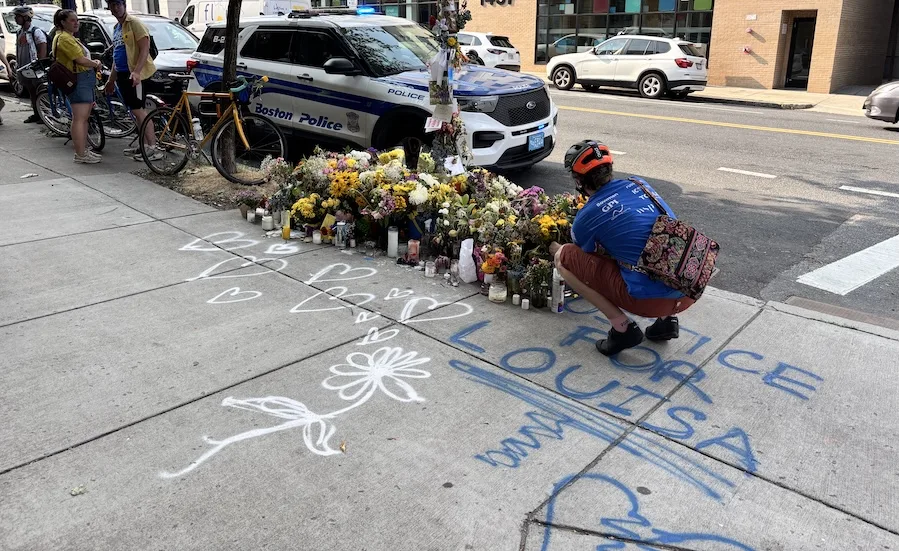
A cyclist places a flower at a makeshift memorial for Louisa Gag, a Boston transportation planner whose bicycle was fatally struck by a recycling truck leaving a construction site on July 9.
One week after a Boston transportation planner who devoted her career to making city streets safer for cyclists was fatally struck by a truck while biking, embattled city Mayor Michelle Wu pledged that stalled street safety projects would advance in the coming days.
Louisa Gag was killed in the city’s Mission Hill neighborhood on July 9 at an intersection that city cycling advocates say would have been made safer by projects mothballed by the mayor. Critics say Wu slowed or reversed the projects and road improvements—including near the crash site—for more than one year. They claim the one-time street safety champion changed her positions when she ran for reelection against Josh Kraft, the son of New England Patriots owner, Robert Kraft, who railed against Wu's bike lane projects during the campaign.
“I really struggled with whether I should come here tonight or not, whether it would help the healing that is so needed for a community in such grief and pain, and whether I would be able to get any words out at all,” Wu said tearfully during a vigil for Gag on July 16.
Wu said Gag’s mother encouraged her to attend the vigil to lay out her vision for safer streets, and that her administration has been working with advocacy organizations and community members on the issues. In addition to a police investigation into the crash, she said the city will do a full analysis of street design “and build this in as a standard practice, one that we hope can be a model everywhere.”
The city will install or replace protected barriers for cyclists, according to Wu, who has assigned two senior members of her administration to a so-called Streets Cabinet “to accelerate policies, planning and capital delivery work that will make our streets safer.”
The crash involved an 18-wheeler recycling truck that moved around another vehicle turning left before hitting Gag on a downhill stretch where the bike lane’s solid line becomes a dashed line. The driver has not been charged with a crime, according to the Boston Globe, which also reported that the truck had just left the demolition site of the One Joslin Place project in the city’s Longwood medical area. Suffolk is building a $1.7 billion, 14-story hospital for Dana-Farber Cancer Institute and Beth Israel Deaconess Medical Center, with the 450,000-sq-ft facility to include 300 inpatient beds and set to open in 2031.
 Boston
Mayor Michelle Wu spoke at a vigil outside City Hall for Louisa Gag, a
city transportation planner killed after she was hit while riding her
bike. Photo by Justin Rice for ENR
Boston
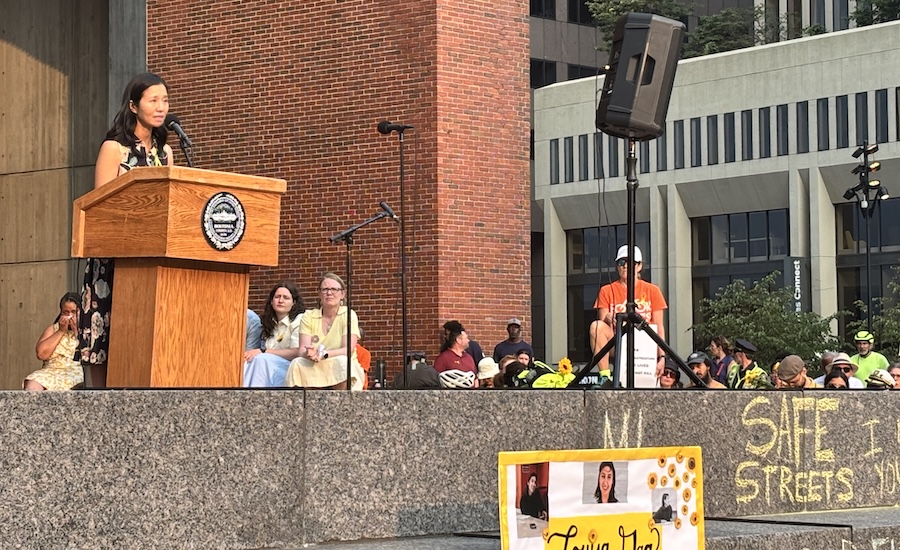
Mayor Michelle Wu spoke at a vigil outside City Hall for Louisa Gag, a
city transportation planner killed after she was hit while riding her
bike. Photo by Justin Rice for ENRBefore Wu spoke, Brennan Kearney, executive director of WalkMassachusetts and a part of the Massachusetts Vision Zero Coalition, told the crowd of hundreds that Gag is one of 156 people to be killed in road crashes in Massachusetts this year. He added that 354 people died on state roadways last year, with more than 2,000 road crash fatalities since 2021. “Hundreds more each year suffer serious injuries,” he said. “This is a street safety crisis in our commonwealth. What are our decision makers waiting for?”
Kearney said the city should restart its speed hump program, and the legislature should pass laws that allow municipalities to use safety cameras to catch excessive speeders. “I'm sad, and I'm frustrated,” he said. “But we aren't helpless.”
The crash occurred near offices of the Boston Cyclist Union, which advocates for cycling safety infrastructure. “The safety infrastructure that we enjoy today, in large part, Louisa had something to do with,” said Tiffany Cogell, its interim executive director, adding that improvements in street design and safety infrastructure save lives. " We know that these deaths are preventable. That knowledge makes the loss all the more painful, and all the more urgent."
She added: "By refusing to accept preventable traffic deaths as the cost of moving through our cities, and demanding that streets protect every person, whether they are walking, biking, rolling, riding in transit or driving. … let us commit ourselves to building the safer, more just city that Louisa worked so hard to create."
Wu said Gag “devoted her life and career to building a Boston, where every resident and every visitor could move through our city safely ... and she was killed on our streets. We owe her action. We have to do better.”