City Scoop | Riverside
Infrastructure Work on the Rise as People Head Inland
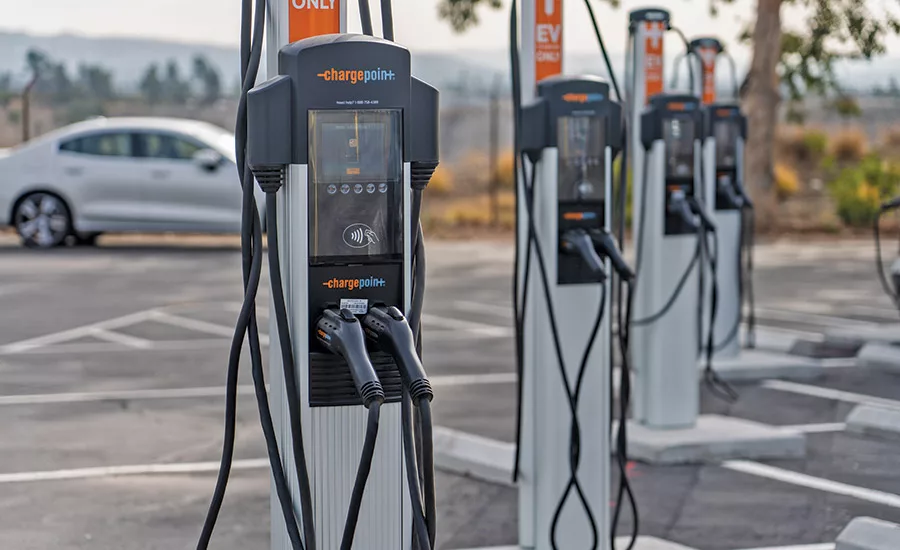
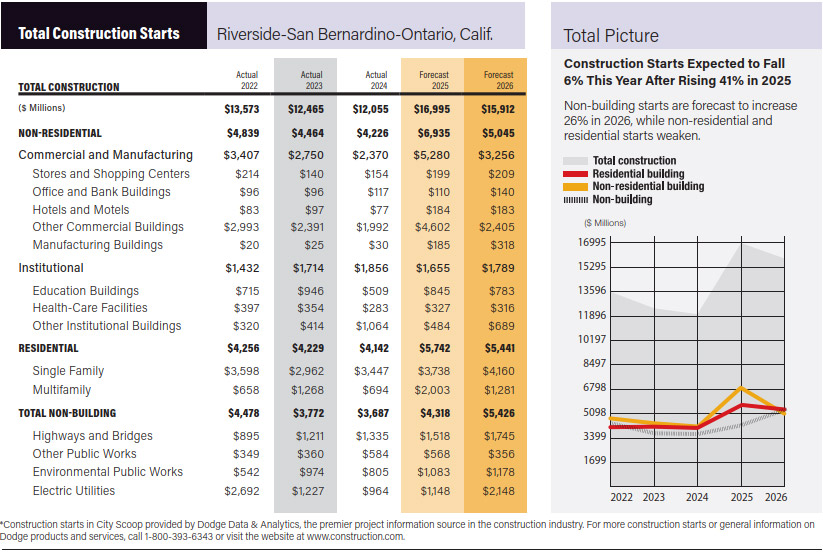
Electric utility starts are expected to nearly double in 2026, rising 87% over 2025, according to the latest figures from Dodge Data & Analytics.

Kirby S. Hays
President & CEO
Hal Hays Construction Inc.
As the second-largest metro area in California and the 12th largest in the country, the story in Riverside County at the moment is growth, Hays says.
“The Riverside-San Bernardino metro added nearly 40,000 people between 2023 and 2024, making it one of the largest-gaining metro areas in the country. Meanwhile, LA County lost 60,000 to 70,000 residents over that same period,” he says. “People are moving inland because they can actually afford to live here, and all of that growth has to be supported with infrastructure.”
Total starts are forecast to fall 6% this year, according to Dodge Data & Analytics, with a 5% dip in residential projects and a 27% fall in non-residential. Non-building starts are expected to increase by 26% on strength in electric utility starts, which are projected to accelerate by 87% this year.
“The work here is more infrastructure and logistics driven, versus the coastal focus on adaptive reuse and high-rise,” says Hays, adding that utility infrastructure is one of three sectors carrying the market at the moment.
“Riverside County consistently ranks among the top gaining counties in California,” he says. “That growth has to be supported, and that’s where the work pipeline comes from—water, power, gas and telecom systems must keep pace.”
The other two sectors showing strength are transportation and warehouse/logistics.
“The warehouse story is the one everyone knows. Over 30% of all waterborne trade entering the U.S. comes through the ports of LA and Long Beach, and most of that cargo passes through Inland Empire warehouses before it reaches the rest of the country,” he says. “There are more than 4,000 warehouses covering nearly 40 square miles in this region.”
But communities are pushing back harder on new approvals through local moratoriums and state legislation such as AB 98, which establishes new setback requirements for logistics facilities near residential areas, Hays adds.
Meanwhile, labor continues to be an issue for Riverside firms.
“The skilled trades workforce is as tight as I’ve ever seen it in my career. Cost of living here is lower than on the coast, but so is the compensation, and that creates a real challenge in attracting quality workers,” he says. “There’s more emphasis right now on finding and retaining skilled self-perform tradespeople than any other time I can remember.”
Hays adds that as a self-performing heavy civil contractor, Hal Hays Construction feels that shortage on a daily basis.
But if there’s one thing that has highlighted how limited resources are throughout the area, it was the extensive LA wildfire recovery effort.
“During the initial emergency response for the Eaton Fire and Palisades, it felt like every available dump truck and earthwork operator in the region got pulled west,” he says. “That kind of sudden drain on labor and equipment has real consequences for projects already underway out here. It was temporary, but it exposed just how thin the resources are.”
On the materials side, oil price volatility stemming from the Iran conflict is pushing asphalt prices higher, which is making suppliers expire quotes faster than ever, adding a level of uncertainty to estimating that didn’t exist just a year ago, Hays says.
“Tariffs have had some impact, but we try to negotiate those away, and most of our projects are shorter duration rather than spanning multiple years, so our exposure is limited,” he says.
One of the area’s landmark projects is the 200-acre, $172-million Ontario Sports Empire development anchored by ONT Field, which is the new 6,500-seat stadium for the Dodgers’ Single-A affiliate Ontario Tower Buzzers. While the stadium opened in March, the full complex will include eight baseball and softball diamonds and a community sports complex that will open later this year, making it the largest sports complex of its kind in Southern California.
As for the regional outlook over the next 12–18 months, Hays’ concerns are mostly external, from federal policy uncertainty to the California governor’s race.
“A trend I’m seeing in public works [is that] project owners are becoming more contentious, quicker to pull the trigger on terminations and more willing to litigate,” he says, pointing out that this kind of environment raises costs across the board. Ultimately, those costs will get passed to taxpayers and ratepayers, Hays says.
“The outlook is still solid though. I keep coming back to the numbers,” he continues. “The Inland Empire grows while coastal California stagnates or shrinks. The Inland Empire has available land, lower costs and continuous population growth. People need places to live, roads to drive on, water to drink, power to turn on. That’s our work.”