$500M Redevelopment Planned for Historic Hampton Beach Casino
New Hampshire redevelopment calls for modern mixed-use landmark with luxury condos
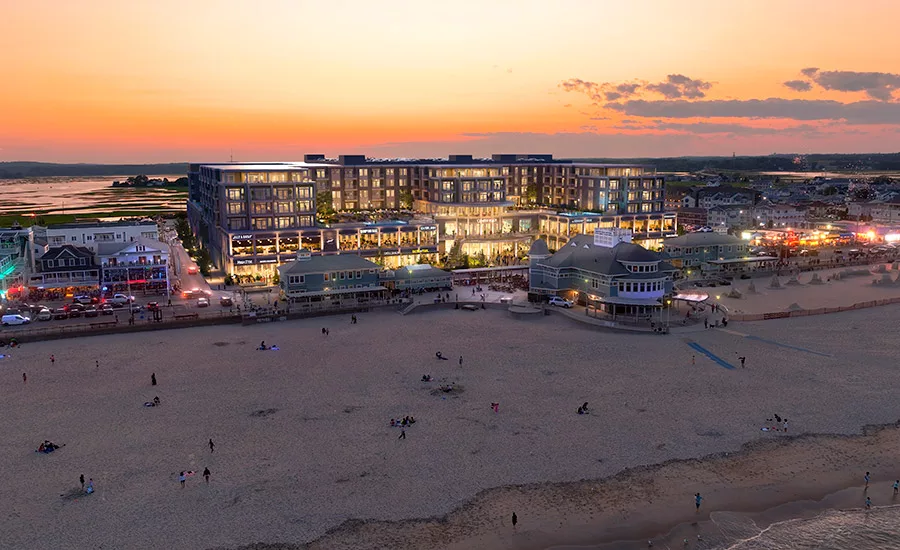
The Hampton Beach Casino Redevelopment reimagines a seaside icon as a vibrant year-round destination. The ballroom will nearly double in size to accommodate 3,500 people. A new 208-room luxury hotel will offer elevated accommodations, spa amenities and ocean views and 99 condos will provide access to one of New England’s most popular beaches.
The Hampton Beach Casino, once one of the largest entertainment venues on the East Coast, has plans to replace its more than century-old two-story building with luxury condos in a modern mixed-use oceanside complex.
The approved plan for the residential/retail redevelopment, estimated at $500 million, is expected to transform the historic property into a modern landmark, with a ballroom that will nearly double in size.
Designed by Cambridge, Mass., architect PCA Inc., the project includes 99 luxury condos, a 3,500-seat entertainment venue, a 208-room luxury hotel with elevated accommodations, ocean views, and beach access, a 52,000 sq-ft charitable gaming casino, retail space, restaurants and structured parking, says PCA.
The owner, Sal Lupoli, president and CEO of the Lupoli Companies, and partner Fred Schaake described their plans for the project during two public meetings late last year. They claim the project will transform Hampton Beach into a year-round destination.
“We have great respect and a heartfelt connection for the social traditions of the 100-year-old Hampton Beach Casino,” said Lupoli. “We plan to preserve these traditions, while seeing the project evolve to become a year-round destination.”
The developers are planning for demolition to begin in September 2026, after the annual seafood festival, as noted in the planning documents. Following completion of demolition, construction is expected to take 36 months with a phased opening.
Rick Friberg, president and CEO of TEC Inc., a civil engineering consulting firm based in Lawrence, Mass., on the project team, said the next step is to finalize designs and hire a contractor, according to a Boston Globe report. Friberg did not respond to ENR inquiries.
The Hampton Beach Casino was built by the Exeter, Hampton and Amesbury (Street) Railway Co. in 1899. After adding a ballroom in 1927 that featured jazz artists of the era, including Louis Armstrong, Duke Ellington, and Bing Crosby, the casino soon attracted some 20,000 people per week, earning a reputation as the entertainment center of New Hampshire.
Lori Cotter, president of the Hampton Historical Society says her organization hopes to "closely work with the owners in preserving some of the building’s historical features through architectural design ideas for the inside or use of photographic elements to show the history of the venue and its use." The society has also offered to help with any necessary research.
Sewer Flows
On behalf of the developer, Weston Sampson completed a sewer capacity analysis, which the town received in April and sent to its consultant Wright Pierce for review.
The town is conducting the analysis to ensure the sewer flows generated from the project can be handled within the closed sewer system as it exists today,” says Jennifer Hale, Town of Hampton Dept. of Public Works director. “As the basis for capacity, when looking at the piping segments, capacity is available if the sewer segment does not exceed 80% of the pipe’s capacity,” she says.
While the draft report includes information on flooding, it “does not include any planning for flood scenarios as it relates to the sewer system and the [town’s] Church Street Pump Station,” Hale says. “If the system needs additional capacity, conditions improvement or adjustments are needed at the pump station, the town and the applicant will need to work together to identify the best mitigation measures.”
Sustainable Planting
Leading the landscape architectural design is Boston-based Halvorson, part of Tighe & Bond, with a focus on public spaces, including streetscape, planting and exterior amenity areas.
“Sustainability is integrated through a planting strategy that emphasizes salt-tolerant, climate-adapted species suited to the coastal environment,” says Shannon Jamieson, senior landscape architect and project manager. “We are also looking for opportunities to reduce heat island impacts and manage stormwater within a highly constrained beachfront site.”
Roadway Upgrades
The casino redevelopment will be coordinated with planned reconstruction of 3.3 miles of New Hampshire Route IA—Ocean Blvd.—in Hampton to be completed in three segments. The estimated cost to upgrade the NH IA in Hampton to make it safer and allow traffic to move more efficiently is $62 million during the next five or more years, the Union Leader reports.
Jennifer Lane, a spokeswoman for the New Hampshire Dept. of Transportation, told ENR that funding has been allocated for the construction of the first one-mile segment, which is set to begin in spring 2029. Funding for final design and construction of the other two segments has not been identified, but the department has submitted a $25 million BUILD Grant application that, if selected by June 28, would allow for construction of Segment 2.
“Phasing construction will likely be the most challenging aspect of the project due to the location of the work, traffic volumes, and beach-related activities,” says Loretta Girard Doughty, NHDOT program administrator, highway design.