Southwest Design Firm of the Year
Water A Big Market for Jacobs in Dry Southwest
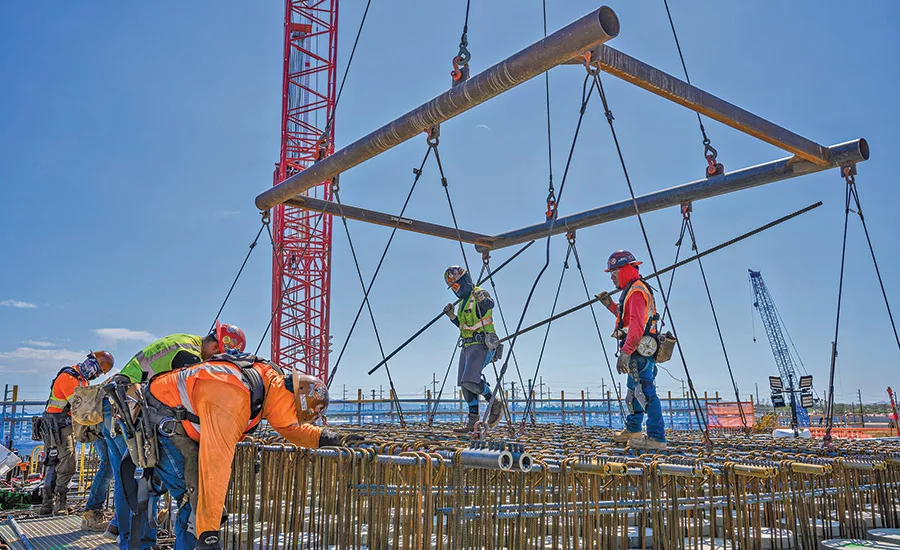
Jacobs fast-tracked the design for Fab 52 in Chandler, Ariz., one of the largest semiconductor fabrication plants in the U.S. The Jacobs/Hoffman/Intel team developed a concrete form system comprised of a grid of circular-shaped penetrations. The forming system was assembled, aligned and prepared off site. A special picking device was engineered and utilized to unload, align and set the slab’s forming modules and prefabricated rebar assemblies.
Jacobs’ regional offices in the Southwest are using innovative delivery and design approaches to expand into new areas and save clients money.
Ranked No. 1 on ENR’s national 2026 Top 500 Design Firms ranking, Jacobs lands in the No. 2 spot on the Mountain States & Southwest list, with $440 million in reported regional revenue for 2025.
Jacobs’ 770 employees in the region work from nine offices scattered across Arizona, Nevada and New Mexico.
Population growth and climate conditions throughout the Southwest make it a particularly active region for the firm’s water sector projects, and Arizona is a hub for Jacobs’ advanced manufacturing work. The firm fast-tracked the design of Intel’s Fab 52 in Chandler, Ariz.—one of the largest semiconductor fabrication plants in the U.S. at more than 2.9 million sq ft—delivering the project in just 3.5 years. The project was named ENR’s 2025 Project of the Year.
ENR Senior Editor Jennifer Seward sat down with Tom Meinhart, Jacobs executive vice president, to learn about the firm’s Southwest presence. The following Q&A has been edited and condensed.
Jacobs is known for its innovation. Can you tell us about a couple of your more forward-thinking projects in the region?
A project that has been completed—the operation and maintenance piece is ongoing—is the Pima County Arizona Agua Nueva Water Reclamation Facility, where we’re delivering advanced wastewater treatment and reuse in the Sonoran Desert. It was originally introduced as an innovative P3 treatment process, and we had good success with cost reduction of $77 million on that. What is neat about this one is that we partnered with an external provider to create Intelligent O&M. At Jacobs, we have a strong operation and maintenance business and operate close to 300 water/wastewater plants across the U.S.—some municipal and some private. We took the knowledge we have from operating all of these plants and combined that with the provider’s foundry platform and built with the help of AI a way to optimize power and chemical costs.
For example, on a wastewater plant like the Pima County project, you’re injecting oxygen into the dirty water, but it’s simplified overnight. The operator will get a notification on his or her phone that will say “you can turn down the blowers from 10 p.m. to 6 a.m.” The system won’t automatically do that; the operator will have to acknowledge ‘yes’ before it will turn down the blowers. In the first year alone, we’ve seen hundreds of thousands of dollars of savings for power and chemical costs. We’re trying to replicate that across our whole platform as a value add to our clients, and in some places we’ve looked at cost sharing on the reduction in commodity costs.
Recent Projects at a Glance
San Juan Lateral Water Treatment Plant will deliver safe drinking water to around 250,000 people across 43 Navajo communities in New Mexico, addressing long-standing access gaps.
Agua Nueva Water Reclamation Facility was designed with Intelligent O&M, saving up to 20% in power usage at the advanced wastewater treatment and reuse facility in Arizona’s Sonoran Desert.
Goodyear Water Treatment Facility is the largest-ever infrastructure project for the fast-growing city of Goodyear, Ariz. The $128.9-million, 8-million-gallon-per-day facility and pipeline were delivered using a fast-track, integrated design-build-operate approach, delivering the project well ahead of state regulatory deadlines.
Brightline West High-Speed Rail in Nevada encompasses 34 miles and 22 structures as part of a 218-mile high-speed rail system that will connect Las Vegas to Southern California in approximately 2 hours. By reducing the number of car trips, the rail line is expected to cut nearly 400,000 tons of CO₂ annually.
Do you have other new technologies in the works?
We have a lot of neat stuff going on right now. Jacobs acquired a company called Streetlight Data out of the Bay Area that does data analytics for traffic. You can see the old-school version in some neighborhoods, where you run over rubber hoses and they have data counters. This [new] system uses data from vehicles, and that data is purchased to essentially look at traffic counts within minutes and hours rather than days and months. We’ve successfully used this in construction zones and determined how to reroute traffic. And you can also use it for planning in terms of future highways and roadways. We have several DOTs across the U.S. that buy that software from us.
What market trends are you watching?
“One of the capabilities we have in the water space is that we can take a project from conceptual planning all the way through the operation and maintenance.”
—Tom Meinhart, Executive Vice President, Jacobs
Population growth, aging infrastructure and some of the climate conditions are driving the water and energy side of our business in the Southwest. Given the water scarcity, we’re seeing a lot of work with water reuse. We have a group of designers nationally that focus on this, and we’re well-positioned for where the market’s headed.
Additionally, the Fab 52 project is one example [that represents] the reshoring and resilience trend, where manufacturers are building more capacity for electronics to be made here in the U.S. We’re one of the premier designers in the semiconductor space, and we follow Intel around the world.
In addition to the Pima County project, another project we’re really proud of is the San Juan Lateral Water Treatment Plant in New Mexico for the Bureau of Land Management, and we’re going to design it as well as build it. We’re obviously proud that we’re the No. 1 design firm in [ENR’s listing], and one of the capabilities we have in the water space is that we can take a project from the conceptual planning all the way through the operation and maintenance. We’ve recently made a full acquisition of PA Consulting out of London. They have a stateside operation, and we’re introducing them to more and more clients. Unlike other firms, we have that consultancy as part of the Jacobs umbrella.
We have the best designers in the market, and then we can turn it over to construction. So that $260-million contract for the Bureau of Reclamation has Jacobs’ name on it. We won’t self-perform the construction; we’ll hire local subcontractors, but we’ll be the contractor for it. And then we have the opportunity if the client elects to operate it for a multiyear contract. I think we can really take it end-to-end in the water space.


-12-copy.webp?height=200&t=1777728024&width=200 "Fab-52.jpg")