Digging Deeper | Airports
Airport Transformation in the Queen City
New terminals and upgrades aim to boost capacity and improve the passenger experience as traffic grows
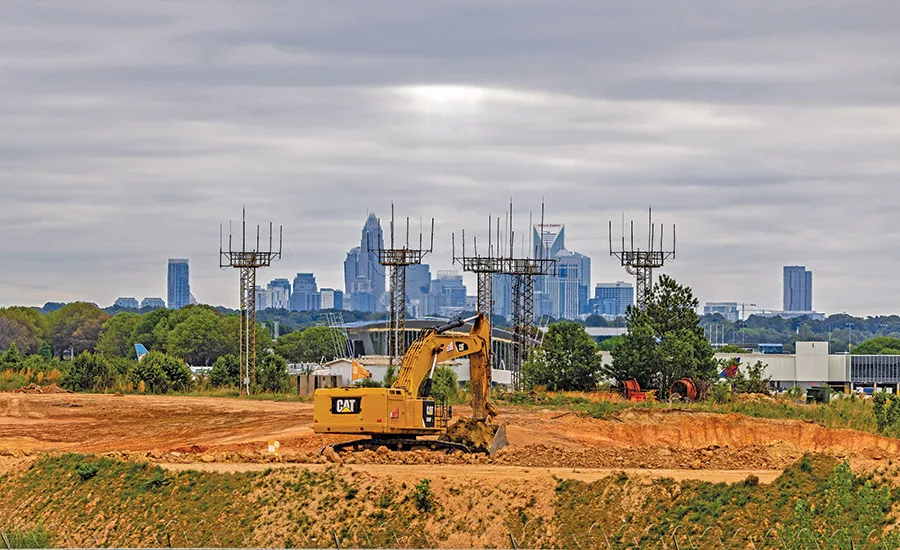
A fourth parallel runway constitutes around $1 billion of Charlotte airport’s approximately $4-billion capital program.
When the $608-million Terminal Lobby Expansion (TLE) opened last fall at Charlotte Douglas International Airport, it marked one of the biggest milestones of the approximately $4-billion Destination CLT program. But an even bigger one is anticipated in 2027, when a 10,000-ft-long, 150-ft-wide fourth runway is set for completion.
“We are about 45% there,” says Jack Christine, the airport’s chief infrastructure and development officer. “We are right on schedule, under budget and barreling toward commissioning in September 2027.”
The program aims to keep up with passenger growth, which increased from 28 million total passengers in 2005 to a record-breaking 50.1 million total passengers in 2019. Passenger counts dropped during the height of the pandemic, but in 2024, the airport broke the record again at 58.8 million. That makes it the seventh-busiest airport in North America and the 35th globally. Considering that it is ranked seventh globally in terms of numbers of aircraft takeoffs and landings, the fourth runway becomes even more crucial, along with full-length parallel taxiways, a system of associated entrance/exit taxiways and two end-around taxiways (EATs) that allow aircraft to taxi around the ends of active runways instead of crossing them directly.

A $604-million terminal lobby expansion, opened last fall, celebrates the roots of the city.
Photo courtesy CLT
The upgrades and expansion encompass more than capacity. The University of North Carolina at Charlotte’s Aviation and Innovation Research Institute is partnering with the airport on an instrumentation and digital twin program in which sensors will be embedded within the new runway.
“It will become a living lab for academia to test new construction methods,” says Nick Loder, associate vice president of aviation with RS&H, the runway’s engineer-of-record.
The upgraded and expanded terminal lobby emphasizes a sense of place—from rocking chairs evoking Southern hospitality, gingham patterns evoking the area’s textile industry, intuitive wayfinding in shades of blue to reference Carolina sports teams and “swooping and rolling” motifs to suggest the area’s hills, says Ben Goebel, Charlotte office leader for lead designer Gresham Smith. “At each of the checkpoints are aerodynamic higher-tech-looking components as a nod to the research and development for auto racing.”

A statue of the city of Charlotte’s inspiration was lowered into place through a 24-ft oculus.
Photo courtesy CLT
Fitting a Queen
The literal crowned jewel of the terminal expansion is a 15-ft-high bronze statue of Queen Charlotte, freed from her exile near parking facilities due to a roadway expansion and lifted some 75 ft into place through a 24-ft-dia oculus onto her pedestal in the lobby.
“We spent a lot of time testing how to harness her,” says Goebel. “She had a patina from exposure to weather, so she got a spa day with a chemical bath.” Crews constructed a protective box around the statue before the move. “Once in the air, the lift took about 45 minutes. It took a few hours to bolt her into place and unharness her,” he adds.
“It was a very tense hour,” recalls Chad Allen, director of operations with Holder Construction, of the statue lift, noting that it rotated in the air. Holder, Edison Foard and R.J. Leeper served as the construction manager at-risk for the expansion, and finished punch list items this month for an overall on-time, on-budget job.
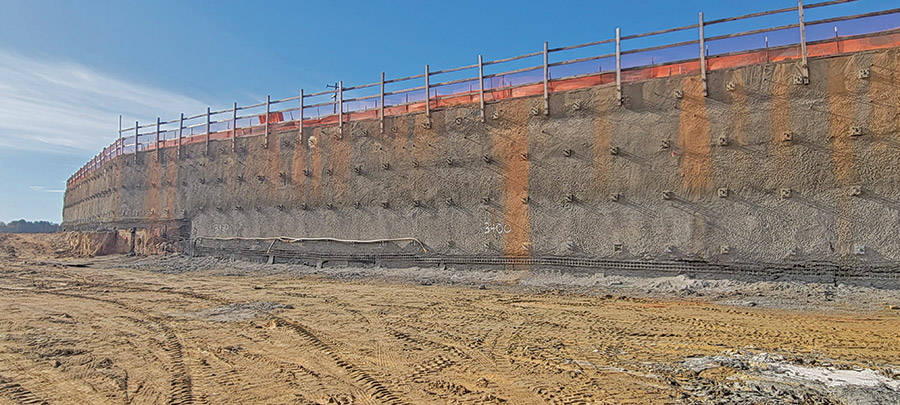
A massive soil nail wall at the south end-around taxiway provides a shield from other facilities.
Photo courtesy AECOM
Construction of the TLE continued largely unaffected through the pandemic, with the dip in passenger traffic too brief to make significant changes to the project’s six-phase, 60-month schedule (ENR Southeast 3/6-13/23, p. 34). Combining 175,000 sq ft of new facilities with 191,000 sq ft of renovations, the expansion consolidated five existing security checkpoints into three larger, more efficient stations, added overhead and underground pedestrian walkways connecting the terminal with the parking garage and a new central energy plant.
Early on, the design resulted in a potential 22-phase project of eight to nine years, recalls Goebel. During preconstruction, the airport conducted workshops with all project team members and its own employees to reduce that to six phases and six years.
“The airport asked us to always keep two entrances open at all times,” recalls Allen. “We ended up keeping three entrances open at all times” out of the five.
“We are about 45% there.”
—Jack Christine, CLT Chief Infrastructure Officer, speaking about the runway project
The major construction component is a 146,000-sq-ft steel truss and glass canopy stretching 155 ft across an elevated access road and terminal curb front. Supported by sixteen 65-ft-tall columns adjacent to the garage and the building envelope, the approximately 12-ft-tall trusses weigh approximately 45 kips each.
“The airport had finished the roadway, so we used two lanes for coordination and layout,” says Allen. “We coordinated the crane footprint within that capture area.” Depending on flight schedules, crews had 4 to 7 hours each night to erect 63 truss segments.
“During the day, we went through the plan and detailed down to the hour what we did that night,” Allen says, noting that the fabricator, SteelFab Inc., had a facility right across the highway from the airport. Crews lifted each half of a truss in the air and bolted it there.
“We were learning field issues as we went along,” says Goebel. “We used laser scanning and simulated everything as much as possible.” Crews also began doing test fits of the trusses on the ground.
Because welding in a four-hour window was “nearly impossible,” Williams Erection Co. came up with a temporary mechanical connection to stabilize each truss, says Goebel. “If the truss was not in place and secured, the contractor would unbolt it and take it down.”
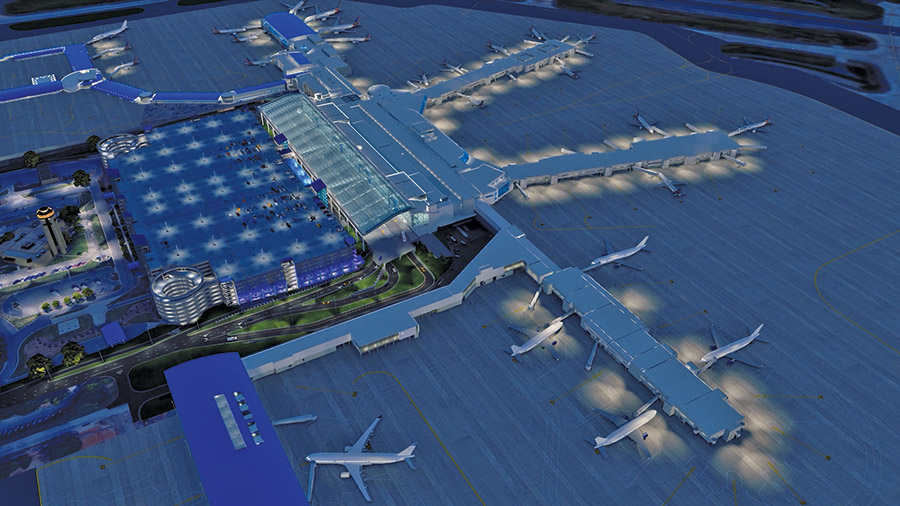
A variety of concourse expansion projects have been completed and more are on the way.
Rendering courtesy CLT
Airfield Array
The fourth parallel runway program is divided into multiple packages, with four engineers-of-record: RS&H for the runway, AECOM for the south end-around taxiway (SEAT), Kimley-Horn for the north end-around taxiway (NEAT) and STV for the relocation of West Boulevard off the SEAT footprint. STV also designed 2,300 linear ft of sewer line associated with the airfield.
Using Autodesk’s Construction Cloud, “all design teams coordinated in real time,” says Robert McAndrews, program manager with HNTB, who serves as a sub for the “master” program management team, led by Delta Airport Consultants and Talbert, Bright & Ellington.
“There are multiple bid packages stacked atop each other. We have a dedicated staff just for utilities, rather than having four different engineers-of-record calling [a utility entity],” he says.
The first phase of the NEAT included enabling work such as the relocation of an airport overlook and a 1-mile segment of road. The second phase includes 13,000 linear ft of pipes, some with up to 84-in. diameters and as deep as 50 ft, says Nathan Summers, senior vice president with Kimley-Horn. “We have 50 structures up to 30 feet deep,” he says. The work also includes 68,000 sq yd of 18-in.-thick concrete and moving 1.5 million cu yd of earth—some of which has to be blasted, requiring coordination not only with the airport but the nearby Norfolk Southern railroad.
“There are multiple bid packages stacked atop each other.”
—Robert McAndrews, Program Manager, HNTB
E.S. Wagner and Hi-Way Paving are building the NEAT. According to E.S. Wagner’s LinkedIn page, it has held seven contracts on the runway program since 2022. According to its website, it currently has almost $90,000 in work such as 8.5 million cu yd of embankment, installation of 52,000 linear ft of storm drainage, some 300,000 cu yd of excavated rock, 3,766 ft of cast-in-place box culvert and clearing of 505 acres of land.
Ames Construction is building the SEAT, which is almost halfway done, says Matt Dubose, AECOM project manager. Major components include a 50-ft-tall, nearly half-mile-long soil nail wall to separate the airfield from an intermodal facility, and a 12-ft by 16-ft concrete box culvert drainage structure receiving three 96-in.-dia pipes. “That goes through the middle of the SEAT to tie into another culvert,” he says, noting that the structures transport stormwater into Coffey Creek.
Utilities associated with the relocated West Boulevard also had to be relocated. The area has two visual screening effects: aluminum honeycomb panels and a 25-ft-high mechanically stabilized earth wall, Dubose adds.
Among many other runway elements, RS&H designed three remote transmit receiver sites, says project manager Nick Loder. “We had two sites that were relocated because the dual end-arounds have to be relatively low for [aircraft] line of sight. It made our RTR relocations more difficult while building a third one for the SEAT.”
Project director Dale Stubbs says with all the bid packages, “it was an earthwork shell game. Each project was prioritized according to which had float and could accommodate stockpiles [of earth].” He adds: “It’s almost entirely a cut job, taking a lot of dirt out. Everything drains to the south. The SEAT ended up with a lot of the culverts and the [soil nail] wall.”

Crews had limited overnight work hours to install segments of the steel and glass canopy.
Photo courtesy CLT
Looking Ahead
The airport and the University of North Carolina, Charlotte (UNCC) announced the $6.5-million Fourth Parallel Runway Instrumentation and Digital Twin Technology Program in April. The program, touted as the first of its kind in the nation, will embed pavement sensors within the runway to provide real-time data and insights into pavement performance and maintenance needs. The data will be used by the airport for day-to-day operational analysis and by the Federal Aviation Administration to enhance future airfield pavement design and construction criteria for airports nationwide, the release stated.
“It is an earthwork shell game.”
—Dale Stubbs, Project Director, RS&H, speaking about the runway program
Tara Cavalline, University of Carolina at Charlotte professor of civil engineering technology and construction management, says there will be some 2,000 sensors embedded at various depths of the runway and topside, along with cameras and a weather station. “We hope this is a test bed that answers questions and gives insights for across the nation,” she says. “The types of research questions are aligned with what the FAA wants to do to understand pavement performance.”
The airport is now looking ahead on the next big capital projects, including extensions of concourses B and C estimated at approximately $463 million each, adding as many as 22 gates in total.
Before that, the airport will begin the bid process for an estimated $405-million, two-phase south ramp expansion.
“We need to add a significant amount of concrete ramp to support dual taxiways around the terminal,” Christine says. “It’s in design right now. The first package will go out to bid this summer and the second a year after that. The ramp will take about 3.5 years to build. During the process we will get into the design for the concourse extensions.”