City Scoop | Houston
Houston Market Stays Active Despite Challenges
Population influx fuels project mix, but labor and market woes persist
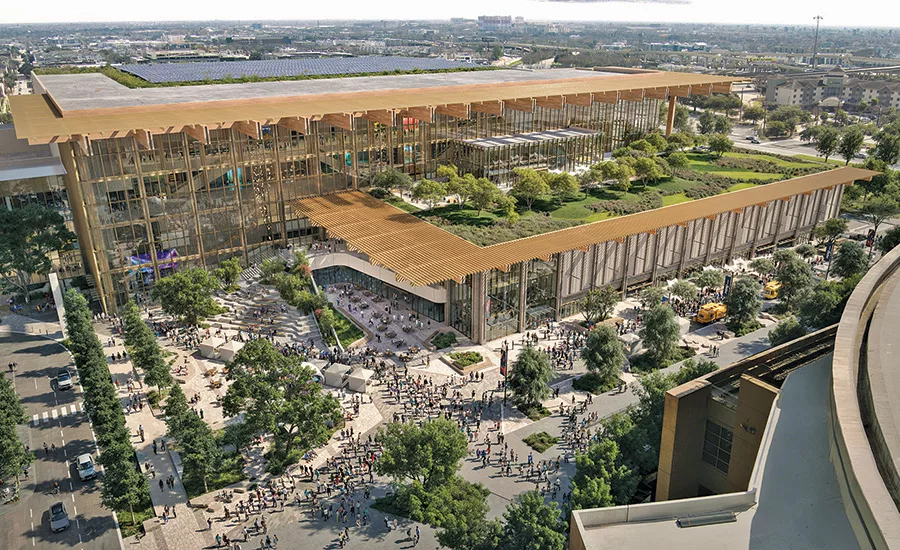
A rendering of the planned expansion of the George R. Brown Convention Center, part of a long‑term redevelopment aimed at enhancing Houston’s downtown convention campus.

Andrew Halphen
Director of Preconstruction
Manhattan Construction Co.

Tamara Hancock
Executive Director
American Subcontractors
Association
–Houston Chapter
More people are moving to Houston than any to other metro area in the country, according to the latest statistics from the U.S. Census Bureau. After adding 126,720 people between July 2024 and July 2025, the Greater Houston area now boasts a population of 7.9 million.
That growth is generating work for the region’s contractors. Total construction starts are forecast to rise 6% year over year in 2026 after seeing a 3% decline in 2025, says Dodge Data & Analytics.
Nonresidential starts, which include hospitals and schools, are expected to climb 11.7% in 2026 while residential starts post 9% growth.
The latest data from the Bureau of Labor Statistics also shows that the Houston area added 11,200 construction jobs, or 4%, between February 2025 and February 2026—the most of all metro areas across the U.S. for that time period.
“The consensus is that there are some really big projects out there that need a lot of construction workers—health care and data centers seem to be the big ones, although K-12 and higher ed aren’t far behind,” says Hancock. “Most of that work is already on the books, so subs are careful with bidding on new work.”

Big tech is making a substantial investment in Houston as well, from Apple’s 250,000-sq-ft advanced manufacturing facility to Foxconn’s $450-million AI server production facility and Inventec’s $250-million manufacturing plant, according to a report from the Greater Houston Partnership in late 2025.
“And, as usual, there is concern with material price escalation and with an aging workforce. Filling those skilled labor jobs continues to be a huge challenge as well,” Hancock says.
On the west side of town at Beltway 8 and I-10, the historic Shadowdale grain elevators are at the center of a new 17-acre development, which kicked off with the groundbreaking of a five-story, 346-unit high-end apartment community in March. Arch-Con Corp. is leading construction of Moody National’s Silo Springs, which is the first part of a 10-year, multiphase, mixed-use development.
However, “megaprojects in the panhandle and Louisiana are pulling our largest contractors out of the local market and putting pressure on local labor availability,” adds Halphen. “This is also applying pressure on local pay as contractors are having to compete with large per diems pulling workers out of town.”
To ensure adequate bid coverage and labor availability, Manhattan is relying on tenured subcontractor relationships. Also, subcontractors are becoming more selective about the contractors that they work with, choosing companies that are safe, reliable and focused on creating mutually successful projects, he points out.
Although nonbuilding starts are expected to be down slightly by 3.7%, major infrastructure work is still brewing. Houston’s third loop is another step closer to completion, for one.
On April 30, the Texas Transportation Commission awarded Ferrovial a $1.47-billion contract to construct one of the last sections of Grand Parkway/SH 99, the 15-mile Segment B-1. Construction will begin later this summer, with completion by 2032.
“There are some really big projects out there that need a lot of construction workers.”
—Tamara Hancock, Executive Director,
American Subcontractors Association–Houston Chapter
After decades of ups and downs, the much debated Texas high speed rail project appears to be taking baby steps forward. Demolition began in May on the long abandoned Northwest Mall, reportedly to make room for a centrally located station for the line that would carry passengers from Houston to Dallas in just 90 minutes.
Construction has also started on Phase 1 of the George R. Brown Convention Center’s $2-billion transformation. The project includes a 700,000-sq-ft expansion called GRB South and a 100,000-sq-ft pedestrian plaza connecting the convention center to nearby Toyota Center.
Phase 1 is expected to reach completion in mid-2028, with the entire campus set to follow by 2038.
Despite the amount of work going on, market volatility and price uncertainty still weigh heavy on local firms. That means clients are reaching out earlier than ever before, Halphen adds. Benchmarking off old projects is no longer reliable, he continues, noting that Manhattan is constantly updating cost models for its clients, accounting for real time market conditions.
“Long lead equipment has become an essential discussion during or in some cases before concept design begins,” Halphen says. “Having experts involved early [and] advising on lead times for items like steel or electrical switchgear has become essential for our clients."
He adds: "We are also way more involved in assisting our design partners to specify regionally available and, in some cases, hyper-local products. This is helping avoid tariff impacts and shipping challenges.”