Burns & McDonnell Sees Record Growth in Texas & Southeast
Driven by surging project pipelines, the firm is scaling its footprint and capabilities across a fast-growing region
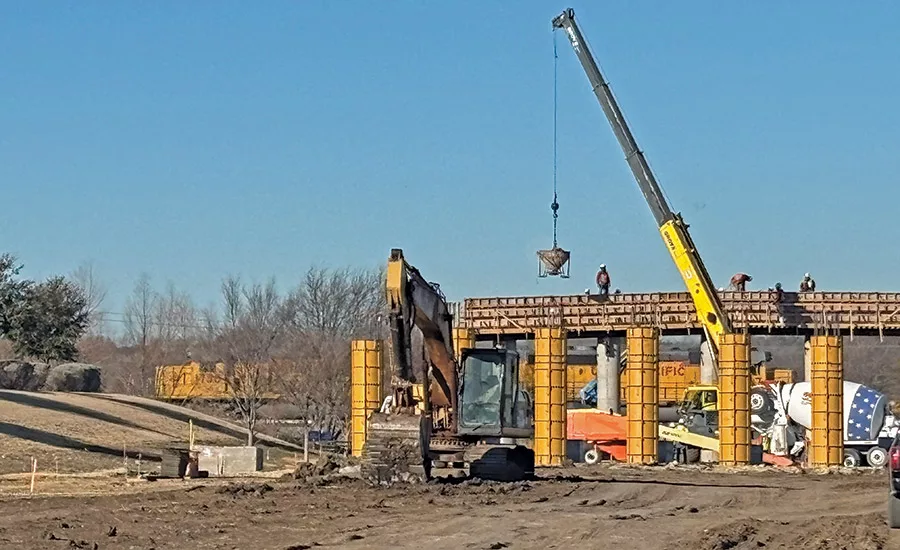
The firm’s Everman Parkway extension project for Fort Worth is the city’s first progressive design-build transportation project.
Burns & McDonnell is in the right place at the right time. With high demand in the mission critical and power sectors, the firm’s offices in Texas and Oklahoma are particularly well-positioned to capitalize on current market opportunities. Last year, the firm generated a record financial performance—more than $1 billion in revenue—in ENR’s Texas and Southeast region. Roughly 75% of that revenue was earned in ENR’s Texas & Louisiana subregion.
The firm has leaned heavily into integrated delivery models, including working with its own construction arm. Its regional offices have emerged as centers of excellence for the global firm while remaining connected to local communities. In light of its recent success, ENR Texas & Southeast named Burns & McDonnell its Texas & Louisiana Design Firm of the Year.
The humming mission critical sector has been a boon for Burns & McDonnell in the region. The firm launched its mission critical practice nearly a decade ago, when the number of design firms in the space was more limited. With a head start on the competition, the firm now works with some of the largest hyperscalers in the world as well as multiple tier-two data center clients.
Today, the firm’s Dallas office has 100 staffers dedicated to mission critical work and serves as the Center of Excellence for Mission Critical for the entire company.
For Scott Clark, senior vice president and North Texas region general manager at Burns & McDonnell, the rapid rise in mission critical demand has been remarkable. A mechanical engineer, he first started working on data centers in the 1990s, during the dotcom boom. “It’s been a really hot market and a really good place for us to be over the last 10 years,” he says. “It started pretty slow—we just had a handful of people—but over the last five or six years, it’s been a really big part of our growth.”
Clark says the demands associated with mission critical work dovetail nicely with many of the firm’s other practices.
“[Mission critical projects] need mass grading, they need roadways, they need electric substations, they need water treatment plants and they need power,” he says. “So it’s literally everything—it’s civil sitework, architecture, structural, mechanical, electrical, fire protection, commissioning. It’s the full gamut.”
While data centers have been a big part of the firm’s growth strategy in recent years, other sectors are strong as well. Karen Bray, senior vice president and general manager overseeing Burns & McDonnell’s South Central region, including Houston, Austin and San Antonio, says the power sector has been particularly strong. In addition to power needs for data centers, population growth also drives demand. Meanwhile, energy infrastructure is also needed for energy export, including liquefied natural gas. “Whether it’s generation of energy, battery storage, solar, transmission, distribution, substations, grid interconnection, anything in the energy value chain has been big for us,” she says.

On a progressive design-build project for Port Arthur, Burns & McDonnell used a 360-degree LED immersive cave automatic virtual environment to engage collaboratively within a high‑definition, full‑scale virtual environment.
Photo courtesy of Burns & McDonnell
Progressive Design-Build
Other strong markets include advanced manufacturing as well as traditional infrastructure, such as transportation and water, Bray notes. An increasingly important part of the firm’s strategy is scaling integrated delivery models to provide greater speed, certainty and collaboration on complex projects. With its in-house construction capabilities, the firm’s ability to pair engineering, procurement and self-perform construction capabilities is a key differentiator.
The Everman Parkway extension project for Fort Worth is the city’s first progressive design-build transportation project. When complete in 2027, the $42-million project will deliver nearly 1 mile of new roadway, a multilane roundabout and a 750-ft bridge over the Union Pacific Railroad.
Last year, the firm was selected for progressive design-build delivery of a new water reclamation facility in San Marcos, Texas. The new 2 MGD facility aims to support rapid residential growth and long-term water reuse needs. As part of its scope, Burns & McDonnell will implement a fast-tracked interim wastewater management system while concurrently designing the permanent facility.
Since 2023, the firm has been engaged in Port Arthur’s first-ever progressive design-build. Ed Long, director of engineering for the port at Port Arthur, says Burns & McDonnell first suggested using the delivery method to effectively navigate the numerous complexities of the project. Long, who had not previously worked with the firm, says he was struck by the professionalism of the team. Before winning the project, Long estimates that the firm had completed about 30% of the preliminary design.
“Once people get here, they want to stay.”
—Karen Bray, Senior Vice President and General Manager, Burns & McDonnell
“I was very impressed with them because they had done so much design and looked at various alternatives of how we could put this project in,” he recalls. “[During the RFQ process], they pulled ahead of the pack with all the work they put into it. They are one of the most professional firms I’ve worked with as far as getting the job done. Their communication in-house is incredible because I could tell one person one thing, and the entire team would do it. It was great to never have to repeat things.”
The project was also among the first to use the firm’s new Innovation Center, which features what it describes as the world’s only 360-degree LED immersive cave automatic virtual environment (CAVE). The space allows teams and clients to engage collaboratively within a high-definition, full-scale virtual environment for design reviews, virtual prototyping and scenario testing without isolating participants in individual virtual reality headsets. Through the immersive experience in the CAVE, the team was able to effectively support infrastructure planning at the port in Port Arthur. Stakeholders were able to walk through proposed layouts, evaluate truck and rail movements alongside active operations and identify potential safety and constructibility concerns before design decisions were finalized.
The firm’s penchant for integrated delivery also improves collaboration with its trade partners. Michael Kimmell, vice president of preconstruction at MEP specialty contractor Southland Industries, says the firm’s ability to see a project from both the engineering and construction sides is a benefit.
“They definitely operate more as a team and really take advice that the installers have,” he says. “A lot of engineering firms will tell you they have their own standard or best practices, and they really kind of operate in a silo. I think Burns and McDonnell do a really good job of developing projects as a team to really get the best input, not only from their own experience, but from everyone else’s as well.”

Burns & McDonnell employees often spend time volunteering at local charities, including Kids’ Meals in Houston
Photo courtesy of Burns & McDonnell
Talent Search
Staying on top of growth means attracting and retaining enough qualified staff. Bray notes the particularly high demand in the current market for electrical engineers, who are critical to much of the firm’s workload. Still, the firm has proven to be a place where talent not only accepts offers, but they also stay. Burns & McDonnell is a 100% employee-owned company, which means everyone from C-suite leaders to a mail room worker has ownership.
“There are a lot of people who come to Burns and McDonnell and stay their whole careers,” says Bray, who joined the firm 24 years ago. “We have one of the lowest turnover rates in the industry. I think we’ve grown organically and very naturally and developed talent internally. We do hire externally as well, but I think once people get here, they want to stay.”
The firm has landed on the Houston Chronicle’s list of Top Workplaces every year since 2009. FW Inc. magazine has also ranked it on its list of Best Companies to Work For in Fort Worth since 2017.
Internships also serve as proving grounds in the firm’s recruiting efforts. This summer, the firm’s Houston office will welcome 60 interns. Last year, the firm hired 700 interns companywide, out of 62,000 applicants.
“Unless there’s a bubble, I don’t see an end in sight.”
— Scott Clark, Vice President and North Texas Region General Manager, Burns & McDonnell
Burns & McDonnell has also shown its commitment to the communities it serves. Employees contributed more than $1 million to United Way chapters across the region. They awarded roughly 25 STEM education grants—totaling approximately $125,000—to K-12 schools in Texas, Florida, Georgia, South Carolina, Tennessee and Puerto Rico.
Beyond education, Burns & McDonnell teams supported a wide range of community organizations and service initiatives, including Girls Engineering the Future, Junior Achievement of Southeast Texas, regional science museums and employee-led volunteer efforts such as STEM festivals, heart walks and youth mentorship programs.
Looking forward, Burns & McDonnell leaders continue to see a well-defined path toward growth. Clark notes that, since its opening in 2010, the Dallas office has grown every year, and he expects that to continue. The firm’s construction arm has definitely been a major contributor to that growth—doubling in size since 2021. However, design opportunities are also robust.
“Unless there’s a bubble, I don’t see an end in sight,” he says. “Our utility customers are asking us for more teams—both design and construction—our hyperscalers want more teams, our infrastructure clients need us to do more. So yeah, it’s a good time to be in our business right now.”