City Scoop | Portland
Portland Upbeat on Outlook but Remains Braced for Rain

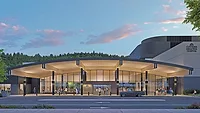
Hillsboro Hops Stadium in Hillsboro, Ore., was delivered through a design-build partnership between Populous and CannonDesign, with construction by Mortenson.

Kevin Nyhoff
West Region Design Director
CannonDesign
The residents of Portland, Ore., are famed for spurning umbrellas despite the region’s reputation for wet weather. Visitors to “The City That Works” can be spotted under the portable canopies while locals opt for rain-resistant outerwear to contend with the persistent drizzle and wind.
That stoic but practical outlook can also be found in the current business mindset contending with a surfeit of uncertainty.
“The present moment feels less like a downturn and more like a period of recalibration and opportunity awaiting,” says CannonDesign’s Kevin Nyhoff.
Caution is connected to a significant recent downturn for the region’s AEC market. According to Dodge Data & Analytics, project starts plummeted by $2.3 billion in 2023 to under $5.7 billion. A recent report by the Portland Metro Chamber found that Portlanders feel deeply uncertain about their city's economic outlook.
From an AEC standpoint, the downturn looks more like an outlier than a hallmark of decline. Last year’s $9.1 billion in starts marked a 60% surge over the nadir two years ago.
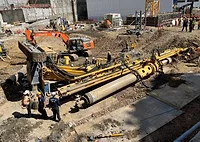
The turnaround can be traced to an explosion of environmental public works projects that grew from less than $400 million in starts in 2023 to more than $2.3 billion in 2024. That initial surge was powered by projects such as the $420-million Willamette Water Supply System Water Treatment Plant and the Willamette River Crossing Project.
While the environmental public works sector has since descended from such airy heights, it remains robust with almost $1.5 billion projected for 2026. More importantly, the overall numbers seem to be on a steady upward trend. Dodge projects the overall value of starts in the region to top $9.3 billion this year.
Despite the prospect of stable, if not spectacular, growth, the region’s AEC industry remains wary. The most pressing worry is the fear that growing financial uncertainty, both regional and industrywide, will create a drag on investment.
“Higher borrowing costs and more conservative lending environments as well as continued increases in construction cost have created a landscape where many projects struggle to move forward,” Nyhoff says. “Even owners with strong, long-term confidence are moving cautiously and delaying commitments or reassessing project scope.”
Financial worries are compounded by the industry’s recurring bugaboos of labor pricing, material fluctuations, insurance requirements and ongoing supply chain challenges.
The budgetary squeeze has resulted in a landscape where projects move more slowly, which, in turn, has led to longer planning timelines and closer examination of project economics, he explains.
That isn’t to say the backlog of Portland projects has completely dried up.

The Broadway Corridor redevelopment, an affordable housing tower in downtown, is slated to begin construction this year. Additionally, Nyhoff notes that development discussions on projects aimed at reenergizing the city core are continuing, including the Lloyd Center site, the Expo Precinct and a potential Major League Baseball stadium. Moreover, regional firms have unique strengths such as expertise in mass timber and sustainability.
“While mass timber is still viewed as emerging or experimental in other parts of the country, in Portland it has matured into a mainstream design and construction strategy supported by a deep bench of innovative and experienced designers, engineers, fabricators and contractors,” Nyhoff says.
Unsurprisingly examples of these types of projects abound including the new Portland International Airport.
There remain opportunities for alert firms, such as bond-funded projects, school modernization efforts, health care investments and infrastructure reinvestment.
“The emphasis seems to have shifted from rapid expansion toward reinvestment and modernization of existing assets,” he says.
In order to hedge against immediate market limitations, Nyhoff has observed that other AEC firms are diversifying geographically into neighboring and emerging markets such as Idaho and Montana.
“There is talent here, and people choose to live here for the community, but we often need to look beyond what the local market alone can sustain,” he says.
Remaining practical about the business environment doesn’t suggest a lack of faith in Portland’s AEC community, Nyhoff says.
“There is a shared belief that the qualities that define Portland—especially its vibrant culture, livability, creativity and design values—remain intact,” he explains. “These fundamentals will continue to position the region for future investment and the next generation of innovative development.”