City Scoop | San Francisco
San Francisco Feels the Headwinds of the AI Wave
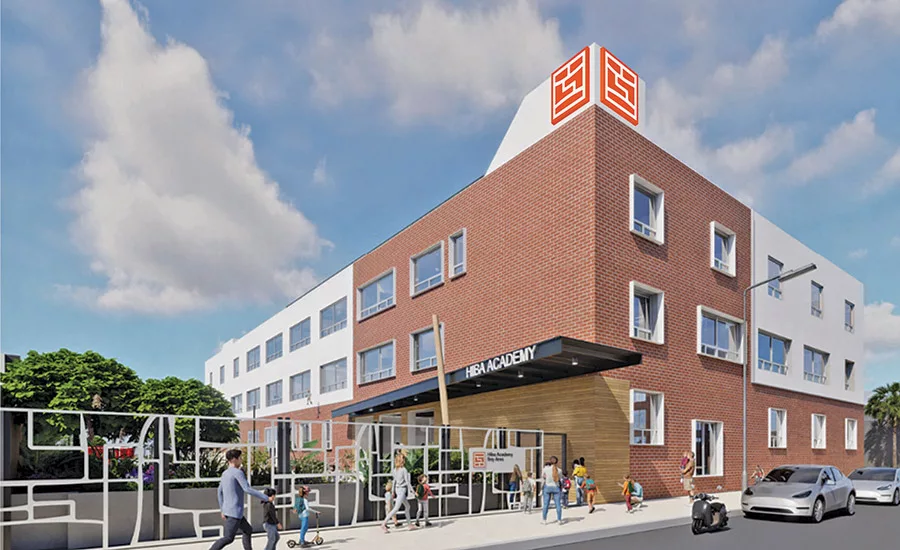
Swinerton’s work on Hiba Academy’s Showcase Square Campus is part of a strong education sector for the region.

Peter Hau
Vice President
Swinerton
The frenzy surrounding artificial intelligence has yet to abate in San Francisco. Many of the key firms in the AI sector call the city their home and are continuing to increase their presence.
Those animal spirits have spilled over to the AEC sector, according to Swinerton’s Peter Hau. “San Francisco serves as the epicenter of AI, leading to stronger office-related construction than neighboring markets,” he explains.
The AI build-out reflects the 2010 social media boom in the city in several respects: massive venture and corporate investment and the generation of start-up clusters that tend to expand from a few dozen employees into much larger footprints.
That, in turn, has ignited demand for premium office space, he says, especially for office buildings with higher-end amenities and the availability of large contiguous vacant floors.

According to an analysis by CBRE, the more than 10 million sq ft of leased space in the city last year was the highest total since prior to the pandemic.
The formula for growth is relatively straightforward. In order to lure the premium talent that AI firms require, there has been an increased expectation of the caliber of the workplace environment with an emphasis on hub productivity, creativity, socialization and the sharing of ideas.
“There is a significant pipeline of office upgrades and repositionings, especially in trophy and Class A buildings with tenant improvements exceeding $450 per square foot,” Hau says.
Those ebullient sentiments can be seen in the Dodge Data and Analytics figures for the region, where commercial building starts totaled more than $3 billion in 2024. The numbers tailed off last year and are projected to top $790 million in 2026.
“Architects and contractors report packed pipelines for tenant improvements linked to AI firms or traditional companies—such as legal and financial services—that provide professional services in support of AI firms,” Hau says.
That upswing has also helped improve the prospects for the city’s downtown that had been struggling with post-pandemic office vacancies and mounting public safety concerns.
“Downtown San Francisco is experiencing a shift from “ghost town” to revitalized activity in key neighborhoods as foot traffic returns,” Hau says.
The increased investment activity is allied with the city’s efforts to improve public safety and business recovery in key economic corridors. Those efforts are showing progress. Although the change is recent, it shows signs of accelerating as the city’s highly amenitized, transit-oriented spaces continue to prove their importance to the business community.
The result is an ideal environment to reap the benefits of the AI economic upswing that has created a host of second-order effects in sectors such as retail, hospitality and services, he says.
The influx of workers has also created a need for quality housing in a state that has been plagued by a long-standing lack of affordable housing. Multifamily housing starts for the region are expected to top $3.9 billion in 2025, more than double the year prior. Single family residential starts are poised to top $1.7 billion this year, having continued a more sober but reliably steady upward climb.
Another sector that is solid for San Francisco is education. The $2.6 billion in starts expected for 2025 marked a healthy uptick for a consistently reliable sector. Swinerton’s work on the Hiba Academy’s Showcase Square Campus, a bilingual Mandarin–English pre-K through fifth grade school is a good example. The adaptive reuse project includes structural upgrades to accommodate the change from office to educational use.
The effort required the use of micropiles, foundation enhancements and new shotcrete walls. The team is also modernizing MEP systems and installing new finishes to meet school standards.
One interesting outlier has been health care. Starts in that sector languished at $233 million in 2023 and then exploded to top $2.7 billion in 2024. The surge is likely linked to the state deadline for such facilities to meet stringent seismic standards by the end of the decade. Dodge predicts starts in the sector will fall back from those heights to a still robust $1.1 billion this year.
One drawback to the emphasis on premier office space has been a neglect of older “legacy class” buildings that have seen little construction activity. It remains to be seen if those owners will reposition their products in order to capture market share, Hau says.