UC Davis Construction Wave Reshapes Sacramento and Davis Campuses

UC Davis Health’s California Tower project in Sacramento topped out at the end of 2025. Completion is expected in 2030.
Over the last five years, the University of California, Davis (UCD) has been navigating sweeping construction initiatives to support its academics, research and services. It’s also working to meet a critical 2030 deadline for new state hospital seismic standards. The university opened 1 million sq ft of new development in 2025—the most ever in a single year.
“We are coming through a very busy period of construction. We will always be adding new facilities. It’s just one of those needs that is never fully satisfied for a big public university. It’s going to keep us busy indefinitely,” says Reed Kawahara, interim executive director of real estate services and director of public-private partnerships at UCD.
If UCD’s project lineup is any indicator, busy might be something of an understatement. In 2022, UCD broke ground on the $1.15-billion first phase of Aggie Square. The same year, UC Davis Health broke ground on its $579-million outpatient surgery center 48X Complex. Then in 2024, UC Davis Health kicked off construction on its $3.7-billion California Tower. At the same time, infrastructure upgrades, parking improvements, community partnerships and other initiatives combined to support and enable these massive keystone projects.
“A world-class university needs world-class facilities to conduct research that benefits humans, animals and our planet,” says Gary S. May, UC Davis chancellor. “In Davis and Sacramento, through partnerships and philanthropy, UC Davis is building and modernizing facilities to support our mission of teaching, research and public service.”

UC Davis Chancellor Gary S. May signs a beam during the formal topping-out ceremony for California Tower in February.
Photo courtesy of UC Davis
A Seismic Challenge
The Davis campus is primarily host to academics, research and the veterinary school. Meanwhile, UC Davis Health, located in nearby Sacramento, houses the medical school and health care campus.
In 2019, the health campus spanned 3.5 million sq ft. After 2030, it will surpass 7 million sq ft thanks to the $7.5-billion Vision 2030 program. The university calls it the largest health system capital expansion in the U.S. More than 600 health projects are under construction, including the flagship California Tower, which will add substantial inpatient, surgical and imaging capabilities. By comparison, UCD has about 30 projects in active construction at the Davis campus.
The tower’s origins lie in a California legislative mandate requiring hospitals to meet two safety milestones: remaining structurally sound after a powerful earthquake by 2020 and being fully operational by 2030.
“California Tower was conceived of as a way back then just to answer the mail that says, ‘Hey, how are you going to deal with your deficient buildings? Oh, we’re going to build a new one by 2030,’” explains Jill C. Tomczyk, executive director of capital projects.
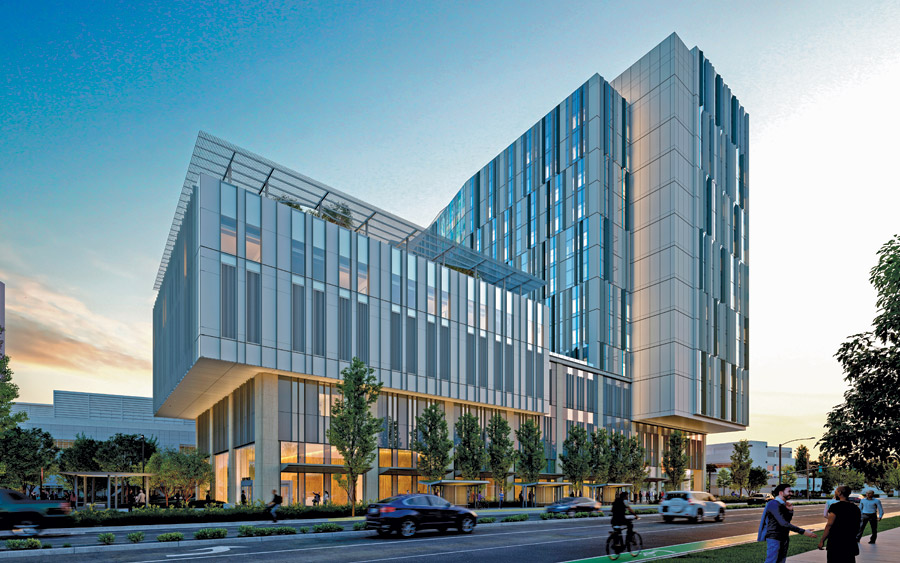
Once complete, California Tower will bring 1 million sq ft of seismically sound hospital space to UC Davis Health’s Sacramento campus.
Image courtesy of SmithGroup
Situated in the middle of the health care campus, the 14-story California Tower is rapidly progressing. Delivered as a progressive design-build—a first for UC Davis Health—the project’s team includes SmithGroup on design and McCarthy Building Cos. on construction.
“This model of delivering health care is not consistent with every client because it takes early engagement and a lot of experience,” says John Stanley, vice president of operations at McCarthy. “UC Davis Health has folks on their side who can really work with us throughout the process. This takes a full integrated effort, and that’s unique.”
After breaking ground in 2024, crews focused on structural work, culminating in the project’s topping out at the end of 2025. Since then, the team has been placing concrete decks and starting interior build-out, Stanley says.
“A world-class university needs world-class facilities to conduct research that benefits humans, animals and our planet.”
—Gary S. May, Chancellor, UC Davis
“In the last month, we’ve started the exterior enclosure,” he continues. “It’s a curtain wall system, glass and aluminum and stone.” The goal is to enclose the structure by winter. Around 700 workers are on site daily, with plans to grow that to around 1,200 workers later this year.
“Currently, we’re running a little bit ahead of our project schedule,” Stanley says. “I think that really speaks to the collaborative nature of this job. It takes a lot of collaboration to get a project of this scale to be tracking ahead.”
As for existing spaces, the North-South Tower, one of the original 1920s structures, was decommissioned and its utilities separated in 2025 to comply with the California Dept. of Health Care Access and Information (HCAI).
“We haven’t demolished it because it is literally like a sandwich attached to its neighboring building that’s fully occupied, the East Wing. It does not have those same seismic requirement deadlines,” Tomczyk explains. California Tower will absorb all the beds from both structures by 2030, so “whether you tear the building down or not, HCAI doesn’t care. They just care that you move all the patients out and decommission the buildings,” she adds.
But adding all this new square footage would be meaningless without the ability to support it at the patient, facility and utility levels. Everything is built to a plan, Tomczyk says.
“Otherwise, you end up with a whack-a-mole approach, where we’re building this in reaction to that. We have to have a vision that says what are we trying to achieve—and Vision 2030 was really about seismic compliance,” she says. “But that’s not all. We had an opportunity when we were programming all of this to look at our existing facility from a more holistic standpoint.”
As a result, other projects have spawned from the tower effort, such as the 270,000-sq-ft 48X Complex (named for its location at 48th and X streets), which opened in July 2025 and took outpatient services outside the hospital. Another is the central utility plant expansion that will include 2,000 linear ft of electrical pathways, 9,000 sq ft of renovations and a new 40,000-sq-ft annex building.
“All this stuff is happening in the 24/7 inpatient setting, which is impossible to shut down. So it’s very, very carefully phased and then executed,” Tomczyk adds.
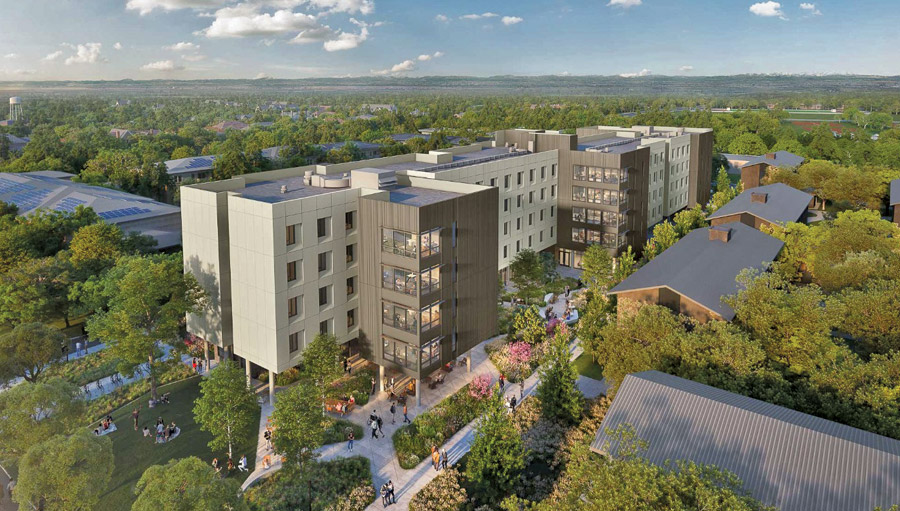
The $100-million Segundo Infill Housing project will bring 600 beds to the Davis campus when it opens in fall 2027. Gensler is the architect and McCarthy is the contractor.
Image courtesy of Gensler
New Approaches
Included within the 7 million sq ft that falls under Vision 2030 is the first phase of Aggie Square, a $1.15-billion, 728,000-sq-ft mixed-use facility that co-locates university researchers and private industry.
“It’s an approach that we haven’t undertaken on a large scale before,” Kawahara says. “Much of the research at Aggie Square is focused around life sciences.”
Two primary buildings—one with wet lab space and the other with dry research space and classrooms—are complemented by student housing and a mixed-use residential building. The project was delivered under a public-private partnership (P3) that includes UC Davis, the city of Sacramento and Wexford Science & Technology.
“Phase 1A is complete insofar as the buildings, and we are occupying those now,” Kawahara says. “Due largely to market conditions, the one element that has yet to materialize in a significant way is the private industry side of the buildings. So the university side is essentially done, but the private industry side is TBD.”
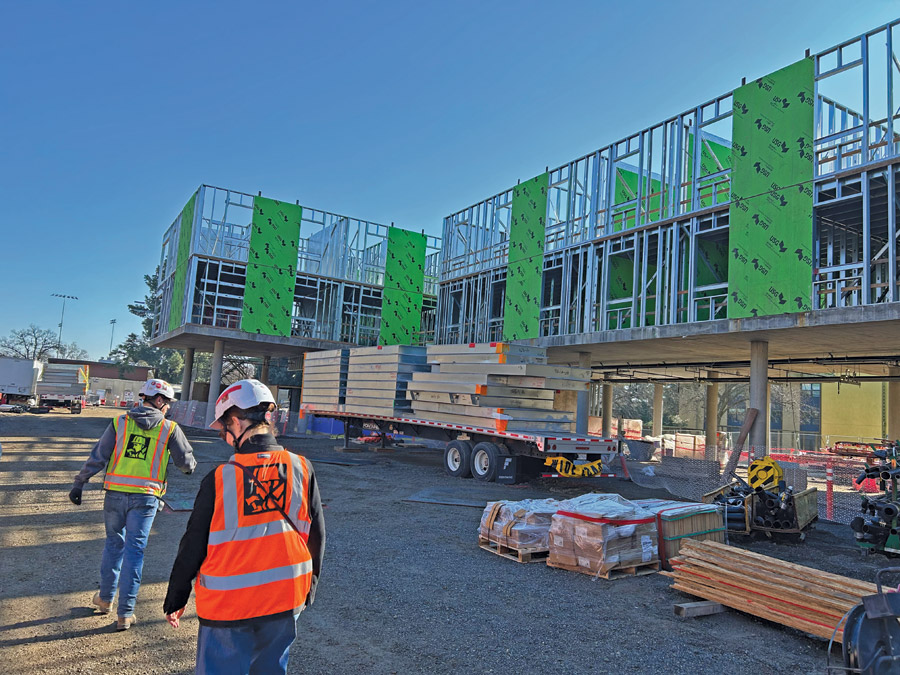
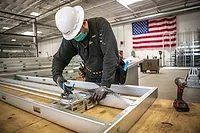
Workers monitor the installation of a prefabricated panel system at the Segundo project in January.
Image courtesy of UC Davis
A second wet lab building will be built on another parcel, but that portion, dubbed Phase 1B, is also waiting on the market and a private tenant to anchor the space.
While there are further phases planned, how those will take shape is to be determined. But Kawahara believes this first phase will help inform the phases to come and even future iterations of the concept.
While some universities remain steadfast in the delivery methods they choose, UCD has been exploring new possibilities and actually has deep experience in P3s.
“At UC Davis, we don’t view P3s as only an alternative tool for financing and delivery. We really lean into the value of the partnership long-term,” says Kawahara, noting that some of the earliest ones were done back in the 1980s.
More than 4,500 beds have been delivered on the Davis campus since 2020 using P3s. And construction just started on the $16.8-million Veterinary Genetics Laboratory, another P3, which will open at Aggie Square in 2027.
“What I hear consistently is people come here because the work itself is very special.”
—Julie Nola, Associate Vice Chancellor and University Architect, UC Davis
“On our larger projects, it’s really helpful to have the contractor at the table during design because they add value—they bring constructability and are closest to the pricing,” says Julie Nola, associate vice chancellor and university architect. “What I hear consistently is people come here because the work itself is very special. People want to build here, and they know we’re open and honest with our partners.”
With California Tower, UC Davis Health decided to try a delivery method they hadn’t done before: progressive design-build.
“It had really only been successfully done at UCSF. And since then, this delivery method has been spreading to several of the other UCs,” Tomczyk says. Health has since added four more progressive design-build projects.
Utilizing these newer delivery methods helps UCD be seen as an owner of choice, especially with so much competition in Northern California for contractors and among health care systems.
“By having that type of a new project delivery, you attract the type of talent that you want because it allows them to work with a public agency in a much more fair and transparent way,” she says.
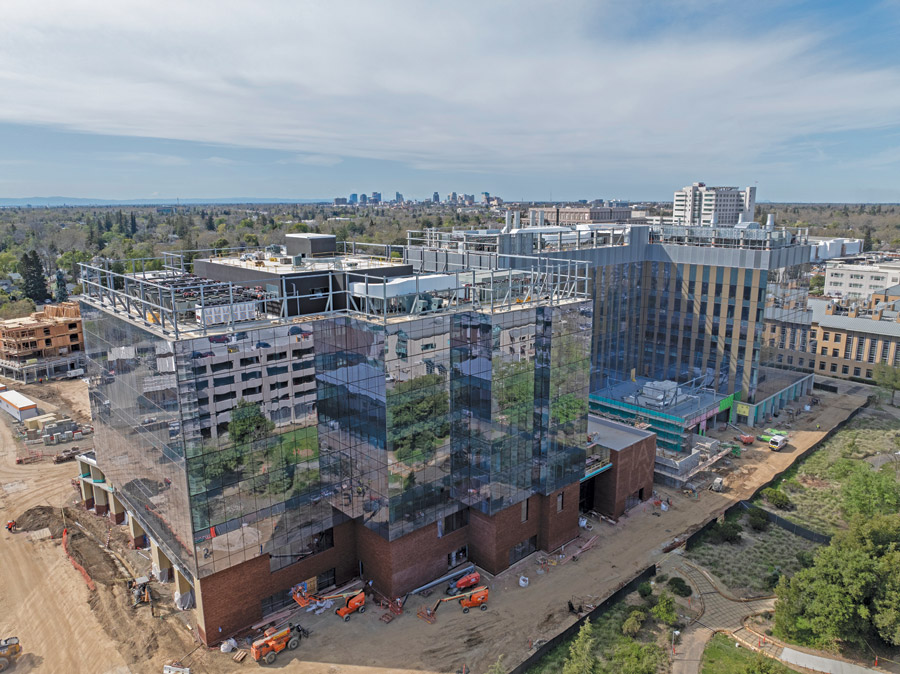
The first phase of Aggie Square is a $1.5-billion, 728,000-sq-ft mixed-use facility hosting university researchers and private industry.
Photo courtesy of UC Davis
More Ahead
Later this year, the $66.4-million Resnick Center for Agricultural Innovation is set to open. And more than $500 million in projects are moving as part of the Weill School of Veterinary Medicine’s capital expansion. Two projects will be let for design-build contracts this year: the Veterinary Education Center and the Small Animal Hospital. Meanwhile, the $19.5-million Hobbs Veterinary Medical Center and $8.2-million Equine Rehabilitation Center are both opening in 2026.
“We’re doing significant infrastructure work on the campus too. In many ways, we function like a small city with our own wastewater treatment plant and electrical substation. Currently, we have invested $180 million in the first two phases of our Big Shift project which replaces an old, gas-powered heating infrastructure system with a more sustainable one,” says Nola, noting that UCD is the first UC to convert. “We have our $38-million water treatment plant as well that we’re building on our West Campus to improve water quality and reliability.”
On the student housing front, the $100-million Segundo Infill Housing project will add 600 beds when it opens in 2027. Another 1,000 beds are on the horizon as part of a replacement project for the 50-year-old Regan Hall as well.
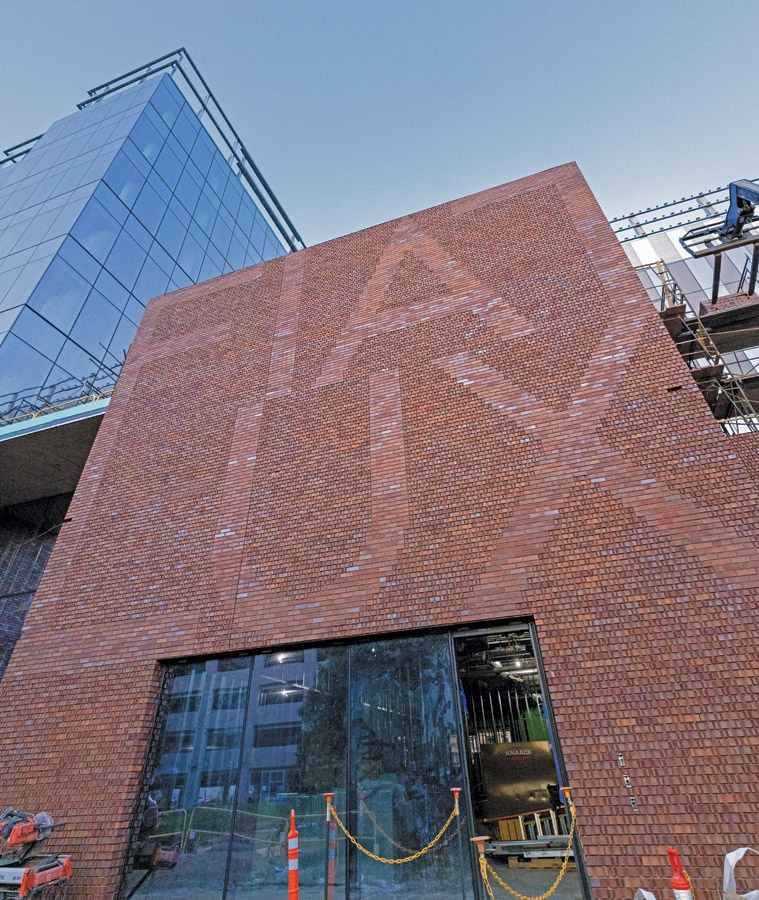
The brickwork on part of Aggie Square features the motto of the University of California, “Fiat Lux” or “Let There Be Light.”
Photo courtesy of UC Davis
Tomczyk points to the university’s ability and willingness to try a different approach when working with industry partners and listening to their suggestions.
“One of the things we did at the beginning was we got a lot of feedback from the big builders in the area on what would make them want to come work with us. And they wanted a sophisticated way to deliver projects, and they wanted to feel like they were partners,” she says.
Although the university won’t be done paying for all this current development until after 2030, plans are perpetually in the works. Multiple studies are underway to explore expansions, where they could sit, what’s needed to make way and more.
“People in my position now, we have to prep for setting up our successors for being able to either build more or tear down easily in order to expand more. The studies are super exciting because they show you the possibilities,” Tomczyk says.