Digging Deeper | Highway/Bridge
Unjamming Atlanta’s Outdated I-285/I-20 East Interchange
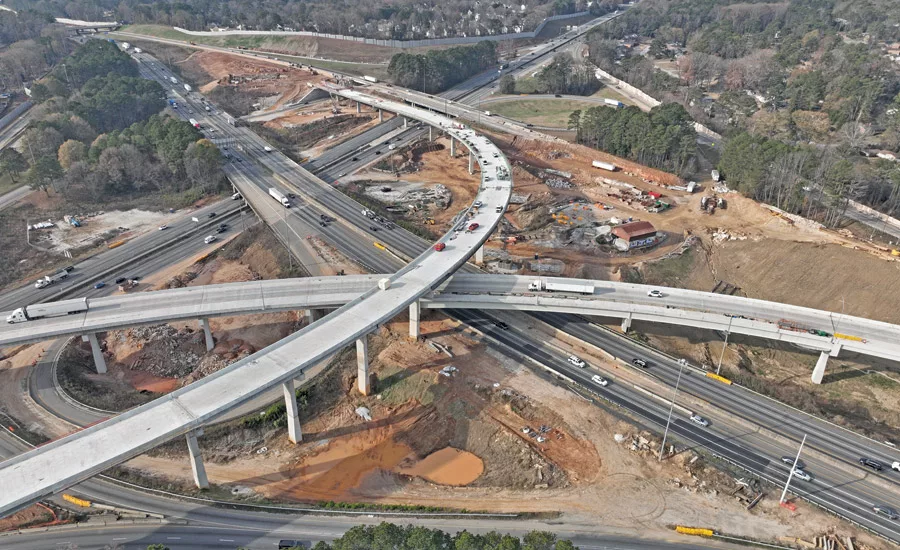
When complete, the troublesome junction should be one of the safest in the state, says GDOT.
Showman P.T. Barnum’s adage of “no such thing as bad publicity” may be true in some fields, but it’s certainly not something a state transportation agency wants.
For example, the I-285/I-20 East interchange in Dekalb County, east of Atlanta, had for years stood apart in a rapidly growing region rife with corridor capacity challenges. As a nexus for a mandatory bypass route for commercial vehicles around the metro area, the interchange’s outdated ramp geometries and other deficiencies were no longer sufficient to effectively handle ever-increasing volumes of traffic on two busy interstates. Over time, the interchange’s reputation has become more widely known, including the recent dubious distinction of placing 14th on the American Transportation Research Institute’s 2025 list of the nation’s top 100 truck bottlenecks.

The revamped I-285/I-20 East Interchange should greatly reduce bottlenecks.
Photo courtesy Georgia Dept. of Transportation
The Georgia Dept. of Transportation had long recognized that resolving the I-285/I-20 East interchange’s woes would be neither easy nor inexpensive, particularly given the extensive structural work required to modernize ramp configurations and add capacity without creating short-term mobility problems in the process. Yet by the end of 2026, the long troublesome junction will be one of the safest and most efficient interchanges in the state, thanks to a four-year, $692-million reconstruction effort that is creating wider, realigned ramps; new collector-distributor lanes; and auxiliary lanes for merging westbound and northbound traffic.
“They can target impactful changes that result in maximum benefit.”
—Greg Munna, Senior Project Manager, East Interchange Builders, speaking about the Archer Western/E.R. Snell project team
Because the reconfiguration of the interchange is part of GDOT’s Major Mobility Investment Program (MMI)—a collection of high-priority improvements delivered through alternative delivery methods—the agency was able to use design-build-finance (DBF) project delivery. GDOT has previously used the public-private partnership variation on other MMIP efforts, including the I-75/I-575 Northwest Corridor Express Lanes and the Transform 285/400 project.
Beau Quarles, GDOT project manager, says the DBF delivery model was well suited for the I-285/I-20 East interchange’s scope, cost, risks and accelerated timeline.

The project included the phased construction of a mainline I-20 bridge over Snapfinger Creek.
Photo courtesy Georgia Dept. of Transportation
“Along with limiting traffic interruptions for motorists—a critical consideration at this interchange—we could leverage the private sector’s ability to assemble capital to advance a project that otherwise would wait for state or federal funding,” he says. “There were also opportunities for project cost savings and improved quality and system performance from the use of innovative materials and management techniques.”
The East Interchange Builders Consortium (EIB), led by two of Georgia’s largest transportation contractors—Archer Western Construction LLC and E.R. Snell Contractor Inc.—brought the additional advantage of familiarity with the agency, the project delivery processes and the interchange’s many complexities.
“The Archer Western and E.R. Snell team is very familiar with the existing interchange, with both companies having personnel living in the area for decades and driving through these corridors,” says Greg Munna, EIB senior project manager. This familiarity also helps the design team, made up of lead designer Infrastructure Consulting & Engineering working with subconsultants Arcadis, STV Inc. and Raba Kistner.
“They can target impactful changes that result in maximum benefit for commuters,” Munna says.

The $692-million reconstruction is creating wider, realigned ramps; new collector-distributor lanes; and auxiliary lanes for merging westbound and northbound traffic.
Photo courtesy Georgia Dept. of Transportation
Strategizing for Success
Ramping up for the start of construction in 2023, the EIB team invested in an extensive preconstruction planning process that would allow work to proceed as efficiently and safely as possible while maintaining traffic in a way that wouldn’t compound the interchange’s existing headaches. To maintain project schedule, for example, Quarles says the project was broken down into manageable design packages. For each one, he says, “the project team set key milestone dates and held itself accountable from all sides to ensure that the project progressed as planned.”
The schedule also helped the team plan for traffic diversions and closures once work got underway to integrate new infrastructure elements into the interchange complex, including the phased construction of a new mainline I-20 bridge over Snapfinger Creek. The team was able to consolidate major tasks into one short-term and one long-term detour to expedite progress and minimize congestion on the two interstates and surface streets. Full interstate closures, when needed, would be limited to nights and weekends.

For the interchange bridges, the project team used single 8-ft-dia and 10-ft-dia drilled shaft foundations for each bridge pier rather than a two-column bent structure.
Photo courtesy Georgia Dept. of Transportation
One design feature that would prove instrumental in helping expedite construction of interchange bridges was the use of a single 8-ft-dia and 10-ft-dia drilled shaft foundation for each bridge pier, rather than a two-column bent structure.
Single column foundation shafts “offered the advantages of a reduced foundation footprint area.”
—Beau Quarles, Project Manager, Georgia DOT
The foundation shafts, which reached depths of as much as 116 ft, “offered the advantages of a reduced foundation footprint area and eliminated support-of-excavation efforts that otherwise would’ve been required for a traditional pile cap design,” Quarles says, adding that the up-front preparation has paid off in nearly four years of relatively issue-free construction. Indeed, the only real surprises were some undocumented utility lines and a few isolated areas of unsuitable material deemed to be the result of subsurface conditions.
“These locations were identified and plan changes were incorporated quickly to maintain the pace of the project,” Quarles says.
The project’s DBF structure offered other advantages for helping the EIB team manage still volatile material costs. Taking advantage of an option to select material indexation adjustments for seven commodities, EIB chose to index asphalt cement and steel H-piles for the nearly 757,000 linear ft of noise walls.
Quarles notes that while some minor supply chain issues arose, “the team developed detailed schedules with the suppliers to ensure the materials dates were understood well in advance of the delivery date.”

The interchange at an early stage of the reconstruction project.
Photo courtesy Georgia Dept. of Transportation
Consistent Connections
According to GDOT, with major project milestones completed and more to come in the next few months, the reconstruction has been largely successful in maintaining the set schedule while also navigating weather and other challenges. Along the way, the EIB team has installed more than 30,600 linear ft of concrete girders and 10,000 linear ft of steel girders, poured concrete for nearly 11,400 cu yd of bridge decks and erected nearly 117,000 sq ft of mechanically stabilized earth walls.
Perhaps the most essential ingredient to the project’s success, Quarles says, has been ongoing efforts to facilitate teamwide communication. Co-locating the project leadership, for example, helped align objectives, identify potential pinch points and areas of potential conflict while facilitating and fostering information sharing and collaboration.

A comprehensive construction phasing strategy has helped minimize traffic disruptions throughout the project.
Photo courtesy Georgia Dept. of Transportation
“This helped us to share information, discuss issues and make timely decisions to keep the project moving forward without any delays,” he explains. “Having a strong GDOT representative on hand helped enable timely decisions rather than create bottlenecks.”
“Having a strong GDOT representative on hand helped enable timely decisions.”
—Beau Quarles, Project Manager, Georgia DOT
Because potential conflicts are inevitable in any construction project, the I-285/I-20 East interchange marked GDOT’s first use of a three-member dispute resolution board (DRB), chaired by an attorney with representatives of GDOT and EIB, and charged with working through technical issues as well as managing potential claims or disputes over time or money.
“Each member has extensive experience in claims and mediation, design and major project construction management,” Quarles says, adding that the panel “has served as a successful prototype for future major projects across the state.”
Alerting the traveling public to construction-related changes in roadway conditions was no less important. “Communication was done early and often,” says GDOT spokesperson Kyle Collins. “Public meetings, social and traditional media coverage and weekly traffic impact updates were just some of the tools we’ve used.”

The revamped interchange improves on the old cloverleaf design with gradually curved flyover ramps and fewer traffic conflict points.
Photo courtesy Georgia Dept. of Transportation
Elements of the reconfigured interchange are scheduled to be put into service throughout the remainder of 2026. This spring will see the opening of new collector-distributor lanes and flyover bridges linking I-20 westbound to I-285 as well as the new I-285-to-I-20 eastbound connecting lane and I-20 mainline bridge over Snapfinger Creek. Noise wall construction, site restoration and other tasks will continue into the summer and fall.
Munna has high praise for the project-long collaboration and the project delivery model that made it possible. He calls the project “a great example of the private-public partnership model and how, through teamwork and coordination with GDOT, we’ve been hard at work on delivering an impressive new interchange on schedule to a corridor that was critically in need of updating.”
Quarles agrees. “EIB has been a great partner on this project. At the end of the day, their success is GDOT’s success.”