ENR MidAtlantic Owner of the Year: Enterprise Community Development: Creating Healthy and Resilient Communities
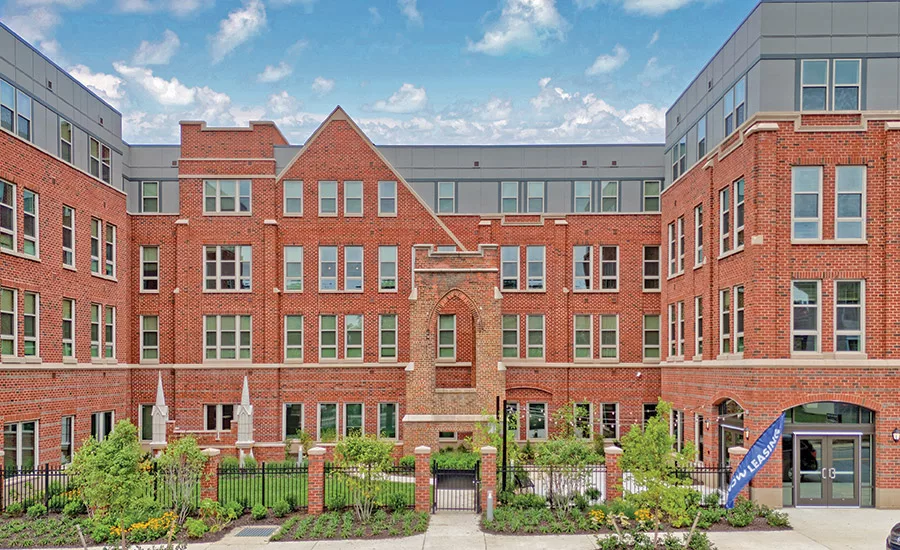
Enterprise Community Development recently celebrated the opening of Highland Terrace Apartments, a 66-unit affordable housing property in Richmond.
Enterprise Community Development is the largest nonprofit affordable housing provider in the MidAtlantic region and sixth largest in the U.S. According to the company, its $1.25-billion portfolio spans 115 communities and 13,000 homes serving more than 24,000 residents across Maryland, the District of Columbia and Virginia.
Part of a national organization that focuses on all aspects of affordable housing, from concept to operation, the company aims to build aesthetically pleasing, sustainable and inclusive communities. Its commitment to affordability, innovation and community engagement has fostered development of a successful and growing clean energy practice focused on a number of multifamily assets in the firm’s existing portfolio. This includes solar generating systems totaling nearly 7 MW at nearly 30 existing properties in Maryland and Washington, plus more than 5 MW developed off site through partnerships.
In addition to overseeing new construction and renovation work with both affordable and mixed-income elements, the company seeks to boost participation in developing projects through programs such as the Let’s Build Accelerator, a model by which it works jointly with community and faith-based organizations to bring neighborhood-oriented ideas to fruition.
Janine Lind, firm president since 2024, spoke with ENR Correspondent Jim Parsons about how the company addresses challenges to meet the rising regional and nationwide demand for affordable housing amid the complexities of strained funding resources. Their conversation has been edited and condensed.
A look at some of Enterprise Community Development’s most recent projects:
Ranleagh Court and Waverly Winds, Columbia, Md.
Totaling $112 million, the projects transformed two 1960s-era complexes to create more than 200 energy efficient units with numerous amenities. Harkins Builders Inc. was the contractor.
Edgewood Commons V, Washington, D.C.
Part of the larger Edgewood Commons campus, the newly completed project provides 150 accessibility-focused units to support independent living by seniors and features 18,000 sq ft of amenity and service space.
New Projects on the Horizon in Virginia
In December 2025, Enterprise Community Development received more than $7.4 million in financing from the Virginia Dept. of Housing and Community Development’s Affordable and Special Needs Housing program to advance a 96-unit affordable housing community in Waynesboro and rehabilitate the 60-year-old, 106-unit Coralain Gardens apartments in Fairfax County. No construction start dates for the projects have been announced.
What’s the market landscape for public and mixed-income projects? What’s made doing them more challenging?
It’s definitely more complicated and challenging today. Interest rates and construction costs that went up during COVID-19 really have not come down, although in recent years we see pricing holding from original bids. However, there are still supply chain pressures as well as higher insurance and operational costs. Unlike a market-rate building, where you may have two or three sources of capital, we need several additional layers to fill gaps. Fortunately, demand and need for housing is such that everyone at the local, state and national levels wants to find ways to build affordable housing faster, bring our costs down and collaborate in public-private partnerships to make the projects happen.
Enterprise Community Development has also increased the number of renovation projects in its portfolio. Is that a new focus for you?
If we focus too much on new construction, we risk losing affordable units in existing buildings that need upgrades. Preservation of existing properties will be a focus for us in the next five to 10 years, and we’ve been working with governments to set aside funding for these projects.

“We are very much committed to the MidAtlantic.”
—Janine Lind, President, Enterprise Community Development
Do you work with the same group of contractors for your MidAtlantic projects or can any firm get involved?
We have a mix of long-standing partners, but we always welcome new partnerships. We have several programs that target small, BIPOC developers, and we look to do the same with our construction partners. We also look for our general contractors to work with smaller minority firms to help them succeed in this business. Local market knowledge is really valuable for us as well. Permitting, entitlements and design reviews can be challenging to navigate sometimes. You have to understand that [in order] to work effectively and not cause more complexity or delays.
Your company has made a strong commitment to incorporate clean power and other sustainability elements into its projects. Is this easier or more complicated in recent years?
Enterprise Community Development works to partner with public and private stakeholders to help accelerate meeting energy needs of low-income housing communities, both inside and outside our portfolio. Unfortunately, many federal-level clean energy incentives are currently being phased out, yet electricity prices are continuing to escalate. To that end, we are committed to continue pursuing efforts to green and decarbonize, pursuing partnerships for offsite solar, maximizing incorporation of EV charging stations, building out battery resilience hubs at a number of properties and implementing energy efficient retrofits across the portfolio where feasible. The technology is changing, so we do strive to keep up with new products. We want to test new things but also want to make sure implementing them is the right thing to do.
How is the Let’s Build Accelerator initiative helping create more opportunities to develop affordable housing projects?
It’s gratifying to us as an organization to provide mentorship, coaching and technical support to help these developers put their capital stacks together and be next to them throughout the project. All communities have a need for new housing, and everyone can play a role.
Is there one recent project that you feel evidences what Enterprise Community Development brings to its work?
We’re about to celebrate the “re-grand opening” of Park Heights Place, a building that serves seniors in Baltimore. The project had a complex financing structure as well as added complexities to improve efficiency and quality of life through interior and building system upgrades—all while remaining occupied by seniors. We brought our partners together to make it as easy as possible for the residents.
What are company plans for the future?
We’re very committed to the MidAtlantic. In our pipeline this year, we have eight new construction and renovation projects totaling just under 700 units. That’s in addition to 10 projects either under construction or in lease that are delivering more than 1,000 units. We’re also looking at increasing mixed-income communities across Maryland, Virginia and Washington.
What’s the most important construction-related lesson learned from your experience in this sector?
Strong preconstruction planning and having that process in-house. Engaging across teams and having them be a part of it from Day 1 when you’re conceptualizing a new community is really critical to project success. Collaboration and strong partnerships are important too. Building relationships and bringing them into your world is really critical for success in this sector.