Energy/Industrial
Baltimore Utility Sidelines Underground Transmission Line Project
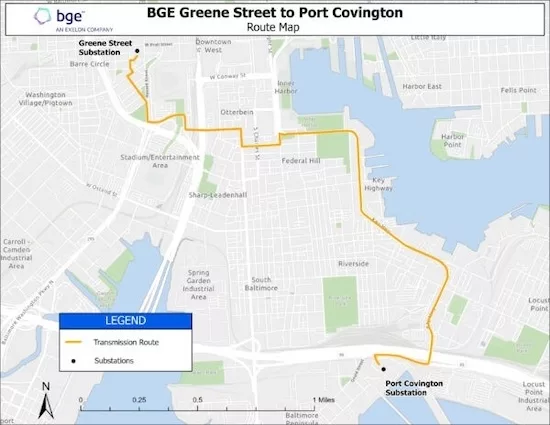
Community and political opposition has halted underground transmission line set to start construction in downtown Baltimore area formerly known as Port Covington.
Baltimore Gas & Electric is “temporarily pausing” a controversial underground transmission project through areas of downtown Baltimore as project costs rise and community and political opposition grows.
The project, scheduled to begin construction next year, is aimed to connect an expanded substation west of downtown with a new distribution facility in an area of South Baltimore formerly known as Port Covington, where a planned 235-acre mixed-use redevelopment has been underway since 2016. Along with the new and expanded substation, the infrastructure would include a total of four 115 kV underground transmission lines.
Estimated in 2019 by the utility's parent firm Exelon as a $109-million project, a cost update the latter posted on Feb. 3, indicated the estimated infrastructure build-out as a $407-million project, with the increase attributed in part to 27% and 50% increases in costs of labor and materials, respectively, as well as “early procurement of long lead equipment, added contractor crews and extended work windows.”
The document also notes that the current design requires a “non-traditional two-story GIS buildout to fit on the usable portions of the land,” said Baltimore Gas & Electric, and a technology it is using for the first time. The utility said using that process “requires vertical routing of cable and auxiliary systems, enhanced fire protection and life safety provisions, and more complex construction sequencing due to limited laydown and access.”
Local news sources have estimated that electrical distribution infrastructure already committed by Baltimore Gas & Electric for the redevelopment effort, now rebranded as Baltimore Peninsula, could potentially push the total cost beyond $500 million.
Although the cost of the new transmission and distribution infrastructure would not be passed on to ratepayers until the system was operational, said Baltimore Gas & Electric. local residents raised concerns about the project’s potential effects on utility bills already affected by demand- and infrastructure-related increases, as well as the prospect of disruptive construction in several historic neighborhoods. The utility said the added costs for the new infrastructure would be spread across thousands of ratepayers over several years, and that the route had been chosen both for “technical feasibility” and to accommodate separate circuit routes to lower the risk of system disruptions.
Opponents have also questioned need for the project, given the slow pace of development at Baltimore Peninsula, where only a fraction of planned 14 million sq ft of new office, residential and retail space has been built. They also criticize the apparent absence of government oversight, as Maryland law currently exempts most underground transmission projects from review by the state’s Public Service Commission. Several key state legislators have vowed to eliminate that exemption through measures introduced in the current General Assembly session.
In a statement announcing the project pause, Baltimore Gas & Electric calls it “a deliberate step” that allows the utility to deepen engagement with local residents and community leaders, incorporate updated development plans from Baltimore Peninsula’s owners and review recommendations raised local leaders.
Baltimore Gas & Electric noted that the new transmission line is part of a “bundle” of other needed transmission upgrades for the area, regardless of projected increases in load demand from within and around Baltimore Peninsula. The project, “also addresses reliability risk from critical transmission and distribution infrastructure that dates back to the 1950s," the statement added. "That risk grows each day this aging equipment stays on the system.”
A statement posted on social media by State Senate President Bill Ferguson (D) characterizes the utilitty’s decision as “what happens when neighborhoods and elected officials organize to hold utility companies accountable to the customers they serve.”