Government/Public Building
NJ $310M Women’s Prison Design Replaces Troubled Penitentiary
The 420-bed Edna Mahan Correction Facility for Women in Chesterfield Township will break ground later this year
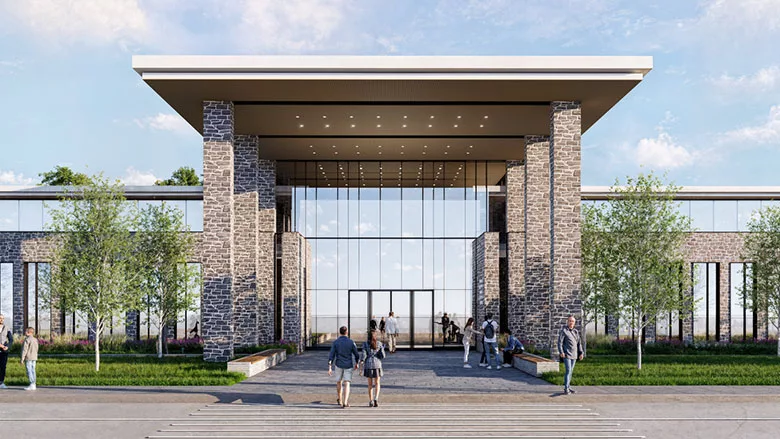
A $310 million New Jersey women’s prison is scheduled to start construction by the end of the year.
A $310 million New Jersey women’s prison is designed as a “more humane” replacement to an embattled facility closing after 112 years in operation, project officials say,
Set to start construction in Chesterfield Township by year end, the replacement Edna Mahan Correctional Facility for Women is sited four miles from the existing one—where more than one dozen correctional officers were arrested in 2021 for sexual abuse, corruption and other violations. Former Gov. Phil Murphy ordered closure of the outdated and decaying prison.
“The new facility is being developed to present a normative environment for incarcerated women,” says Gary Thomson, a program executive at Skanska, the project contractor, “with a campus approach that creates neighborhoods and program space offerings to ready the women for re-entry into society.”
The design follows a trend during roughly the last decade to shift away from hard, punishing materials in designing jails and prisons, with architects encouraged to take a softer approach.
In a Q&A on the website of architect HOK, which has designed many justice architecture projects, Kristine Bishop Johnson, a director of its global Justice practice and former chair of the American Institute of Architects Academy of Architecture for Justice knowledge community, said deploying trauma-informed design on prison projects provides supportive environments “truly focused” on rehabilitating those dealing with psychological or physical ailments stemming from addiction, poverty, prior neglect or being separated from family and friends while incarcerated.
“Having them sit in a hardened cell to dwell on their problems does not promote the healing they require or provide them the tools needed to re-enter society,” she said.
Skanska’s Thomson says the New Jersey project design replicates “self-contained communities” with a goal of creating a “non-intuitional setting" that includes elements such as “indoor and outdoor spaces which are comfortable and livable, promote the incarcerated person’s sense of identity and dignity, enable an expanded level of choice of approved activities and mobility within the housing units, program areas and exterior spaces.”

The prison’s design includes self-contained communities with a goal of creating a non-intuitional setting with elements such as comfortable indoor and outdoor spaces.
Rendering courtesy HOK
Growing Pains
While overall U.S incarceration rates have declined in recent years, those for women have soared. Since 1980, the number of imprisoned women rose seven-fold—from 26,326 in 1980 to 186,244 by 2023.
Jurisdictions are responding to this growing incarceration rate in different ways. While some advocates push for alternatives to prisons, saying the U.S. has far too many, others are choosing to replace outdated facilities with new designs. “There are still often not enough [women] to fill a new large facility,” said Richard Wener, a psychologist who has studied the environmental psychology of prisons and jails. “That’s the plight–if they share a part of a prison, they get fewer facilities and restricted movement, so they won’t interact with men, but have to have a lot of [women] to justify building.”
Thomson notes that the New Jersey project’s campus-style design could potentially be adapted to a fluctuating population.
“The campus design allows for growth if necessary and the flexibility of multiple housing units [and] living spaces may have the ability to constrict if the future brings a less robust population,” he says.
Wener believes communities should consider investing in alternatives to prisons such as home confinement with electronic monitoring because incarceration is the most expensive option and most likely to cause harm to already traumatized incarcerated people, even with “good design and good intentions.”
Women who are incarcerated should be placed in “the best environments,” he adds— especially because many incarcerated women are mothers and therefore should be placed in “normalized settings” where they can interact with their children. It’s also important for the women to be able to do things such as cook for themselves. “If they are placed in prison, better places with better design helps,” Wener says. “But still, [they] should have the fewest possible people incarcerated.”
Bishop Johnson said pre- and post-trial justice facilities “are not going away anytime soon, so why not work on making them more conducive to the needs of those in custody as well as to staff and visitors? Why not use our seat at the table with lawmakers and facility operators to educate them as to how spatial and operational impacts can support rehabilitation and lower recidivism rates?”
She noted that HOK does not design facilities with solitary confinement or capital punishment spaces and does not work for private prison operators or design facilities meant specifically for holding undocumented detainees.
The state Dept. of Correction also engaged with experts outside of the design community as the building process began, includng "current incarcerated women, community stakeholders, medical and mental health professionals, along with custody and civilian staff," Thomson said. "Our team has also solicited input from important user groups including staff."
Choices of materials, finishes and colors will also help achieve this “non-institutional” atmosphere, as well as “natural daylighting and a connectivity between interior spaces and landscaped exterior features,” he added.
Early Work
Set to be built on an existing state site set back from a main road, the prison is not expected to impact the surrounding community when it opens in 2027 and set to be fully completed in early 2029.
Early phase work consists of upgrading existing water and wastewater treatment plants that now operate onsite and will service the new facility, a Skanska spokesperson said.
Thomson added that the team is “closely monitoring the cost and availability of materials and equipment and will decide if we need to prepurchase to ensure that [they are] ready when needed in the field according to our master schedule.”