City Scoop | Los Angeles
Los Angeles Likes the Look of the Future
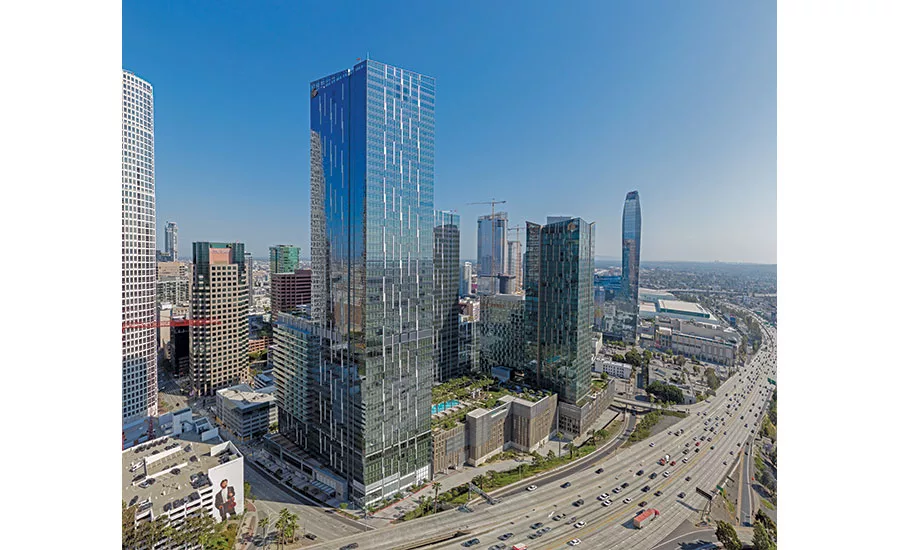
PENTA partnered with Pankow to construct the 56-story, 1.1M-sq-ft Metropolis Residential Tower R3 in downtown Los Angeles.

Paul Dutmer
Vice President, Southern California
The PENTA Building Group
For the past few years, Los Angeles and the wider Southern California region have been on a steady upswing in terms of construction projects. That trend is something the AEC community is expecting to continue, says Paul Dutmer, vice president for Southern California at The PENTA Building Group.
“The 2026 construction outlook in Los Angeles appears very active with strong momentum,” he says.
There are quite a few AEC firms in the Los Angeles region boasting strong revenue growth, healthy backlog and multiple project opportunities. “Owners are prepared to build, with projects at various stages of planning and construction—which is great,” Dutmer says.
The positive atmosphere is expected to be bolstered by the efforts to prepare for the 2028 Olympics.
“While few Olympic-specific projects have fully started, momentum is building, mostly through early discussion and planning,” Dutmer says.
He says projects are likely to accelerate in the hospitality space, which will host the massive influx of travelers expected to flood the city to witness the world’s largest global sporting event. There will also be a need to construct temporary structures, facilities and utilities to support visitors.
At ENR’s Los Angeles Infrastructure Forum in November, officials again touted the Twenty-Eight by ’28 initiative, which aims to complete 28 major transportation infrastructure projects before the 2028 Games. LA Metro alone boasts a $35-billion program of 60 projects in the works.
“As promising as that level of opportunity sounds, this environment also brings risks,” Dutmer warns.
General contractors will have to carefully weigh factors such as project location and labor availability when deciding which projects to pursue. Additionally, the growing number of projects could strain the capacity of subcontractors. Firms will need to be smart about staffing and diligent in planning to maintain quality control and ensure contract schedules are met. “Overall, the market is healthy, yet demanding,” he says.
Dutmer says PENTA recorded a record year in Southern California in 2025 and has similar expectations for 2026. Statewide, PENTA tallied $1.164 billion in revenue for 2024, ranking 20th in ENR West’s tally of Top Contractors last year.
Dutmer points out that construction’s strong regional momentum is seen across a wide range of submarkets, “though each area has its own execution risks.”

He says project-type diversification is visible across higher education, health care, tribal gaming development, public works and hospitality/entertainment.
Information compiled by Dodge Data & Analytics on construction starts indicates that construction starts for the Los Angeles region this year will total more than $30 billion, up 15% from 2025. Non-residential starts are expected to lead the way with $11.8 billion in starts, but residential starts will accelerate sharply after falling back last year.
A standout current project for PENTA is the Los Angeles County Puente Hills Regional Landfill Park, which is currently under construction on its first phase.
The project involves transforming a 142-acre former landfill—once the nation’s second-largest—into a sustainable park space. Works also include a new Environmental Justice Center and operations and maintenance facilities.
“We’re glad to be working with LA County Public Works long-term master plan to redevelop the landfill into a major regional park,” Dutmer says.
The region is not immune to industrywide issues, but their impacts have been muted thus far. Tariffs, for example, have prompted companies and owners to adjust and budget for them. Cost escalation driven by long permitting or construction delays is a more present worry.
“Even a 3% to 5% increase can affect project viability, so contractors continue to factor inflation into bids and revisit costs if schedules are affected,” Dutmer says. And due to the famed Los Angeles congestion and limited space, logistics are tougher, forcing firms to find innovative solutions.
“Deliveries, crane placement and staging require careful planning,” he says. “This has increased the use of prefabrication, which improves efficiency, reduces safety risks and helps manage complex urban projects.”