City Scoop | Little Rock
Arkansas Population Boom Spurs High Demand for Buildings, Infrastructure
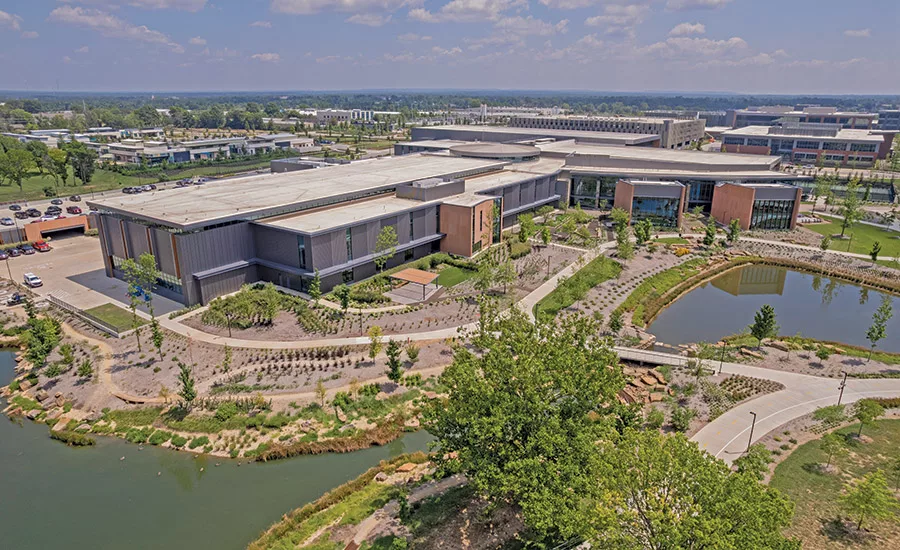
Walmart’s new multibillion-dollar 350-acre campus in Bentonville will include 2.4 million sq ft of space for offices, services, parking decks and amenities.

Ted Vuong
Managing Principal
Walter P Moore
From Little Rock to Bentonville, the largest population centers in Arkansas are seeing significant growth, creating demand for both building and infrastructure projects to support existing residents and businesses while planning for the future.
Demand for construction projects to support population growth has been particularly high in Northwest Arkansas. Between 2010 and 2024, the area’s largest metro areas all saw significant population growth, including Fayetteville (39%), Bentonville (73%), Rogers (34%) and Springdale (25%). With that growth, neighboring suburbs are also feeling the surge. In Farmington, just outside Fayetteville, the number of building permits issued by the city more than doubled between 2024 and 2025.
In 2024, the Northwest Arkansas Council estimated that the northwestern region was adding 36 people per day. The council estimates that by 2050, the region’s population could nearly double, reaching more than 1 million people.
“From a market standpoint, the residential market is booming,” says Ted Vuong, managing principal at Walter P Moore. “They can’t build houses fast enough here.”
In larger cities, apartments are the main residential focus, which Vuong says underscores the need for more walkable, pedestrian-friendly neighborhoods. With residential demand comes other needs, spurring new commercial, institutional and infrastructure projects. Along with that, Vuong sees new retail stores and restaurants popping up. Meanwhile, demand for services and health care is also rising.
Vuong says several cities have issued RFP for significant master planning to get ahead of growth. “Infrastructure is being looked at and scrutinized pretty heavily because of the amount of people coming [to the area],” he adds.
The region’s largest employers remain among its main sources of growth, including Walmart in Bentonville, JB Hunt in Rogers and Tyson in Springdale. One of Walter P Moore’s largest projects in recent years has been Walmart’s new multibillion-dollar 350-acre campus in Bentonville. The project includes 2.4 million sq ft of new spaces for offices, services, parking decks and amenities, like childcare and fine dining. Its 12 office buildings were designed to achieve LEED Platinum certification. The campus is powered by 100% renewable electricity. It features more than 115 acres of native and adapted plantings, including 5,000 trees. Nearly seven miles of pedestrian walkways and trails wind through the campus.
“The community flows through the campus, both in and out, as a destination or an origination,” Vuong says.

Vuong notes that the industrial demands of the area’s largest companies continue to be a major source of work, including for distribution centers.
In Little Rock, total construction starts recently experienced a significant surge, fueled in large part by a strong manufacturing sector.
Total construction held relatively stable between 2022 and 2024, according to Dodge Data & Analytics. However, last year, starts in the area jumped 43% from $2.17 billion to $3.12 billion. Dodge forecasts that total starts could bump up another 6% this year, rising to $3.3 billion.
“Infrastruc-ture is being looked at and scrutinized pretty heavily because of the amount of people coming [to the area].”
—Ted Vuong, Managing Principal, Walter P Moore
The biggest contributor to the recent boom in starts came from manufacturing projects in the area. Last year, starts jumped from $112 million to $859 million—a nearly eight-fold increase.
In 2024, Gray Construction topped out a $400-million composite decking and railing facility in Little Rock for Trex. Last year, Welspun Tubular announced a $150-million expansion of its existing Little Rock facility, creating a new longitudinally submerged-arc-welded line-pipe mill and coating facility. The new facility aims to enhance the company’s capabilities to serve the oil and gas sector. Other recent projects include a 300,000-sq-ft manufacturing facility in Little Rock for Elopak, constructed by ARCO National Construction, and a $15-million facility for architectural metal panel manufacturer Morin.
Other major sectors, including institutional, residential, transportation and public works, are on track for a strong 2026. Institutional work surged from 2022 to 2024 and settled back last year, but those sectors—particularly health care—are forecast to see starts increase by 18% in 2026 to $623 million, according to Dodge Data & Analytics. Residential starts jumped 19% last year, with another 10% growth predicted this year. Likewise, Dodge forecasts that non-building starts could increase by 14% this year.