Digging Deeper | Sports/Entertainment
Jackie Robinson Ballpark Redo Saves Baseball History
$30-million renovation of Daytona Beach minor-league ballpark delivers MLB-mandated upgrades, ensuring baseball history is safe at home
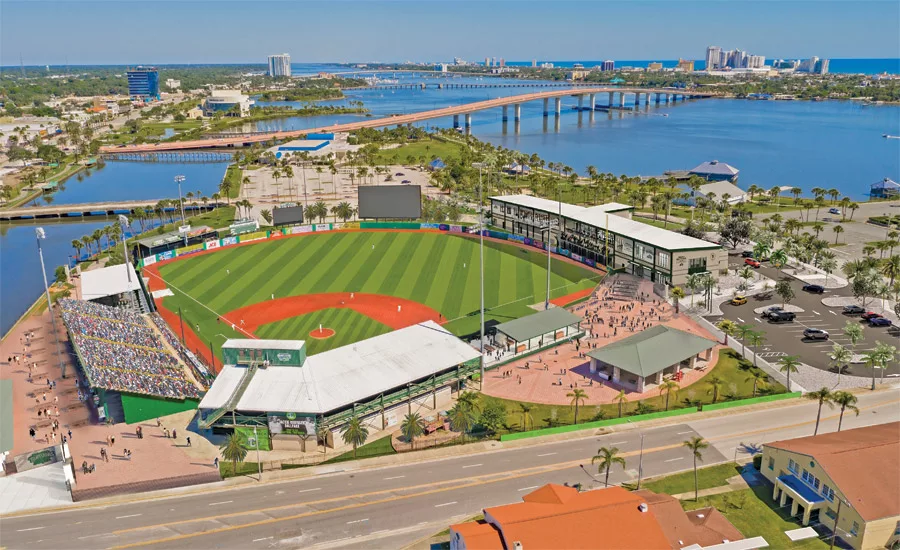
The rendering above illustrates the $30-million renovation of Jackie Robinson Ballpark, which is nearing completion in Daytona Beach, Fla.
In late 2020, Major League Baseball announced a change that put most of the approximately 160 minor league teams on notice that they would need to upgrade their ballpark facilities by 2026—or else.
Moving forward, Commissioner Rob Manfred announced that minor league ballparks would have to meet MLB’s Professional Development League (PDL) standards. This would require ballpark owners and minor-league teams to add modern weight room facilities, home and visiting team clubhouses of at least 1,000 sq ft, pitching/batting tunnels and other items.
That announcement prompted what would become a major building boom for minor league parks, with teams collectively investing an estimated $2.3 billion in a combination of upgrades and, in a few instances, construction of new facilities, according to Sports Business Journal—all of which made 2024 and 2025 the “two highest ballpark investment spending years” in minor league history.


Major League Baseball mandated in 2020 that all minor-league ballparks include player development facilities.
Image courtesy of Barton Malow & MSA Sport
While a majority of ballparks needed some level of improvements, one stood out for its historical significance—Jackie Robinson Ballpark in Daytona Beach, Fla. First opened in 1914 as City Island Ballpark, the facility was renamed Jackie Robinson Ballpark in 1990 in recognition of Robinson’s heroic role in integrating professional baseball—the first step of which occurred in a March 17, 1946, spring training game at City Island Ballpark between the Brooklyn Dodgers and their minor-league affiliate, the Montreal Royals.
Notably, the historic moment didn’t happen in Daytona Beach by chance. While all other Florida minor-league cities were adhering to state segregation laws of the day, Daytona Beach civic leaders—including civil rights activist and community leader Mary McLeod Bethune, chief among them—were resisting, and fighting to make sure Robinson could play in their city.
“We have had our share of underground surprises.”
—Len Moser, Vice President, Barton Malow
“Jackie Robson was told no, he could not play in many places, but the city of Daytona Beach, with the help of local leaders, said yes,” says Dru Driscoll, deputy city manager for Daytona Beach and the project’s main owner representative.
“So, maintaining that there’s only one place he first played professional baseball, it’s our responsibility to rehabilitate the ball field,” Driscoll adds.
For Bill Baker, architect/managing partner with MSA Design—the lead design firm for the ballpark’s ongoing $30-million renovation—the importance of that day in 1946 made it absolutely imperative to elevate Jackie Robinson Ballpark into MLB’s new minor-league standard.
“I can think of nothing more tragic than if Daytona didn’t have a [minor league] team here,” Baker says.

Originally known as City Island Ballpark, the baseball field is sited on an island within the Halifax River.
Photo courtesy of Barton Malow & MSA Sport
First Pitch
Barton Malow kicked off construction of the design-build project in 2024, with the first of three planned phases slated to be completed in time for this year’s spring training. The project includes construction of a 38,400-sq-ft player development facility, new home and away clubhouses—including complete removal of the existing clubhouses—indoor batting cages and fitness areas, upgraded dugouts, office space, club seating and infrastructure improvements as well as brighter lighting, padded outfield walls, better field drainage and accommodations for female staff—all items mandated by MLB in 2020.
Also pitching in as structural engineer of record was GRAEF, which provided mechanical, electrical, plumbing, fire protection, and structural engineering services in support of the project’s design and delivery.
The ballpark’s location on an approximately 100-acre island in the middle of the Halifax River, which also houses a city library and city courthouse building, threw contractors numerous curves, says Len Moser, vice president with Barton Malow. “We have had our share of underground surprises,” he says. “We’re sure that renovations and improvements over the years were not well documented.”

The city of Daytona Beach plans to add a 1,500-sq-ft Jackie Robinson Museum to celebrate his achievements both on and off the baseball field.
Photo courtesy of Barton Malow & MSA Sport
The ballpark’s 100-plus-year-old age also meant that most of the utility services on City Island needed to be repaired, upgraded or replaced to accommodate modifications to the ballpark and its surrounding infrastructure, Moser explains.
With the island site’s water table described as “especially high” during the summer rainy season, the extensive underground utility work was slowed by the need to de-water with wellpoints and high-pressure pumps, Moser says, adding that progress wasn’t always steady. “Sometimes it felt like we were pumping water from the ground to the canal and it’s feeding right back underground to our pumps full circle, [and we were] making no headway at all,” he says.
“We wanted to modernize the facility but maintain the historic charm.”
—Dru Driscoll, Assistant City Manager, Daytona Beach
The island’s location posed other complications. With the ballpark’s footprint taking up almost the entire project site, one immediate challenge was finding space for the all-important PDL standard facilities.
“[That] required some more real estate outside the footprint of the ballpark,” says architect Baker, calling the ballfield and its dimensions “somewhat sacred” due to its historic designations. The ballpark is also tightly bounded by Orange Avenue along the first-base line and a canal along the third-base line.
Fortunately, the formerly city-owned tennis courts, which closely abutted the ballpark’s right field, had fallen out of use, making them “prime real estate” for the player development facilities, says Baker. “It really gave us the opportunity to do the things we needed to do.”
The building will house team offices, climate-controlled weight rooms, dedicated fitness and strength-training areas and dining spaces that emphasize player nutrition, among other amenities. Notably, the new facility will also include restrooms and other spaces designed for women, which the old ballpark lacked.
The surrounding ballpark will accommodate hitting and pitching tunnels, batting cages and upgraded field lighting.


The ballpark provided limited space to construct the player development building.
Photos courtesy of Barton Malow & MSA Sport
Other site improvements will create new secure parking spaces for players and team members, accessible stadium parking for fans and dedicated field storage, for instance.
At the same time, Driscoll, deputy city manager with Daytona Beach, noted one downside to the player development building’s right-field location.
“The hardest part is we’re losing a wonderful view of the river” from the grandstands, he says. “But I don’t believe that the new building detracts; it enhances it by giving you more of a wraparound ballpark feeling.”

The player development building will include training facilities as well as team offices and additional seating for fans.
Photo courtesy of Barton Malow & MSA Sport
Additionally, the building provides enhanced seating options that are located in the building, including 102 outdoor seats and club-level seating for groups of varying sizes. Additionally, fans sitting in this new right-field seating section will be the first to get a clear-through view of downtown Daytona Beach and the park that traverses along the left-field side of the ballpark.
Importantly to the Daytona Tortugas, the Cincinnati Reds minor-league affiliate that plays at the ballpark, the simple fact that the player-development building is enclosed—and not just open-air—provides new revenue-generating opportunities.
“We’ve never had a proper space like this [PDL building] to be able to host different events,” says Jim Jaworski, general manager with the Tortugas. In the past, regarding the availability of spaces for groups or events, Jaworski says, “We’ve always been asked, and our answer is always yes. But no matter what time of year, we’ll ask, ‘Which outdoor space would you like to be in?’ And then the answer is, ‘Oh, never mind.’”
Jaworski is especially pleased with the project’s delivery of a modern, up-to-date facility.
“Not only from the fan perspective, but also from the players and player development perspective, and from a staff standpoint, this is certainly a space that we’re proud of,” he says.
Pointing out the new accommodations for women—which include team employees as well as umpires—Jaworski says, “We just have those proper spaces now and proper facilities to do what we need to do. It’s the standard.”
Utility Upgrades
Additionally, Barton Malow and team had to install a new water line along Jackie Robinson Parkway to provide domestic water and fire sprinkler service to the ballpark. In early February, subcontractor Drewery Site Development crews began installing a 12-in. water line under the Magnolia Avenue bridge, spanning roughly 250 ft.
Barton Malow is also replacing a seawall running along the canal on the ballpark’s west side. “I’m not sure of its age, but it’s safe to say it’s well past its useful life,” says Moser.
Retaining the 100-plus-year-old ballpark’s feel was a foregone conclusion for the city.
“We wanted to modernize the facility but maintain the historic charm,” says Driscoll. “We added embellishments such as the beams on the exterior of the new PDL facility to mimic the historic grandstands to give that wraparound feel.”
In addition to the renovation and updating of the ballpark, the city of Daytona Beach and Volusia County are funding approximately $23 million in improvements to City Island, including the construction of a new seawall.
“The city is really investing heavily in the island, so a lot of people think it’s just a ballpark project, but it’s really an infrastructure investment for the city of Daytona Beach,” says Baker with MSA Sport.
One additional ballpark feature of the renovation is the planned construction of an approximately 1,500-sq-ft museum.
“We’re planning to construct a Jackie Robinson Museum to help tell his story of when he was in Daytona Beach and his life and legacy,” Driscoll says. He adds that one of the things he’s learned about Robinson during this project is that “playing baseball was such a minimal part of his life.”
Even so, Robinson’s continuing impact upon Major League Baseball seemingly cannot be overstated.
Says Driscoll: “To this day, there’s one player that Major League Baseball has a special day for, where everyone wears his number—and that’s Jackie Robinson.”
While all project team members are enthused about the renovated ballpark’s upcoming opening day, architect Baker sums up the project team’s efforts in delivering the new Jackie Robinson Ballpark.
“Now it’s going to be an amazing, funky, cool single-A ballpark on an island in a river,” he says. “How cool is that?”

