ENR 2025 Top 25 Newsmakers
David K. Beesley: Deployed Trenchless Method Called Spiral Wound Lining on a Manhattan Sewer Project
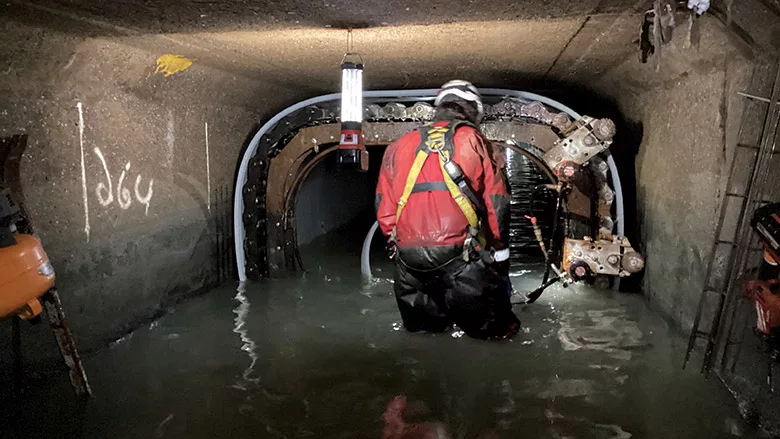
Installing spiral-wound lining involves using a waterproof machine, constructed in the sewer, to create a new structure within the existing one.

Related Article:
Innovation Gives New York City Sewer Project a Twist
Back to:
25 Top Newsmakers
David Beesley led Coppola Services’ $29-million rehabilitation of the South Street Interceptor, a nearly 1,000-ft-long, 8x6-ft combined sanitary and storm sewer located nearly 30 feet below a busy roadway, which itself underlies the FDR Drive viaduct in Manhattan’s Financial District.
At the request of the city’s Dept. of Design and Construction (DDC), Beesley’s team used a trenchless method called spiral wound lining. The approach would all but eliminate the inherent disruptive effects of conventional open-trench repair—extensive excavation, relocation and support of multiple utilities, and closure of the key roadway for a year or more. And with the addition of a temporary bypass line to a parallel sewer, the interceptor could be taken offline temporarily during nighttime construction activity, then re-energized during the day.
Although Coppola had performed numerous underground infrastructure projects using spiral wound lining, the South Street project would prove unique in both size and scope.
Beesley, Coppola’s vice president for project management, says that as part of its preparations the team constructed a mock-up of the interceptor to provide workers with a specific idea of its size and dimensions.
“We wanted to be ready for whatever we would encounter on South Street,” says Beesley.
Many of the challenges encountered after lining work began in May 2024 defied even the most detailed planning. Beesley’s team tackled a host of challenges, including the frequent buildup of debris, particularly after heavy rain events, which often required extensive equipment cleaning prior to each work shift.
“Our progress was inconsistent,” Beesley says. “On certain nights, we’d get the production we expected, others just a fraction of it. But as we went along, we became more familiar with what to expect on a weekly and nightly basis.”
Along the way, unforeseen changes in the sewer’s dimensions required reconfiguring equipment. Multiple leaks also required patching in advance of the new lining, including two wall cavities that continuously spewed high-pressure water from the East River.
DDC Assistant Commissioner Iyad Marzouq praises the perseverance of Beesley’s team in tackling these challenges, as well as his close coordination with the agency as the project unfolded.
“He was always available to us, and very understanding of what our needs and goals were,” Marzouq adds.
Whether Beesley’s team was taking care of a malfunctioning pump or securing new machine parts to accommodate areas with limited clearance, Beesley “would jump on it and do what he could to keep the project moving,” says Marzouq.
Although lining work was completed in November 2025, Coppola has since performed a meticulous quality inspection program to ensure the resulting lining meets DDC standards.
Marzouq says the project, which is within budget, has provided DDC with many valuable insights into future applications of spiral wound lining as a cost-effective alternative for underground infrastructure rehabilitations where an open-cut approach would be problematic.
“And so much of that came from the work of Beesley’s team,” Marzouq adds.
Beesley considers the project a valuable learning experience in the application of spiral wound lining as a rehabilitation strategy.
“It was the right fit for the right project,” he says.