Texas Supreme Court Rules for Road Contractors in Critical Legal Immunity Test
Contractor groups rallied with court briefs
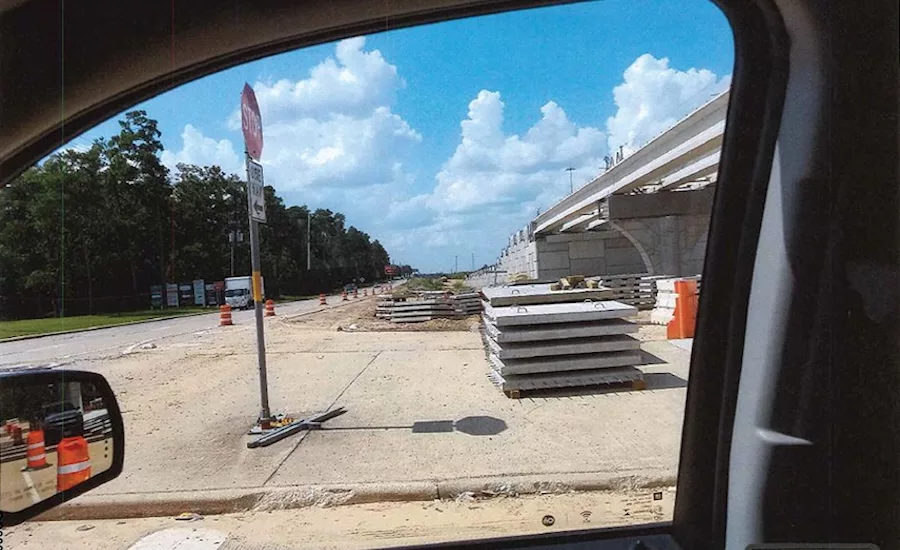
A stop sign where Pedro Alfonso Castaneda most probably sought to make his fatal left turn while new traffic signals had not yet been activated. The accident triggered a test of contractor liability that was decided Dec. 12.
The Texas Supreme Court overturned an earlier ruling by appeals court judges clarifying who is protected by the Texas Dept. of Transportation's legal immunity shield. It is a state law barring lawsuits against contractors for auto accidents as long as the contractors build according to the design.
The case, which was closely watched in other states that grant immunity, involved the interpretation of the word "for."
In the ruling issued Dec. 12th, the court decided that a road contractor and its traffic signal subcontractor did indeed work for TxDOT and therefore can receive the liability protection under Texas Civil Practice and Remedies Code § 97.002.
The case, Third Coast Services and SpawGlass Civil Construction v. the family of Pedro Alfonso Castaneda, stemmed from a horrific accident in 2019. After leaving a plumbing supply store one afternoon, Castaneda pulled up in his Toyota Tacoma pickup at an intersection adjacent to a busy highway overpass construction project in Pinehurst, Texas.
Recently installed traffic signals at the intersection were still covered by black plastic fabric and not yet operational. Castaneda came to a stop at the intersection and then, according to witnesses, rolled forward and began a left turn onto the highway frontage road. He never finished the turn. Instead, a truck hit his pickup and spun it around as a second truck struck Castaneda's pickup and drove it into a utility pole, severing power lines. Castaneda died at the scene.
The legal battle over Castaneda’s death began in 2019 with the family eventually suing general contractor SpawGlass and traffic signal contractor Third Coast for negligence leading to the accident.
Third Coast and SpawGlass disputed the charges, saying they were not responsible for what happened on the roads or for what may have triggered a deadly driving mistake by Castaneda in failing to yield to the other vehicles. But their primary legal defense, stated in a motion filed before a trial could begin, has been that, as government contractors, they are immune and can’t be sued.
That lawsuit started a multi-year and multi-court battle to determine if either contractor could be sued.
The companies and the state’s contractor and subcontractor associations, in amicus briefs in both the lower courts and the state supreme court, argued that under state law any work performed under the supervision of TxDOT was shielded by an extension of the immunity from lawsuits TxDOT itself enjoys. That defense has become a government contracting legal cause célèbre over the issue of immunity.
The family argued that since Montgomery County, not the state directly, had hired SpawGlass, and that the contract was performed in the county, the TxDOT shield was not in force.
Two lower courts agreed with the family.
However, the Dec. 12th ruling by a panel of Texas Supreme Court judges, written by Justice Rebeca Huddle, clarifies several points.
One of those points concerned whether a direct contract between the state and the contractor is needed for immunity to apply. The Supreme Court judges ruled that the statute’s immunity shield extends to a contractor that constructs or repairs a highway, road or street for TxDOT.
Although SpawGlass’ contract was with Montgomery County and not TxDOT, the contractor still gets the same privileges as a direct privity contract.
A Dual Employer
The court agreed with the contractors’ main argument that they, in fact, worked for TxDOT because TxDOT would ultimately operate and maintain the frontage roads where the work—and the accident—took place. The court wrote, “Because SpawGlass and Third Coast contracted to perform work on the frontage roads, and TxDOT would exercise responsibility for their operation and maintenance after the project’s completion, the contractors’ work was both ‘for’ the County and ‘for’ TxDOT.
The Court also rejected the appeals court's narrowing of the definition of “construct” to exclude general contractors. “A general contractor," the judges wrote, "who bears ultimate responsibility to the owner for a construction project ‘constructs’ the project even though the general contractor may not actually perform the physical work.”
Much to the relief of Texas road contractors, the decision both clarifies and codifies § 97.002’s immunity to subcontractors and indirect contractors on projects where TxDOT retains ultimate responsibility or benefit from the work, even without a direct TxDOT contract.
The legal battle isn't over.
The Court remanded to the lower court the issue of whether the contractors conclusively proved compliance with material contract documents—an essential component to retaining immunity. The result of that decision will determine whether the contractors are in fact liable.
But the principle of dual employment was settled.