2025 West Best Projects
Project of the Year Finalist, Excellence in Safety, Best Renovation/Restoration: MAX Red Line Extension and Reliability Improvements Project
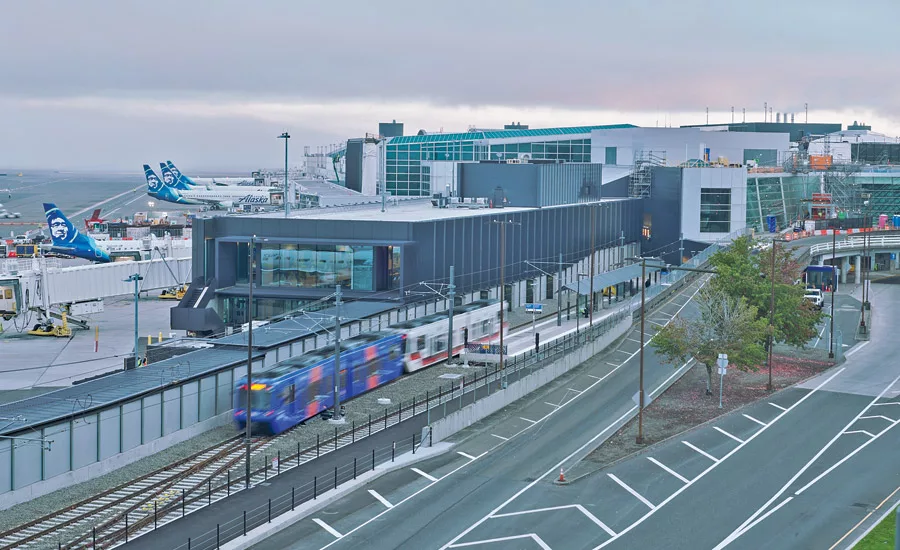
MAX Red Line Extension and Reliability Improvements Project
Portland, Ore.
PROJECT OF THE YEAR FINALIST, EXCELLENCE IN SAFETY and BEST PROJECT, RENOVATION/RESTORATION
Submitted by Stacy and Witbeck Inc.
Owner Tri-County Metropolitan Transportation District of Oregon (TriMet)
Lead Design Firm Parametrix
General Contractor Stacy and Witbeck Inc.
Modern Railway Systems O’Neill Construction Group Inc.
The $149.8-million MAX Red Line Extension and Reliability Improvements Project—TriMet’s “Better Red” program—delivers the most significant capacity and operational upgrade to Portland’s Red Line since the service opened more than two decades ago.
The project was led by prime contractor Stacy and Witbeck Inc., with Parametrix as lead designer. Major systems and station work was performed by O’Neill Construction Group and Modern Railway Systems. The three-segment program expands access, eliminates a key system bottleneck and improves reliability across the entire west-side MAX network. The project was delivered on time and on budget.
TriMet’s goal was straightforward: reduce delays and create a consistent one-seat ride between Hillsboro and Portland International Airport. Achieving that vision required complex work across three geographically separate areas—the airport segment, Gateway Transit Center and Hillsboro’s Fair Complex—delivered while maintaining daily light-rail operations.
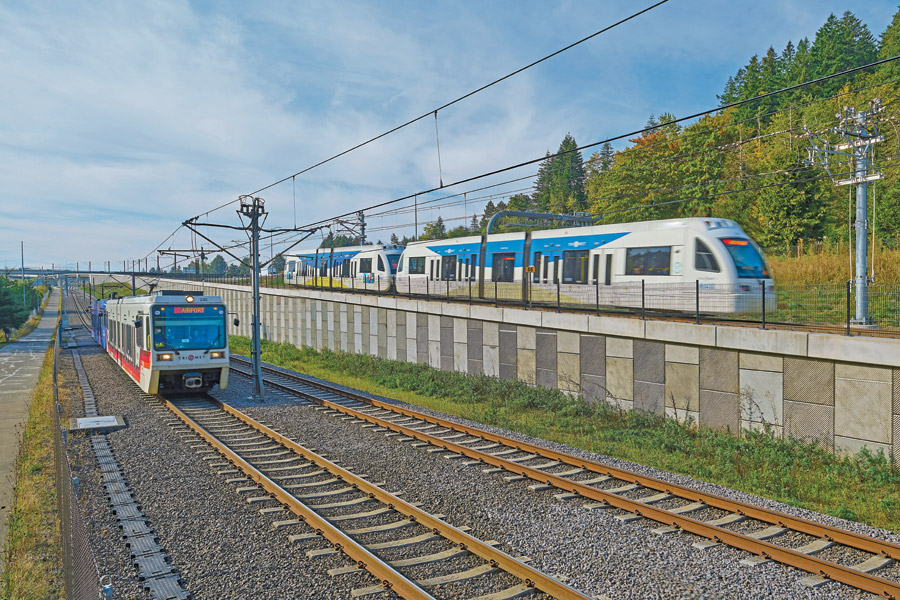
Photo courtesy HDR
“During the 36 months of construction, we did not have a single unplanned impact on service,” the project team noted, crediting detailed daily coordination with TriMet operations.
At PDX, crews reconstructed Air Cargo Road and rebuilt the airport station while double-tracking nearly a mile of new rail, coordinated with major terminal redevelopment.
Utility work included relocating the airport’s 18-in. sewer force main and installing a 16-in. earthquake-resistant ductile iron waterline—the first of its kind in Portland’s public streets. The team also reconfigured the 8-in. water line supplying the glycol fill station, maintaining service throughout.
The most technically challenging element emerged at the Gateway Transit Center, project leaders noted, where the team replaced a critical junction that constrained Red Line frequency.
To maintain operations on a corridor with seven-minute headways, Stacy Witbeck proposed a precast split-bent bridge system in lieu of a cast-in-place box girder.
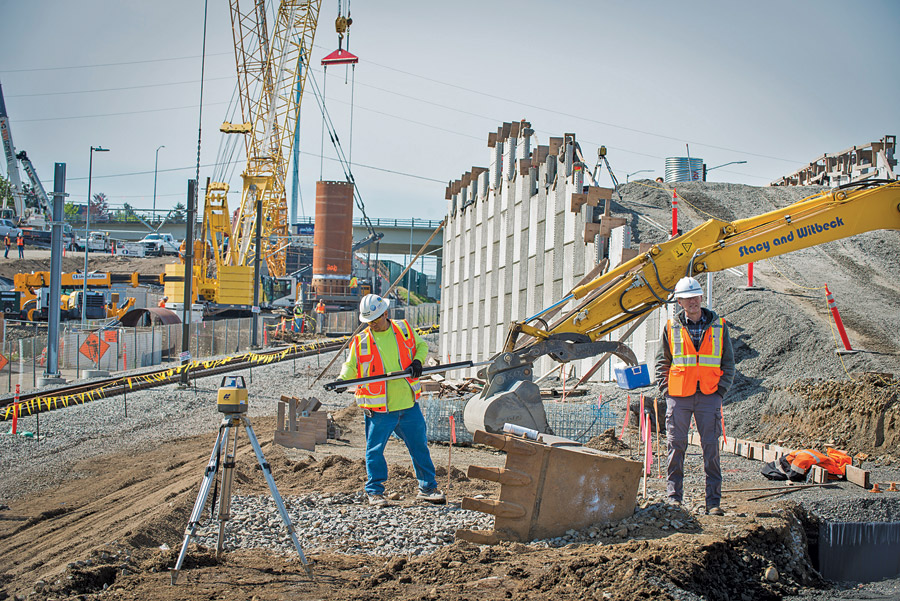
Photo by Andes Photography
“The challenge was to construct a full track bridge over an existing operational track … while maintaining full safety compliance,” the team wrote.
The precast bent—exceeding 100,000 lb—was installed in a weekend shutdown, enabling the remaining bridge work to proceed safely outside the live track envelope.
This innovation reduced the required closures from four weeks to two weekend-only shutdowns and helped the project finish on schedule.
“Stacy Witbeck hit each deadline and was able to restore operations on time,” TriMet said.
Safety defined every phase of the effort. The contractor self-performed more than 300,000 work hours with zero recordable or lost-time incidents. OR-OSHA consultant Tim Moore, who reviewed site operations, wrote that the MAX Red Line work was “probably the best organized and most professionally operated project that I have seen, especially given the scope.”
Stacy and Witbeck’s safety approach blended technology, field observations and leadership. Team members used HCSS Safety to flag and resolve hazards in real time, and the contractor adapted work roles to retain valued personnel.


