Disaster Recovery
Houses Slated for Demolition Relocated to Fire-damaged LA Neighborhood
Altadena, hard-hit by wildfires, sees architectural firm make creative reuse of old housing stock
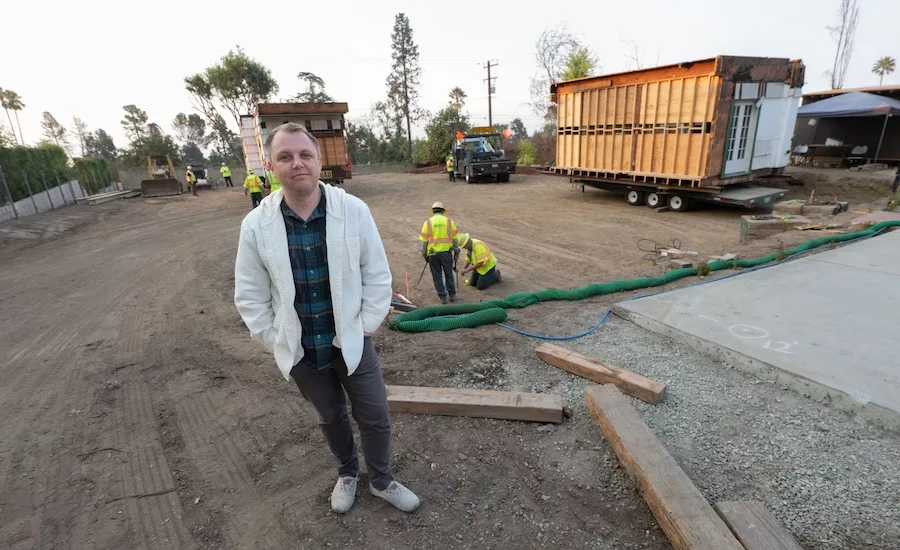
Morgan Sykes Jaybrush, creative director at LA-based architecture firm Omgivning, stands by the site of a new foundation in fire-damaged Altadena, Calif., awaiting delivery of a historic home that was slated for demolition.
Los Angeles architects and preservationists are living up to the city's history of relocating historic homes to help some of the more than 13,500 households in the Altadena and Pacific Palisades neighborhoods displaced by this year's wildfires that spread across 37,500 acres and destroyed more than 16,000 structures.
Morgan Sykes Jaybush, creative director of Los Angeles-based architectural firm Omgivning, has a life-long passion for historic preservation and sustainability. The firm is known for its adaptive reuse and historic building restorations, and Jaybush also sits on the board of the Santa Monica Conservancy, a nonprofit dedicated to heritage conservation.
Immediately after the fires, Jaybush and industry colleagues began discussing the realities of rebuilding, what the county government would require and alternative housing scenarios, including pre-fabricated homes and RVs on sites where homes once stood.
Jaybush had an idea: Could these older homes, that didn’t quite meet the criteria for historic designation, be relocated to Altadena rather than be torn down to make room for new development? The Craftsman style of many of the houses would fit with the Altadena ambience, he thought.
“Why couldn’t we do what we used to do?” Jaybush asked, noting that 75 years ago, Los Angeles-area homes were frequently moved to make way for new infrastructure, including freeway construction. Relocation provided a more sustainable solution.
With assistance and collaboration from a host of partners, including small architectural firms, the City of Los Angeles Council District 13, the County of Los Angeles and the Los Angeles Conservancy, the Historic House Relocation Project was launched. Jaybush serves as project director.
Around the same time this idea came together, Evan and Caitlin Chambers, an Altadena couple whose home was destroyed in the Eaton fire, were scrolling the Instagram account Before the 101, which chronicles how construction of the U.S. Route 101 freeway changed the Southern California landscape in the mid-20th century. A post noting that three historic Craftsman homes in Hollywood were slated for demolition to make room for an apartment complex caught their eye.
The couple wondered if, instead of tearing those houses down, they could buy one and relocate it to their Altadena property. They started making inquiries, and soon they connected with Jaybush. They then began the process of securing one of the Hollywood homes for relocation.
Permits and More Permits
Environmental work, including ground remediation, had already been completed in most of Altadena, with local government clearing the way for rebuilding. Individual homeowners were now tasked with determining the best—and economically feasible—path for them to move forward.
California’s existing building code allows for house relocation, with a few caveats, explains Omar Garza, principal with Nous Engineering, the project’s structural engineer. There must be a condition assessment of the building and recommendations for any necessary repairs. The new foundation must be designed for current code requirements, and engineers have to determine the best way to attach the house onto the new foundation.
With Jaybush spearheading the project, the Chambers and the developer agreed on a $1 purchase price for the 2,400-sq-ft house, with the couple responsible for relocation costs, associated fees and remodeling expenses. Jaybush and his team worked to secure a range of city and county building and relocations permits, as well as a fire rebuild permit. They lined up contractors and specialists in moving historic houses, while also determining the best methods to dismantle the two-story structure to transport it the 20 miles from Hollywood to Altadena.
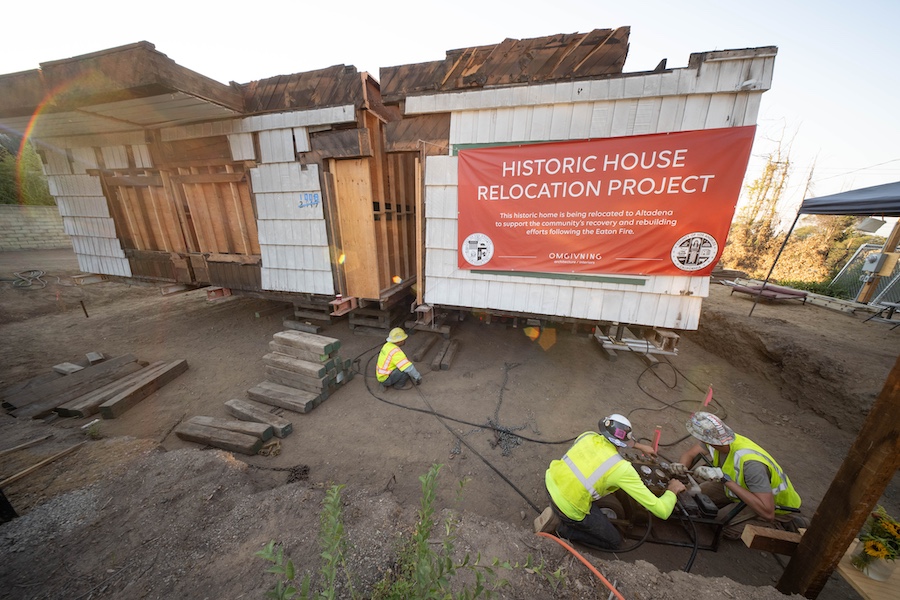 Relocating existing homes to fire-ravaged areas is seen as a win-win for rebuilding. Photo courtesy Omgivning
The county granted a special permit to move the building before the foundation permits were in place, a crucial step as the developer would only sell the house if it could be removed quickly from the site.
The Chambers told their friends in Altadena about their relocation plans, and soon Gwen Sukeena and Jacques Laramee had identified a Craftsmen home slated for demolition in the Los Feliz neighborhood that they could purchase from a developer for $1 to relocate to their Altadena property. Each developer ended up saving about $42,000 each in not having to pay for demolition.
Both arrangements also served as a learning curve for Jaybush and his team as they worked through the various jurisdictions to obtain permits and line up contractors and vendors with experience in historic home relocation and preservation.
Due to scheduling issues the Sukeena and Laramee house was moved first. To ease navigation and safeguard the vintage components, crews cut off the second floor of the house and removed the original doors, molding and millwork, parking them in the first floor of the structure. “The older homes are beautiful and have unique finishings that aren’t built in newer homes,” Jaybush said. “Every joist was saved,” he added, noting that the 1910-built house had original redwood still in great condition.
Workers removed and saved the roof sheathing, but individual roof shingles were discarded. Walls were deconstructed down to the studs. The first story remained intact down to the sill plate, with the wood and tile flooring saved. Flooring for the second story remained intact atop the ground floor of the house.
The first floor was sectioned into four pieces for transport. Three slices were cut along the long floor plan and an adjoining sunroom became the fourth piece. Crews disconnected the structure from the foundation and cut in equal widths along an interior bearing wall without cutting through the finished flooring so that it would be easier to patch.
A similar process was followed for deconstructing the Chambers’ house.
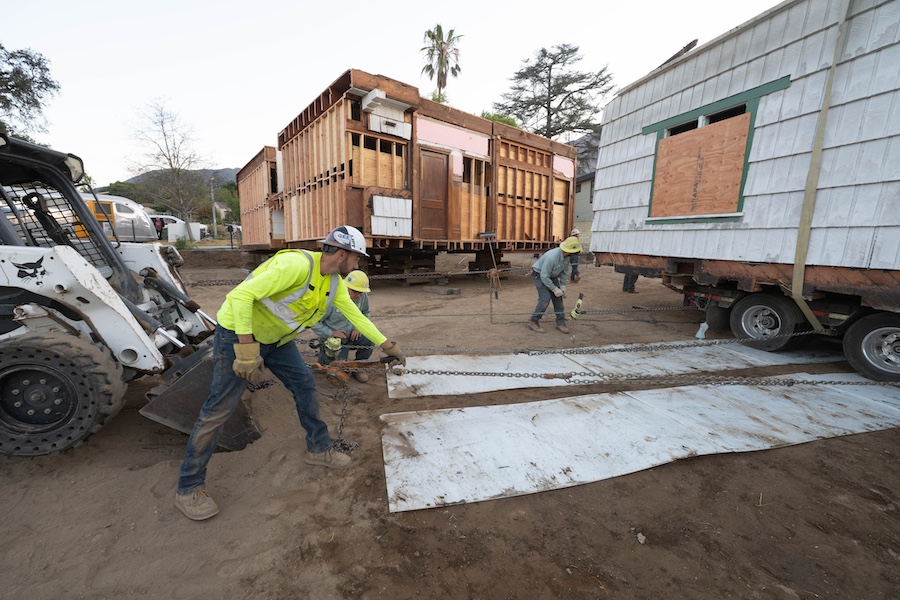 Segments of a relocated home are positioned on flatbed trucks. Photo courtesy Omgivning
 Dinuba House Movers, one of only two California firms with historic structure relocation expertise, positioned the four elements on jacked up steel beams that were lifted onto flatbed trucks. The route would typically be about 15 miles from Los Feliz, but to avoid obstacles the route grew to 26 miles, with trips scheduled overnight to avoid traffic.
“The process of physically moving the house is one of the more challenging aspects of the project,” said Jaybush.
The structural engineer agrees. These types of relocation and rebuilding efforts “are logistically more complex than a typical project,” says Garza, who had previously worked with Jaybush. “He’s very creative and an out-of-the-box thinker,” Jaybush says. “You need flexibility. You never know what you’ll find when you open a wall in an old house.”
Crews had to maneuver the four house sections onto the tight existing footprint in Altadena. The lot is on a slight slope so the flatbeds couldn’t simply back in, says Jaybush. Workers graded and repacked the compacted soil to create a level landing to park the trucks. The Dinuba crew had worked in tight spaces before so they used plexiglass and dishwashing soap, with the aid of a compact track loader, to push and pull the flatbed precisely where it needed to be.
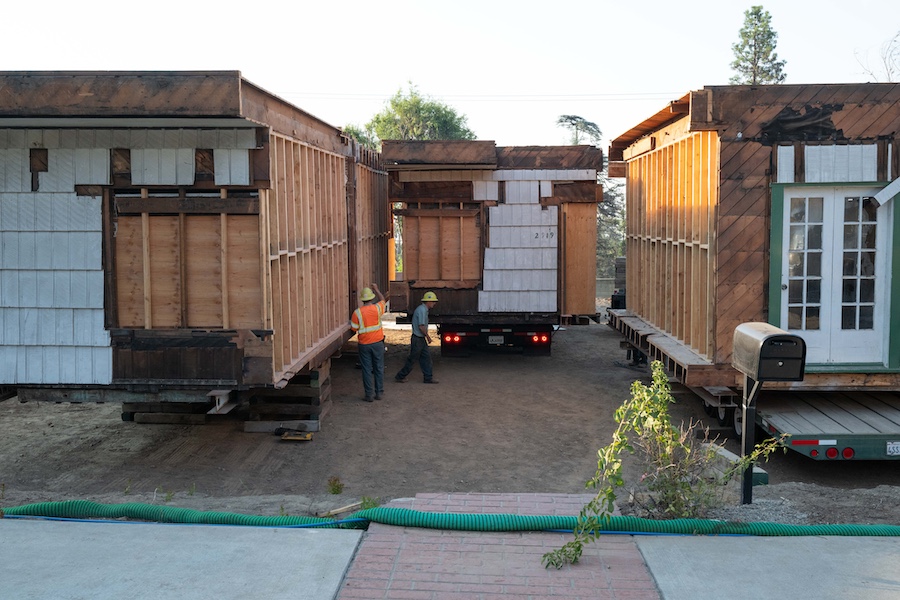 Homes were cut into segments for over-the-road transport and alignment with their new footprints. Photo courtesy Omgivning
The reassembled house sections were tied together to close the gaps and then set on raised steel beams supported by crib blocking to await the new foundation permits and related inspections. “You have to ensure that the current California building codes are adhered to,” notes Garza. Current zoning laws also must be followed, and engineers adhere to the local structural strengthening for wind and seismic design. Structural engineers oversaw the placement and mounting of the house on the foundation after it passed inspection. Contractors are now reattaching the second floor, adding new electrical wiring and a new roof. After that it becomes a remodeling job, says Jaybush.
“It’s definitely a very unique project," says Garza, adding “It’s more linear during a regular construction project". An older home will always need upgrades, but these need new structural framing elements where the cuts were made. There is also work needed to bring the home up to current building codes. But putting aside the relocation aspect, it’s not too different from buying an older home and updating it while keeping the aesthetic look, Garza explains.
The owners of both relocated houses plan to renovate the kitchens and bathrooms and make other modifications. Jaybush estimates the total cost of the relocation will range between $700,000 and $800,000. That is still lower than the average square foot cost of $450 for new home construction in the area, he adds.
It’s a more sustainable solution as well, says Jaybush, since an entire building is not being thrown in the trash. “It’s a way to preserve history and bring historic character back to a neighborhood that has lost so much.”
While sustainability is a factor—Jaybush claims the carbon footprint is a lot lower for this type of construction— a full house relocation is not for everyone. “You have to be the kind of person who likes an older home with character, and have the wherewithal for the ups and downs of moving and dealing with red tape, permitting and other factors compared to wanting a brand new constructed home,” he says. The cost factor shouldn’t be the only consideration, Jaybush adds.
More Houses, Ready to Move
A third house, a 1926 bungalow in West Hollywood, is slated for relocation to West Altadena sometime after the Thanksgiving holiday. The house will be cut down to fit the new footprint which is 48 ft wide. With setbacks it can accommodate a 38-ft-wide house.
Three additional houses are slated to be moved next: one in Santa Monica, one in South Los Angeles and one in Pasadena. Jaybush said he has about five or six houses in the pipeline to be moved but that several factors, including getting on the house mover’s schedule, are delaying final contracts. The number of houses in Jaybush’s “inventory” changes daily, but he notes that 56 property owners have confirmed willingness to sell homes to the relocation project. Omgivning staff are working to identify the owners of another 135 houses also are slated for demolition.
About 168 families, mostly from Altadena, are on the list for a relocation house, with 10 under contract. Another 38 contracts have been issued and are awaiting signatures, said Jaybush.
As word has spread, people who are not fire victims have expressed interest in buying a home for relocation. Priority is given to people who lost their home in the fires, says Jaybush, but not everyone who lost their home in the fire is mentally or financially ready to make a rebuilding decision. When homes become available and developers need to move quickly, readiness becomes a factor, he said.
The Omgivning website has forms for both building owners to submit if they have a house for sale and relocation, as well as forms for people who are interested in relocating one of the houses to their property. Community groups also have been instrumental in matching people with housing opportunities. “You’re playing matchmaker” says an Omgivning spokesperson, “between the home set for demo and the homeowner who would want to buy it.”
About eight Omgivning staff are working on the relocation project. Omgivning is using multiphased agreements so the firm gets paid for the first phase of house hunting. Once a house is identified, the rest of the contract is finalized. Jaybush anticipates Omgivning will need to hire a mix of project managers who are also architects to put drawings together and other duties.