Buildings
New Coney Island Development Adds to Local Housing Boom
Flooded during Hurricane Sandy, the city property is offered up as part of an Adams Administration search for more housing opportunities
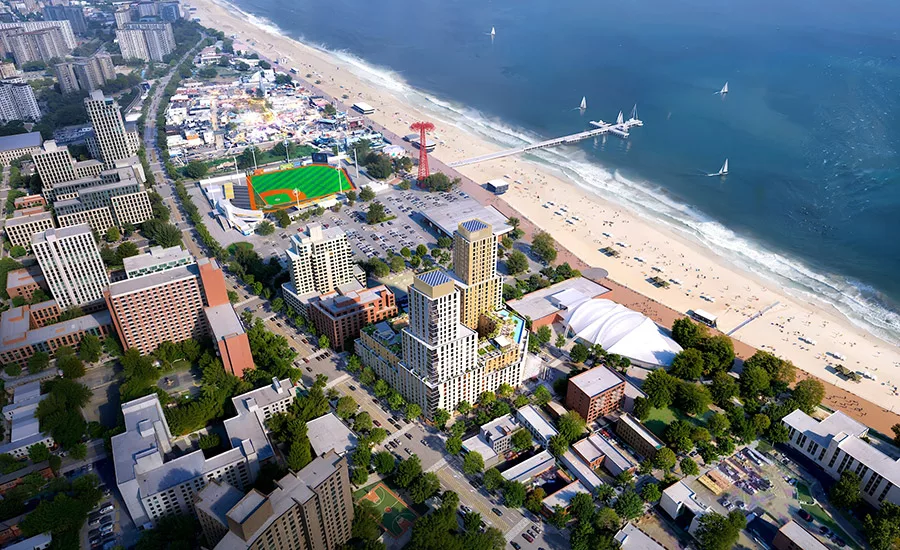
RYBAK Development has won New York City Economic Development Corporation’s competition to develop the coveted, 80,000-sq ft Coney Island West Parcel “A” into a $350 million mixed-use residential/retail complex with 505 rental units, designed by IMC Architecture.
What will eventually be two, 28-story towers on either side of an 11-floor section are part of a broader push by the city to build new housing and improve infrastructure in the coastal neighborhood.
Three other housing developments across the street from the RYBAK project are in the works or have been completed in the last several years. Meanwhile, the city is adding two additional streets to the area.
RYBAK Development, along with its partner IMC Architecture, won the property through a competitive RFP process and is expected to start construction on what the partnership calls the Tilyou Towers in 2027.
Besides being part of other neighborhood changes, the project also aligns with broader plans by the Adams Administration to identify plots of city-owned land that can be converted into housing, as mandated by the mayor in an executive order issued last year.
This particular Coney Island site is currently a public-access parking lot. RYBAK Development is expected to buy the land and apply for the 485-x tax abatement program. A parking facility available to nearby residents will be incorporated into the new building.

RYBAK Development’s residential/retail complex, designed by IMC Architecture, will feature an 11-story “podium” section and two 28-story towers. The podium will have a large outdoor tenant amenity rooftop terrace on the 11th floor, including an infinity-edge swimming pool overlooking the Atlantic Ocean, lounge, gaming area, children’s playground, pet-friendly facilities and kitchen. Indoor amenities will be located on the fifth floor.
Rendering courtesy IMC Architecture
The boost of extra apartments in the area is a mixed bag, says Samantha Ross, the director of Urban Neighborhood Services, a Coney Island-based nonprofit that helps connect residents with jobs and housing. Ross pointed out that many of the locals her organization serves can afford $800 to $1,000 in rent.
When it comes to big developments put up nearby, “a lot of people who are low income can’t afford to live in those,” she says. The affordable units in the RYBAK construction will range from 40% to 100% of the Area Median Income, with the average sitting at 80%, or nearly $91,000 for a single-person household. At the same time, Ross expects the arrival of higher-income tenants to attract more grocery stores, banks, and other businesses.
Tenants who have moved into some of the newer developments in the neighborhood have also complained about noise from the adjacent Coney Island Amphitheater, so future construction should probably better insulate against the sound, Ross said.
The venue will also be undergoing renovation soon. In November, the NYC Economic Development Corp. will issue an RFP for a vendor to update and operate the broader complex, known as the Seaside Park Community Arts Center.

RYBAK Development’s residential/retail complex will feature numerous tenant amenities serving rental tenants of 505 units, including an amenity rooftop terrace on the 11th floor, which will house an infinity-edge swimming pool overlooking the Atlantic Ocean, lounge, gaming area, children’s playground, pet-friendly facilities and kitchen. Indoor amenities will be located on the fifth floor.
Rendering courtesy IMC Architecture
Like the new construction nearby, Tilyou Towers sits on land flooded by Hurricane Sandy. Mechanical, electrical, and plumbing equipment, along with housing and other “critical infrastructure” will sit roughly 13 feet above sea level or five feet above grade level, says Eugene Mekhtiyev AIA, LEED, Revit, a principal at IMC Architecture. Accessible entrances won’t meet this threshold, however, and will be protected with moveable flood shields. Preliminary plans also call for 8,000 sq ft of on-site solar that would offset some of the common utility charges.