2025 East Best Projects
Best Health Care: United Health Services Wilson Medical Center New Tower & Renovation
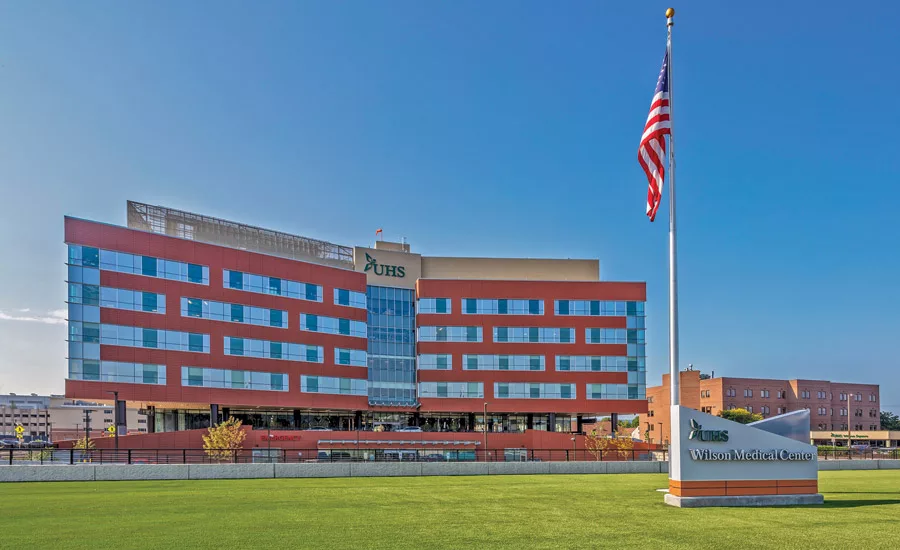
United Health Services Wilson Medical Center New Tower & Renovation
Binghamton, N.Y.
BEST PROJECT
Submitted by LeChase Construction Services
Owner/Developer: United Health Services
Lead Designer: Chianis + Anderson Architects
Construction Manager-at-Risk: LeChase Construction Services
Structural and Civil Engineer: Klepper, Hahn & Hyatt
MEP Engineer: Engineered Solutions
Serving as the front door to Wilson Medical Center campus, the six-story, 183,000-sq-ft tower features 120 private patient rooms, an expanded emergency department and an accessible new entrance and relocated helipad.
Approximately 25% of the tower was prefabricated or preassembled off site, including bathroom pods; patient room headwalls; exterior sheathing panels; modular racks for mechanical, electrical and plumbing systems; and interior main stair towers. Even preassembling the tower’s 540 interior doors provided benefits such as cutting onsite installation time by more than half and eliminating the need to store inventory and handle small parts.
Together, these measures saved approximately $1.5 million, eliminated more than 38,200 hours of onsite labor and shortening the schedule by about six months. This offset the pandemic-related delay in getting the project underway, enabling the team to meet both the original delivery date and the $132-million budget.
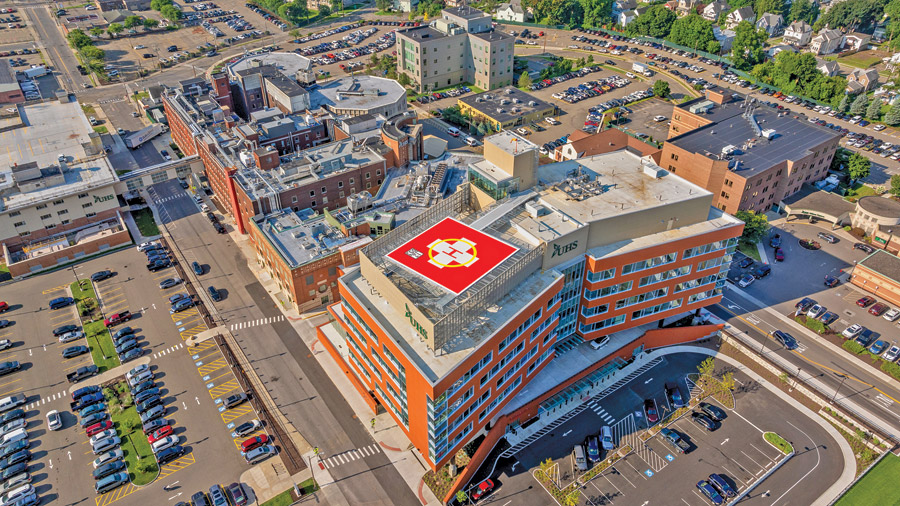
Photo by Revette Studio 2024, courtesy of LeChase Construction Services
To keep the hospital fully operational during the four-year construction phase, the team developed a 25-phase plan that began with the addition of a new generator building and a temporary oxygen farm to provide uninterrupted services. Once three new high-capacity generators were installed, tested and operational, the old units were removed to begin excavation for the tower. Working around hospital operations, deliveries requiring crane picks were limited to a two-hour window once a week.
Three tie-ins were required between the new tower and existing hospital, including a challenging connection on the first floor that required cutting through walls of the existing hospital. Temporary enclosures built around the openings kept noise, dust and particulates out of active hospital areas.
Patients now have private, more spacious rooms that are equipped with negative ventilation to create isolation space in case of future pandemics.
The emergency department has more than doubled its size, featuring five zones with dedicated nurse stations and four trauma bays with direct access to the ambulance entrance and trauma elevators.