2025 West Best Projects
Best Office/Retail/Mixed-Use: Healthpeak Properties' Vantage Phase I
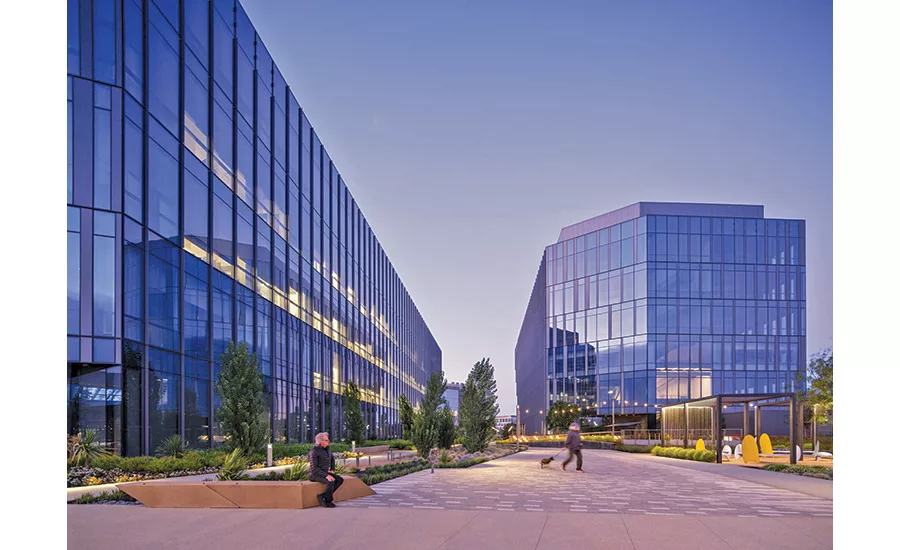
Healthpeak Properties’ Vantage Phase I
South San Francisco, Calif.
BEST PROJECT
Submitted by Salas O’Brien
Owner Healthpeak Properties
Lead Design Firm Flad Architects
General Contractor Hathaway Dinwiddie
Civil Engineer Wilsey Ham
Structural Engineer Salas O’Brien
MEP Engineer Meyers+ Engineers
Landscape Architect Fletcher Studio
Designed to nurture biotech discoveries, this purpose-built life science campus will serve the region’s academic, commercial, and industrial science and technology research institutions. Scope of work included construction of two speculative laboratory buildings, a two-story amenity building and site infrastructure. The facility features a 50/50 ratio of laboratory to Class-A office space.
This space also provides 342,000 sq ft for future life science tenants in order to support the owner’s master plan that envisions six buildings totaling more than 1.7 million sq ft on the 19-acre campus. All three buildings are LEED Gold certified. A pedestrian plaza flows around the buildings as well, helping foster community by offering abundant space for recreation and collaboration.

Photo by Jason O’Rear
Dramatic overhanging fronts for the two lab buildings pushed the team to explore various structural schemes, including conventional cantilevered floor framing, canted columns, story trusses and a masted rooftop structure to hang. After careful consideration, the canted column option became the most cost- and schedule-effective solution, while also being the most aesthetically pleasing. Now the six-story building’s floors step outward, cantilevering toward the site’s northeast corner, while the second building’s five stories subtly extend this architectural statement across the site.
However, the cantilevered column system and twisting floor plates posed several challenges during construction that required close coordination. The cantilevered floor plates progressively extend, causing inherent twisting for each floor under self-loading conditions. To ensure stability during the erection phase, crews coordinated cabling and temporary structure design and closely monitored and controlled framing displacements throughout construction. Meanwhile, the buckling restrained braced frames sit in a core configuration to limit impacts on future tenant programming by maximizing free space at the perimeter bays. The exterior wall is also designed to allow for flexibility and connection to the outdoor spaces, and the enclosure features metal panel cladding with large glass openings.