2025 West Best Projects
Best Airport/Transit: San Francisco International Airport Interim Corridors
San Francisco International Airport Interim Corridors
San Francisco
BEST PROJECT
Submitted by Turner Construction Co.
Owner San Francisco International Airport
Lead Design Firm Gensler
General Contractor Turner Construction Co.
Civil Engineer Telamon Engineering Consultants Inc.
Structural Engineer Magnusson Klemencic Associates
MEP Engineer Rosendin Electric
Plumbing/HVAC Southland
Fire Protection Transbay
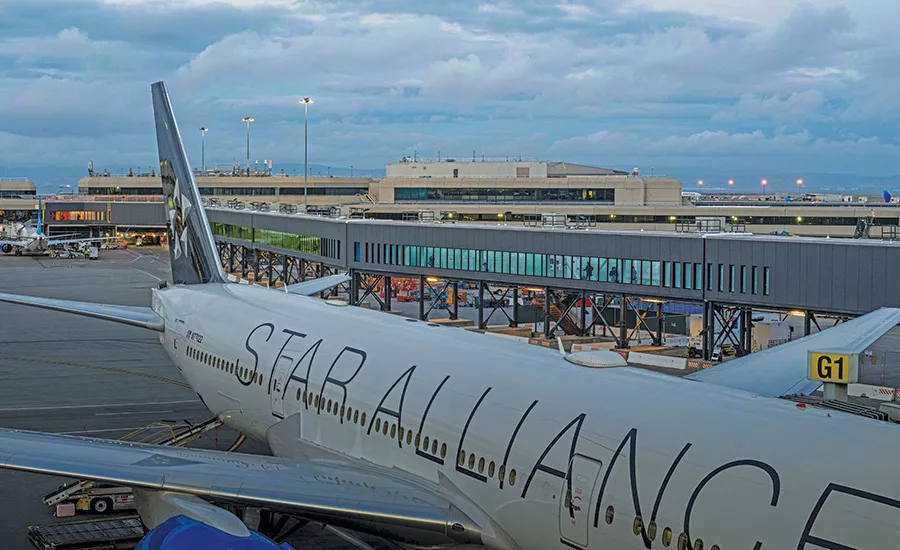
A unified design-build team’s precise planning and collaboration ensured early completion on the $44-million Interim Corridors at San Francisco International Airport. Completed as part of the $2.3-billion Terminal 3 West Modernization, the project’s scope of work included two temporary elevated passageways—one 440 ft long and the other 1,000 ft long— to maintain secure passenger circulation during active terminal construction. This project helped minimize airside disruption, eliminate gate closures and reduce the overall terminal program schedule by nearly a full year.
Offsite modular construction proved vital in realizing the two corridors, composed of 11 prefabricated and structurally distinct corridor modules. Each was built off site on a repurposed location identified through a cross-departmental airport effort.
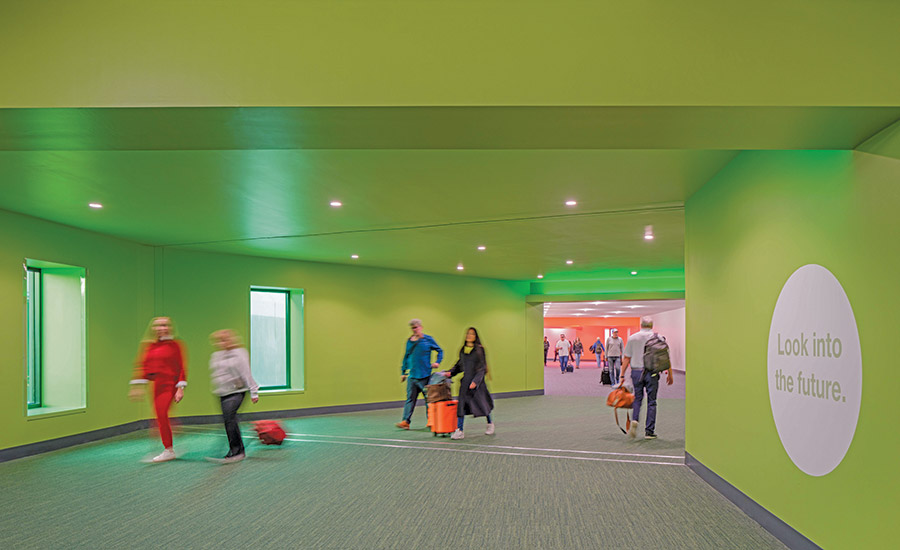
Photo by Jason O’Rear Photography
A design-build approach allowed for early trade partner engagement and phased bidding, so steel procurement and fabrication began at 75% design. Meanwhile, a dedicated VDC team performed laser scanning and created detailed logistics videos and digital twin mock-ups to ensure precise planning and stakeholder buy-in.
While design specifications called for a two-year service life, the project team constructed the modules as close to permanent standards as possible. Each module was fully equipped with structural steel, MEP systems, fire protection, security systems and interior finishes before being moved into place.
The modules sit on raft foundations to prevent airfield penetration and allow for up to 22 in. of seismic movement. Flexible slip joints between modules and at terminal tie-ins ensured resilience under airport-specific conditions as well. For the structural footings, the design-build team piloted a 100% portland cement-free concrete mix produced by C-Crete. This marks one of the first such uses of this kind of concrete in a structural application on a public project.
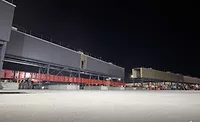
The move occurred over 11 consecutive night shifts, with each module making the more than one-mile-long journey across the airfield atop self-propelled modular transporters. The corridors were delivered within budget and 10 days ahead of schedule in November 2024.