2025 Southwest Best Projects
Best Project, Landscape/Urban Development: Ashler Hills Park
Ashler Hills Park
Scottsdale, Ariz.
BEST PROJECT
Submitted by Valley Rain Construction Corp.
Owner City of Scottsdale
Lead Design Firm Floor Associates
General Contractor Valley Rain Construction Corp.
Civil Engineer Hilgart Wilson
Structural Engineer Bakkum Noelke Consulting
Architectural Engineer Weddle Gilmore
Electrical Engineer Woodward Engineering
Plumbing Engineer Associated Mechanical Engineers
Key Subcontractors Rummel Construction; Torrent Resources; LC Concrete; Kimbrell Electric; Calient Ironworks; Stout Construction Services
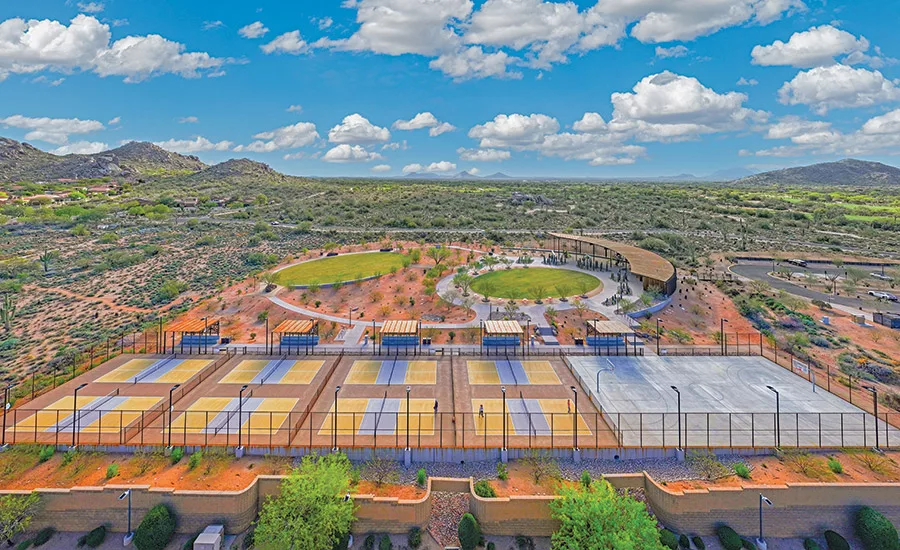
Located on a 17-acre site adjacent to established neighborhoods, the park incorporates a variety of recreational amenities into the natural desert landscape. Key amenities include shaded playgrounds, open turf areas, picnic ramadas, adult fitness equipment, a basketball court and eight post-tensioned pickleball courts, which were positioned at lower elevations and screened with native vegetation to reduce noise. The park also features shaded seating, walking paths and onsite parking. All lighting is centrally managed and designed to limit light pollution. A large federally regulated wash was preserved in place and spanned with a custom steel entry bridge to maintain natural drainage flow without the use of culverts.
More than half the site is preserved as open space or was restored using native vegetation. Mature saguaro cacti were protected in place or carefully salvaged and replanted. Rainwater harvesting and bioswales reduce runoff and support long-term ecological health. Construction materials were carefully selected for environmental performance and reduced maintenance. For example, weathered steel was used extensively, offering durability and eliminating the need for paint or coatings. Court striping and ADA markings were sandblasted rather than painted, reducing VOC emissions and long-term upkeep.

Photo courtesy Ensuel Kola
Early value engineering—such as reducing turf areas and selecting durable, low-maintenance materials—supported both sustainability and cost control. When soil conditions revealed areas of bedrock that prevented drywells from functioning as originally designed, the project team developed a network of surface drainage and pipe culverts to connect retention and detention basins. The innovative approach met all stormwater management requirements and reduced the cost of the overall drainage system.
Along with a safety plan that resulted in no injuries or recordable incidents over more than 28,000 work hours, the contractor implemented measures to protect nearby residents and public areas from dust, noise and disruption.