2025 Southwest Best Projects
Southwest Project of the Year: Mountain Line Downtown Connection Center Brings Mass Timber to Northern Arizona
Despite overcoming a steep learning curve in using a new material for the region, the project team met a high bar for sustainability and safety
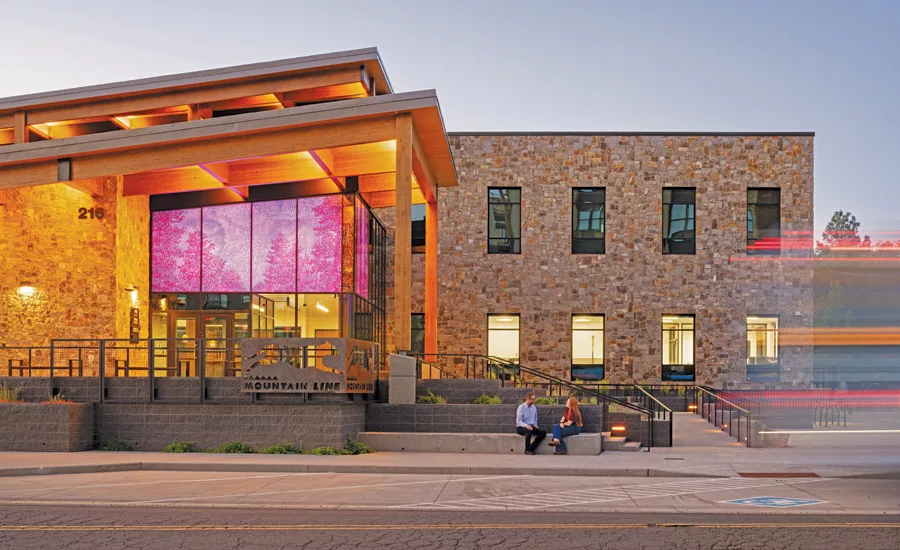
The team sought to create a minimalist, materials-forward design. The project also incorporates public art via a separately funded arts program.
Mountain Line Downtown Connection Center
Ariz.
BEST PROJECT, AIRPORT/TRANSIT, and EXCELLENCE IN SUSTAINABILITY
Submitted by Loven Contracting
Owner Mountain Line
Lead Design Firm HDR
Construction Manager Loven Contracting
Civil Engineer Ardurra
Structural Engineer MBJ
MEP Engineer Affiliated Engineers (AEI)
Mass Timber Consultant Timberlab
Providing residents with a welcoming new transit facility, the $25.5-million first phase of the Mountain Line Downtown Connection Center nestles into an extremely tight footprint surrounded on three sides by a busy railroad line, the main roadway to downtown Flagstaff and active bus terminals. Designed by HDR, the two-story, 20,938-sq-ft operations center brings mass timber construction techniques to Northern Arizona for the first time, and it is only the second such building in the state.
“Our vision was to create a facility that would be functional and welcoming for our employees and riders, would complement the rich history of Flagstaff’s Southside and would lead the way in sustainable design for public infrastructure,” says Heather Dalmolin, Mountain Line CEO and general manager.
The judges agreed. “From safety to sustainability to teamwork to innovation, it checked every box for me,” one panelist said.
With mass timber being so new to Arizona, construction manager at-risk Loven Contracting not only had to get up to speed quickly themselves, but also had to facilitate an extended planning process as well as educate local trade partners. To lend additional expertise, “we went out for a qualifications-based solicitation for the mass timber trade partner and selected Timberlab out of Oregon to partner with, bringing them in at 60% drawings, which really helped to finish the design,” says Jon Hansen, Loven president.

The team had to meet tolerances of 3/16 in. between the masonry shear walls and the CLT. Using BIM to plan penetrations resulted in a sleek, clean interior.
Photo courtesy Emily Gerdes/Loven Contracting
The team engaged with the city of Flagstaff early to navigate the permitting process. Joint discussions covered fire resistance, moisture protection, connection strategies and code interpretations, the team says, which gave the city the confidence to issue its first permit for a mass timber structure.
Site demolition began in March 2023, which came with its own set of challenges. In addition to being hemmed in on all sides by transportation lines under different jurisdictions—a BNSF railroad to the north with 125 freight trains running every day, ADOT’s roadway to the west, a Flagstaff street to the south with a dozen Mountain Line buses arriving and departing every half hour and a future large-scale Army Corps of Engineers-led flood control project, Rio de Flag, to the east—construction crews also had to place underground a high-voltage power line feeding downtown Flagstaff that runs through the site.
“The DCC has set a standard for how publicly funded buildings can be both functional and beautiful.”
—Heather Dalmolin, CEO & GM, Mountain Line
The building also sits within a 100-year floodplain, which required mitigation. After studying various methodologies, “we found out that if we just went up 6 more inches, we’d be at the correct height that we would need to be to not have any flood protection,” says Jarod Bogenrief, project architect with HDR. The project adheres to universal design, and access ramps, landscaping features and stairs are integrated into the entry plaza with minimal guardrails.
The project began going vertical in fall 2023 to get ahead of the winter season. Due to the fabrication timing for the mass timber, the project’s load-bearing masonry walls had to be built first; they also serve as the building’s shear walls.
To accommodate the timber, precision was critical. Masonry shear walls had to meet tolerances of 3/16 in. to align with prefabricated timber. Walls were surveyed every 4 ft to ensure precision. All system penetrations had to be planned and prefabricated into the timber. The team used BIM for advanced coordination, trained local trades and adjusted typical workflows to better fit the use of mass timber.
By coordinating all MEP penetrations in advance, CLT panels arrived primed for installation, reducing construction time and rework. Through rigorous planning with Timberlab, 30 truckloads of mass timber were delivered just in time, each component lifted directly from the trailer by a single crane placed in the only viable location and carefully avoiding subsurface stormwater retention chambers.
Just-in-time delivery also minimized disruption to surrounding businesses, residents and Mountain Line operations, the team says, adding: “This carefully choreographed process allowed the project to be completed safely and efficiently in a high-traffic area, setting a high standard for urban infill site development with minimal community impact.”
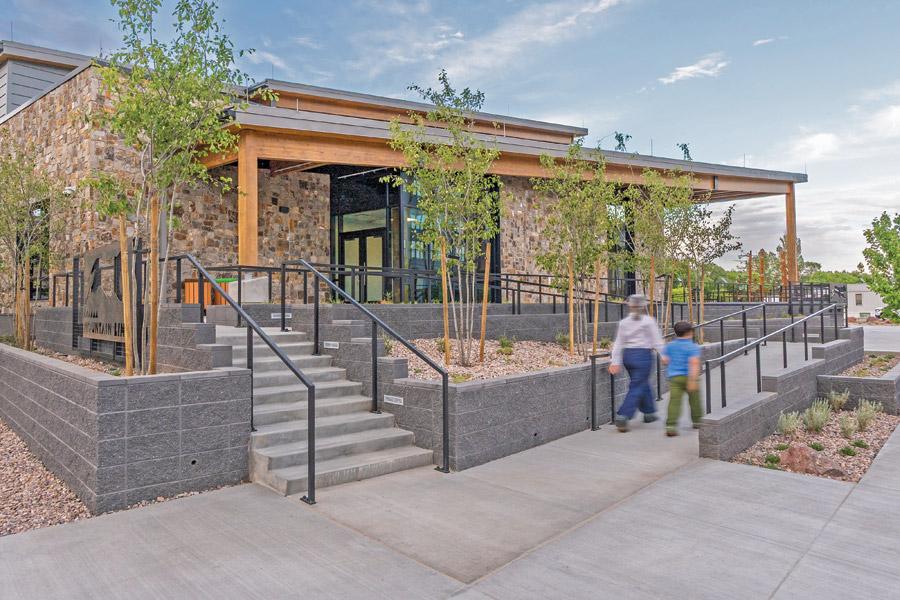
The building was raised to avoid the need for flood protection in the site’s 100-year floodplain. Access ramps, landscaping and stairs are integrated into the entry plaza in an organic way.
Photo courtesy Emily Gerdes/Loven Contracting
Inspired by Northern Arizona’s robust sustainability culture and buoyed by the promise of lower operational costs, the team designed the project to achieve net-zero energy use via radiant heated and cooled floors, chilled beams, cold climate air source heat pumps and photovoltaic panels that will supply about 80 kilowatts, says Brett McQuillan, senior building performance engineer at Affiliated Engineers Inc. “The chilled beams in combination with the radiant floors let us minimize the amount of overhead distribution that was required in the building, which allowed us to expose more of the CLT mass timber structure,” he says.
Heating from below also boosts efficiency and reduces the overall volume needing to be heated, especially in Flagstaff’s cold winters.
Safety was also a primary concern due to the tight site conditions, active transit corridors, demolition of an existing structure and use of a long boom crane to install mass timber from a single lift point. Subcontractors say Loven more than lived up to these challenges.
“Their sites have become the kind of place where I want to send my young apprentices because I know they’ll be safe, and they’ll be learning the right way to do things from Day 1,” says Chip Ogden, owner of Another Plumbing Co. “Every morning started with clear expectations. Loven’s supervision team was on it. They are consistent, professional and always willing to slow down and explain things. From proper PPE use to job hazard analyses, these were more than checkboxes; they were habits getting formed in my crew’s muscle memory.”
Melonie Leslie, president of G & G Masonry, adds, “We utilized open communication with each other regarding potential safety issues on site to get them resolved before arrival such as power lines, deep footing conditions, wall bracing and safe unloading zones.” Masonry work followed a silica exposure control plan, and there were daily inspections of scaffolds and fall protection equipment.
“The final product took what was once an eyesore of a building in one of the community’s most prominent locations and transformed it into a warm welcome to historic downtown Flagstaff,” says Dalmolin. “The DCC has set a standard for how publicly funded buildings can be both functional and beautiful, and we are proud to call it our new home.”