Digging Deeper | Environment
Southern California's Wildlife Crossing Prepares for its Debut
The Wallis Annenberg Wildlife Crossing in Agoura Hills will be the largest in the world when completed.
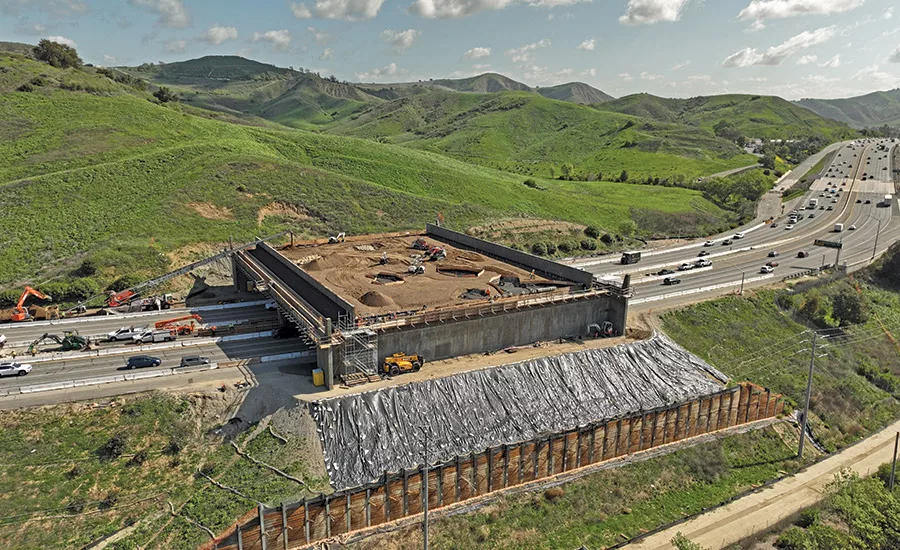
The Wallis Annenberg Wildlife Crossing north of Los Angeles Is the first bridge in the California Highway System designed and built specifically for wildlife connectivity.
The world’s largest wildlife crossing is taking shape over the busy Highway 101 in Agoura Hills, about 35 miles northwest of Los Angeles. Phase 1 of The Wallis Annenberg Wildlife Crossing is just about complete, and Phase 2 began this summer.
The $92-million public-private partnership is led by owner California Dept. of Transportation (Caltrans), with the National Wildlife Federation serving as a key fundraising partner. Chicago-based Rock Design Associates LLC is leading design, and Valencia, Calif.-based C.A. Rasmussen Inc. is the general contractor.
Spanning 10 freeway lanes, the 12-acre project’s purpose is to protect and reconnect native animals isolated by the highway. A National Park Service study found that highways are not only deadly for animals trying to cross, but also create islands of habitat that can genetically isolate wildlife such as the cougars of the Santa Monica Mountains as well as bobcats, birds and lizards and other fauna.


“The Wallis Annenberg Wildlife Crossing will soon protect Los Angeles’ native wildlife and over 300,000 drivers daily, as well as provide a cutting-edge model for urban wildlife conservation,” said California Gov. Gavin Newsom in a news release.
In Phase 1, crews built the 210-ft-long, 174-ft-wide crossing, providing an acre of vegetative space with up to 4 ft of soil and 5,000 plants native to the Santa Monica Mountains, namely coastal sage scrub plant species. It is constructed with more than 26 million lb of concrete, vegetated sound barriers, habitat rock formations and 6,000 cu yd of soil.
Robert Rock, president and CEO of Rock Design Associates, says the biggest difference between the wildlife crossing and a regular roadway bridge is that crews are dealing with dead load instead of live load. “You have to deal with the loading on top of the structure and saturated soils and water,” says Rock. He adds that the design weight for the dead load was about 425 lb per cu ft on top of the structure.
Darwin Vargas, Caltrans senior bridge engineer, says the purpose of the crossing—to provide for animals—is unique. “Typically, we build bridges to allow movement for trains, vehicles, cyclists or pedestrians. This bridge is built for nature and to allow animals to cross,” says Vargas. “What is unique is the approach we took on how to design and build it. As an example, the color of the concrete on the bridge and the lighting was specifically chosen to minimize impact to wildlife while maintaining safety standards for the traveling public. The soil that was placed on the bridge was designed from the molecular level on up.”

Graphic courtesy of the Annenberg Foundation
The crossing is a pinned bridge, supported with 82 precast box girders weighing 60 tons each. Adam Rasmussen, president of C.A. Rasmussen, says that for a pinned bridge, the deck is what holds it together.
“You have an abutment on either side of the 101 freeway, and they’re hanging up in the air,” says Rasmussen. “You set the girders across, and they all connect like a Lego set, and the concrete holds it all together.”
“The girders are put together like a giant Three Musketeers bar.”
—Robert Rock, President & CEO, Rock Design Associates
As part of Phase 1, crews backfilled the north side of the crossing. For Phase 2, the south side of the crossing will be backfilled with an equal amount of earth for weight and pressure.
“Caltrans is very specific that when you put pressure against one side of the bridge, they want you to bring that dirt up equally on the other side of the bridge, because that’s gonna hold it together,” says Rasmussen.
The girders were put together “like a giant Three Musketeers bar,” says Rock. “Inside is a giant chunk of foam, and there’s a rebar cage, and then they had to put concrete around the outside of it,” he says.
“You’d think that you could pour [concrete] down on both sides, and it would be fine,” he adds. “But the issue is that because of how they had to construct the girders, if you pour it down on both sides of that form, air gets trapped underneath in the middle. So what they had to do was pour it down on one side, vibrate it underneath the bottom, then pour the other side and coat the top of it to close the whole thing off.”

The first step of construction the wildlife crossing involved building the concrete abutments on either side of US 101.
Photo courtesy of Caltrans
Designers opted early on for precast instead of cast-in-place girders. Crews were able to truck in three to four of the units each night, requiring only half of the freeway to be closed at a time. “If we would have done cast-in-place concrete, we would have had to build all that falsework and then close the entire freeway,” says Rock, adding that it took 43 consecutive nights of alternating nightly closures to place all 82 girders.
Vargas says the most challenging aspect of the project was shutting down the 101 freeway while crews erected the girders with the help of a 500-ton crane.
“We could not deviate from the tolerance of being off by one half-inch on the over 100-foot-long girders to set them in place,” he says, noting that girder placement took only six weeks as opposed to two months.
Setting the falsework to support those girders was also difficult, says Rasmussen. “We used more than 100,000 board feet of lumber and 11,000 three-fourth-inch bolts,” he says. “This was a design created by Rasmussen in collaboration with Caltrans to ensure the temporary supports could support the girders until the top deck of concrete was poured.”

The busy freeway had to be shut down for periods while a 500-ton crane placed the precast beams for the overpass.
Photo courtesy of Caltrans
Creature Crossing
Phase 2 will reconnect the hillside north of the freeway with the wilderness area on the south, allowing animals to roam freely and safely across the structure. This will involve about 11,000 truck loads moving more than 110,000 cu yd of earth over a 125-ft grade differential.
“The majority of the dirt is located on the north side of the freeway and is needed on the south side to complete the tie-in from Phase 1 to Phase 2 of the project,” says Rasmussen. “There is an incredible amount of finish grading that has to be completed. The final grades are very important to the project, as they are part of a meticulous landscape design that will be planted and landscaped to blend in seamlessly to the existing mountains.”
Rasmussen adds that crews are trying to reuse as much existing earth as possible on the site, which would keep the price down.
“Anytime you don’t have to handle dirt or haul it away, you save money, so we’re trying to rebalance the site, adjust grades, and we are mining the dirt to see if any of it can be screened and processed to be used for structural backfill,” he says. “Obviously when you’re building bridges and you get them up in the air, you have to backfill against the abutments; you can’t just use any type of dirt, it has to be select, and it has to have special characteristics. And this is a big piece of the project, probably millions of dollars.”
“This bridge is built for nature and to allow animals to cross.”
—Darwin Vegas, Senior Bridge Engineer, Caltrans
For Phase 2, the earth will be used to backfill the south side of the wildlife crossing, and a new, 200-ft-long by 60-ft-wide bridge will be constructed over Agoura Road. This new structure will be a pinned bridge like the larger wildlife crossing, but it will not have precast girders.
Phase 2 also involves restoration of natural hydrology to ensure proper water flow, protection of mature heritage oak trees and coordination with multiple agencies to relocate essential utilities along the freeway corridor.
The project was originally planned to open in 2025, but the “last two springs brought crazy rainstorms, which had a major impact on pushing back the schedule,” says Rock. He says on a couple of occasions, unseasonable, heavy storms brought several inches of rain that washed massive amounts of sludge into footings while crews were trying to complete freeway abutments. This caused substantial delays to the schedule, says Rock.

Once the bridge deck was completed, 6,000 cu yd of soil were spread across it to create a natural environment.
Photo courtesy of Caltrans
When everything is complete in December of 2026, the project will blend into the hillside with the use of colored concrete instead of paint on both of the bridges and all exposed elements, including columns, abutments and exterior girders.
“Colored concrete makes that bridge a little different and adds to its beauty, but it is also challenging,” says Rasmussen. He says the color was so rich and there was so much additive in the mix to get the color that they wanted, that the concrete was slow to cure and get the strength it needed.
“It was concerning watching the concrete cure over 28 days, but it did cure on time, and it all worked out in the end,” says Rasmussen. “And the slower concrete cures, the less chance there is for cracking.”
Rock says to obtain the desired brown color, crews added about 55 lb of pigment to each concrete mix, as opposed to about 5 or 6 lb per mix for architectural concrete.
“We’ve added a pigment into the concrete to reduce the surface reflectivity index of the concrete so that when artificial light bounces off that surface and hits that particulate matter in the atmosphere, we don’t have sky glow, because sky glow actually is an impediment to wildlife movement at night,” says Rock.
The project exemplifies a growing trend thanks to $350 million in Infrastructure Investment and Jobs Act funding for wildlife crossing construction rolling out in 2023. A proposed high-speed rail line connecting Southern California and Las Vegas will include wildlife crossings as part of an agreement between the developer, Brightline West, and the California Dept. of Fish and Wildlife.
And in Colorado, a $15-million Greenland Wildlife Overpass aims to reduce vehicle-animal collisions by up to 90% on one of the state’s busiest highway stretches. The 209-ft-long, 200-ft-wide bridge will, when built, rival the Annenberg crossing for the status of being the world’s largest.