August 2025 City Scoop: Sacramento
Sacramento Construction Stays on the Rising Road
Construction starts returned to earth after a 2024 surge driven by health care, but the longer term trends point to an upward trajectory
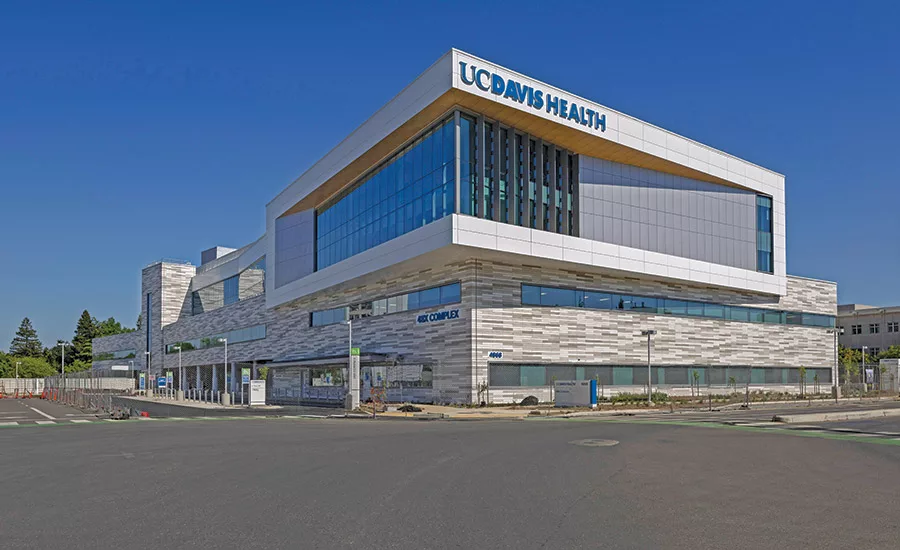
Progressive design build, which was used on DPR’s UC Davis Health 48X project, is growing in popularity across the Sacramento region.

Abe Sipes
Sacramento Business Group Leader
DPR Construction
The Sacramento AEC sector has quietly emerged as an island of stability as a sea of finanical uncertainty has engulfed the state. A boom year in 2024 that was driven by non-residential building starts may have ebbed only to rebound next year.
According to Dodge Data & Analytics, regional construction starts experienced a boom in 2024 to reach $11.4 billion. That figure is expected to plummet by more than 20% to $9.1 billion this year, although remaining $1.6 billion over 2023.
An increase in economic confidence and demographic growth are the likely reasons, Sipes says.
“Financing is a little bit better than it was a handful of years ago when the market had kind of dipped, and now it seems to be coming back,” he says.
The standout performer in 2024 was health care facilities, which topped $3.9 billion for the region. According to Sipes, the surge in starts is likely tied to a demographic shift away from the San Francisco Bay Area and into the Sacramento region.
“There’s more health care needs in the area and health care providers seeing that, and so there’s a ton of work,” he says. “We’re also seeing life sciences markets pick up, which has been good.”

The UC Davis Health 48X complex that opened this summer is a prime example. DPR partnered with SmithGroup for the progressive design-build delivery of the $579-million outpatient surgery center on the UC Davis Sacramento campus. The 268,228-sq-ft facility boasts a full floor of 14 operating rooms, including a hybrid OR and multiple robotic ORs as well as a full suite of four interventional radiology rooms.
UC Davis also recently debuted the first phase of a major life sciences facility on the Sacramento campus, the $1.2-billion Aggie Square research hub (ENR West 4/29/24 p. 28).
The ambitious effort was delivered through an innovative public-private partnership between UC Davis, the city of Sacramento and Wexford Science & Technology. Contractor Whiting-Turner Contracting Co.’s first phase of work focused on two primary buildings that make up 728,000 sq ft of multi-use space featuring areas for start-up companies, community programming and classrooms.
While health care and life sciences have boomed, DPR remains sanguine about other core markets that have not enjoyed such a robust recent performance.
“Financing is a little bit better than it was a handful of years ago when the market had kind of dipped, and now it seems to be coming back.”
—Abe Sipes, Sacramento Business Group Leader, DPR Construction
“Higher education has been down a little bit recently for us,” Sipes says. “They’re still building, but it’s not the pace that it was a few years ago.”
According to Dodge, education building starts did indeed take a dip in 2024, reaching just $350 million after topping $863 million two years prior.
Starts are expected to total $566 million this year, a nice rebound but significantly under the heights hit in 2022.
For DPR, mastering progressive design build, which was used on the 48X project, has proven to have an array of benefits.
The delivery mode improves the company’s bottom line while going a long way toward building stronger relationships with clients due to the collaborative approach it requires, Sipes says.
“I personally think it is just a great way to build,” he says. “You end up getting an owner that
has a product at the end of the day [that] they’re typically happier with.”
Design build has also proven to be an effective way to battle industrywide challenges such as rising materials costs and supply chain disruptions. By getting ahead of the design, choices regarding items that require long lead times can be anticipated, decided on and executed, Sipes says.
Another strategy the firm has employed is prefabrication, constructing elements of the buildings in advance and integrating them into the structure on a planned schedule.
Putting together elements of the building when supplies are available eliminates the delays of constructing everything piece by piece in the field.
“By building stuff well before it actually goes into the building, you kind of know some of these milestones that have to happen, and then when the material shows up, it’s ready to go right in,” he explains.
“There is less of a chance for the rest of the construction to be impacted,” he adds.