Government/Public Building
Pennsylvania Project Team Wrangles with Long-Span Timber Complexities
British Columbia-based StructureCraft helped design an affordable rec center for Upper Macungie Township
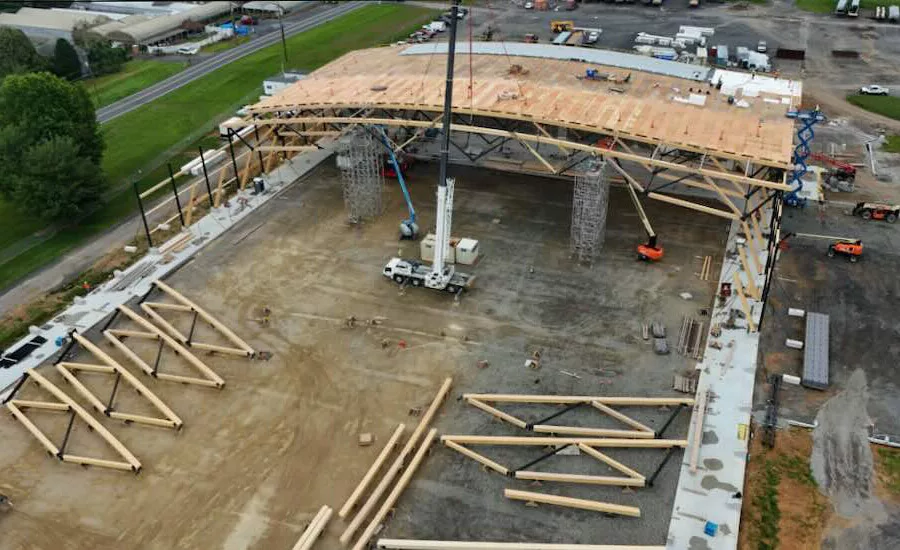
Heavy timber framing is one quarter complete for the UMT Community Lifestyle Center’s indoor soccer facility. Roof construction is also underway with installation of glulam purlins with two layers of plywood fabricated and installed by StructureCraft crews in early summer.
An architecture team spent nearly a decade designing and redesigning a recreation center for a growing Pennsylvania township that ultimately opted for an affordable heavy timber-steel hybrid building.
British Columbia-based StructureCraft—structural engineer of record and superstructure design builder for the $49 million project—was tasked with conceiving a long-span timber building that would fit the project’s budget, a key concern for Upper Macungie Township.
“I have had this vision for some years now to see how we can create an economical and attractive wood/steel hybrid structure as an alternative to the utilitarian steel buildings the public has grown accustomed to,” says Gerald Epp, president and chief engineer at StructureCraft.

The UMT community recreation center includes four interconnected buildings with a total gross floor area of about 188,000 sq ft. The 133,000 sq ft indoor soccer facility is the largest of the four structures that includes two flex gyms, and an entrance/amenity building.
Credit: HKA5
Upper Macungie Township Manager Robert Ibach recalls when the township of 29,000 people decided to consider a mass timber design, “we took a final look at steel and found the cost of timber construction was cost competitive with steel at the time slightly higher in cost.”
Including four interconnected buildings, the recreation center with a total gross floor area of about 188,000 sq ft. The 133,000 sq ft indoor soccer facility is the largest of the four structures that will include two flex gyms with basketball courts, and an amenity/lobby building. The indoor soccer facility includes gable walls framed with glulam columns and wind girts. The flex gym buildings are similar with gable walls and purlin-plywood roof panels, and the amenity/lobby building feature a mix of light wood frame walls and glulam framing.
Set for overall completion next summer, the project’s timber superstructure erection began in April and will finish by year’s end.
“It has taken a long time to get here,” says Ibach. “At times it looked like nothing was going to be built.”


View of bottom chord node on the indoor soccer facility’s portal frame where high compression was occurring. The StructureCraft team detailed support so the pipes that connect to the nodes brace up into the building’s diaphragm, locking the nodes so they are unable to jut out sideways.
Courtesy of StructureCraft
*Click the images for greater detail
Minimizing Costs
In 2016, the town hired Howard Kulp Architects to create a design that didn’t just look like another factory warehouse. The township wanted “a blend of structural innovation, sustainability and a warm, inviting community space that provides both function and beauty,” says Nathan Moyer, project manager for Allentown-based HKA5, which merged with Howard Kulp in 2024, and is now the project’s design architect and architect of record.
The township also wanted the center to serve as a landmark of the Lehigh Valley region, the fastest growing and third most populous region in the state, according to a report released by the township.
But to do all this within the township’s budget, material costs had to be minimized. The team achieved this by designing a structurally efficient, long-span building that maximized offsite pre-assembly to keep labor costs down.
René Visscher, StructureCraft senior structural engineer and lead project engineer, says all the computer numerical control milling of the wood connections was conducted off site. “The glulam arrived with the CNC notching and cutting complete and the majority of the fasteners and the connections pre-installed,” Visscher says.
The fully fabricated Austrian glulam beams, columns and trusses totaling 50,000 cu ft, in addition to 250,000 lb of steel structural members and 80,000 lb of steel connections received by StructureCraft from its suppliers, were shipped to the site, Visscher says.

At the east elevation with the gable wall, crews erected the first portal frame for the indoor soccer facility in early summer.
Courtesy of StructureCraft
Achieving stability along the long-span structure required optimizing the geometry of the portal frame, Visscher says. “In schematic design we explored a range of different structural options to arrive at a solution that’s the most materially efficient and structurally safe,” he says.
Spanning 280 ft, the top chords near the center span, the bottom chords and the struts at the outer edges of the timber steel portal frame structure down to the foundation, are all under high compression, Visscher says. To stabilize the bottom chord nodes with pipe bracing to prevent them from buckling outward, the team linked the four bottom chords together and tied that up into the building’s diaphragm.
Once the team built its parametric geometry model, Visscher spent a month exploring a range of geometric and structural options that fit within the job constraints using finite element modeling software.
“I can explore geometry, structural behavior and a little design in real time to speed the optimization process,” he says.
Ibach, the town manager, says “The beauty of the design” provided momentum for the project, which has received some $44 million in awarded bids and includes $750,000 in federal funds and $5 million from the state.
The project is also a nod to the township’s agricultural background with Pennsylvania German post and beam constructed barns. “This building, in a small way, pays homage to that history by replicating that style of construction,” Ibach says.

Crews lifted and rotated one of the 124-ft-long keystone assemblies for the indoor soccer facility in early summer.
Courtesy of StructureCraft
Procurement Strategies
The dynamic of procurement and finalizing the delegated design, which was 60% complete at bid time, created significant challenges, says Kyle Collina, project manager for Butz Construction, the town’s construction manager.
Knowing StructureCraft and the architect would be fine-tuning the design and some of the details would change as they progressed required strategic volleying to consider the impact of various timelines subject to town approval, along with procuring the European spruce timber from Austria. Preconstruction timing was key to managing this hurdle since the wood needed a long lead time, so the team planned its start date and milestones accordingly.
“Our preconstruction strategy was to have the project and costs approved at a mutually convenient time in relation to procurement/fabrication of the heavy timber members,” Collina says, “including consideration of the time of year it would arrive on site for installation.”
The biggest hurdle to date is tying in the insulated metal panels on the walls, Collina says. The Butz construction team had to fine-tune the shop drawings between the metal panel supplier Kingspan and StructureCraft and make it weather tight. Since StructureCraft was finalizing the design at bid time, the whole project team worked together to fine-tune the elements that interacted with the structure and troubleshoot those details to provide a complete building envelope, he says.

Crews landed a keystone assembly on the shoring towers in early summer for the indoor soccer facility.
Courtesy of StructureCraft
Site Progress
Following a rainy spring, crews are working to make up lost time. Heavy timber framing is one quarter complete for the indoor soccer facility, he says. Roof construction is also underway with installation of glulam purlins with two layers of plywood fabricated and installed by StructureCraft crews.
“We’ll continue chasing StructureCraft, trying to get the building weather tight as possible, quickly following our completed work with the roof and metal panel installation,” says Collina, who is working on his first structural timber project. “I can see how this one is something new in the region that is going to be unique for the community.”
Ibach is excited about big contributions the small recreation staff at the center will provide for residents. “There will be opportunities for all ages and abilities to enjoy the facility and what is offered inside,” he says.


.webp?height=200&t=1777728024&width=200 "Harvard’s American Reparatory Theater project")
