Digging Deeper | Industrial/Manufacturing
$3.2B Pharma Project Offers Rx for Rapid Facility Replication
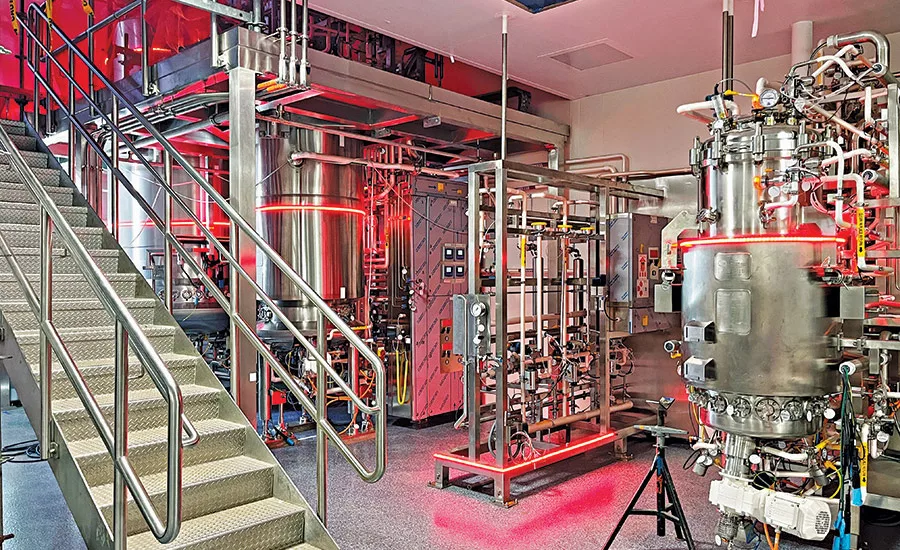
Scheduled for August 2025 completion, the initial $2-billion phase included construction of a 1-million-sq-ft complex with two drug substance manufacturing buildings, each containing four 20,000-liter bioreactors, plus an automated fill-finish, packaging and labelling building.
Currently under construction in Holly Springs, N.C., Fujifilm Biotechnologies’ new $3.2-billion cell culture contract manufacturing site is a one-of-a-kind facility that is designed to be North America’s largest hub for the production of biologics, vaccines and advanced therapies, according to the company.
At the same time, the facility’s buildings, layouts and process systems have been designed to be quickly and easily replicated virtually anywhere around the world, positioning Fujifilm Biotechnologies to help global clients bring their innovations to market as quickly as possible.
Demand for these services was evidenced by the company’s decision last year to expand the Holly Springs plant before the scheduled August 2025 completion of the initial $2-billion phase—a one-million-sq-ft complex with two drug substance manufacturing (DSM) buildings, each containing four 20,000-liter bioreactors, plus an automated fill-finish, packaging and labelling building. Jacobs, the program’s engineering, procurement and construction manager, has already begun construction of a $1.2-billion, 400,000-sq-ft expansion that will double manufacturing capacity. That phase is scheduled to be complete in March 2027.
Lindsay Gerding, senior vice president and general manager for Jacobs’ life sciences operations, says such rapid growth is understandable in a global pharmaceutical market where spending is expected to top $2 trillion over the next four years. The growth is driven in large part by advancements in therapies for the world’s aging population. That, she adds, has changed the role of companies like Fujifilm Biotechnologies, which operate as contract development and manufacturing organizations (CDMOs) to pharmaceutical companies.
“Where once CDMOs focused more on producing lower-cost and generic drugs, they now provide the speed and scalability to get breakthrough drugs to market faster, allowing pharmaceutical companies to focus on product development and testing,” Gerding explains.
Cloneable Collaboration
Not surprisingly, designing and delivering such a high-tech pharmaceutical manufacturing facility required an equally aggressive timeline. The key, says Gerding, was using a data-centric approach in which a digital template was created from consistent modeling and data standards. This, in turn, enabled Jacobs’ design team to develop a flexible, modularized design that would help speed the process of constructing the facility and fabricating process equipment for installation.
“Not only did we have a 3D model of the design, we were able to incorporate scripts—[rule-based algorithms]—that would automatically create models for replication, all with less effort,” Gerding says.
“We were able to incorporate scripts— [rule-based algorithms]— that would automatically create models for replication, all with less effort.”
—Lindsay Gerding, Senior Vice President and General Manager, Jacobs
Because Fujifilm Biotechnologies planned for the Holly Springs complex to be the model for a similar facility to be constructed in Hillerod, Denmark, Jacobs’ design team incorporated details to ensure concurrent compliance with both U.S. and Danish building codes, including specifying interior environment enhancements such as additional glass and ductwork. Another consideration was the fact that buildings in Hillerod must meet architectural requirements based on Frederiksborg Castle, the historic seat of Denmark’s kings. As such, DSM buildings in Holly Springs, as well as those in future iterations, are limited in height to approximately 80 ft.
As a full EPCM, Jacobs’ construction team was closely involved from the outset, providing constructibility input that helped shape the design. The firm’s data-driven approach also facilitated the use of time-based 4D-animated schedule development, allowing the project to transition seamlessly into a construction phase that also would maximize the use of prefabricated modularized components and improve trade collaboration in the field.
This approach would also help optimize project staffing, which was critical for a project of this scope and size, says Jacobs vice president and executive program director Glenn Wakefield.
“It’d be unrealistic to try and recruit that many workers to do everything needed on site, given the labor shortage,” he says, adding that eliminating millions of hours of construction at elevation through offsite prefabrication “would also make the project much safer.”

Jacobs, working as an EPCM, was scheduled to complete the first phase of Fujifilm Biotechnologies’ new cell culture contract manufacturing site in late August and has already started construction on the second phase.
Photo courtesy Jacobs
Building Blocks
Before putting these plans into action, Jacobs first needed to assemble a construction team and identify supply sources—not an easy task in the post-COVID construction environment of 2021. Rather than relying on bid proposals, Steve Ingle, Jacobs’s life sciences construction director, says a more personal team-building approach was needed.
“It took a lot of getting people on the phone, explaining the project and seeing if they could provide what we were looking for,” Ingle says.
Preparing the plant’s 150-acre site for construction was hardly easier. Ironing out a 60-ft elevation change required moving approximately 1.6 million cu yd of earth, and an estimated 200 tons of dynamite was used to blast out partially weathered rock. The close proximity of residential areas added another dimension of complexity, which Jacobs addressed by using excess topsoil to build a large berm along the site perimeter and installing seismographs in nearby lawns. An onsite batch plant, which would produce 45,000 cu yd of concrete, eliminated the need for more than 4,000 truck deliveries, Ingle adds.
Set on slab-on-grade foundations, the shell buildings for the Holly Springs plant are steel-framed with insulated panels. For both project phases, foundation slab sections in the DSM buildings are up to 18 in. thick, depending on floor loading requirements. Autonomous robotic inkjet printers are used to lay out precise floor plans directly onto the slabs, helping reduce clashes in the field.
“We tried to build as big as we could while making sure we didn’t create something that couldn’t be replicated elsewhere.”
—Steve Ingle, Life Sciences Construction Director, Jacobs
Construction of the buildings must be carefully synchronized with fabrication, testing and installation of hundreds of modularized process equipment, or skids, delivered from partner suppliers across the country. Local subcontractors fabricate pipe racks for the miles of cabling, piping and ductwork connecting the systems.
Jacobs says more than 10 million tons of equipment were received for Phase 1. The largest “super-skid,” a 70-ft by 150-ft high-stability storage system comprised of more than thirty 4,000- to 12,000-liter vessels, was disassembled after factory acceptance testing and shipped to Holly Springs aboard 25 trucks.
“We tried to build as big as we could while making sure we didn’t create something that couldn’t be replicated elsewhere in the world,” says Ingle, who likens the project to building 250,000-sq-ft watches, with multiple layers of intricate process and support equipment, all of which must be installed in the correct sequence.
Having received the go-ahead to build the Holly Springs plant’s second phase, Jacobs had the opportunity to implement construction process refinements gleaned from the past two years of construction. They include casting all floor penetrations along with the slab, incorporating exterior siding clips into the prefabrication process and modularizing 35-ft-deep pits for process and biologic waste tanks located in each of the DSM buildings.
As a result, Jacobs says, the first 10% of the Holly Springs plant’s second phase has already yielded four months of schedule savings.
“It’s a unique opportunity for the same craftworkers, supervisors and design team to immediately apply everything that we’ve collectively learned,” Ingle says. “We’ve even identified a few opportunities where prefabricated tasks are actually more efficiently performed in the field, such as fabricating pipe racks that carry only a few lines.”

To enable the building’s design to be duplicated and ensure concurrent compliance with U.S. as well as Danish building codes, building heights are limited to approximately 80 ft.
Photo courtesy Jacobs
Supporting Speed and Safety
Although much of Fujifilm Biotechnologies’ equipment and building systems are fabricated off site, Jacobs says the Holly Springs site itself remains bustling with activity. Summer 2024 saw the onsite population peak at 2,500 craftworkers, along with hundreds of engineers/designers and construction managers.
To attract and, perhaps more importantly, retain craft labor for the project, Jacobs has provided amenities such as air-conditioned toilets and break rooms, a fully staffed medical center and open parking. Similarly, all project team members occupy the same space in the project’s trailer complex.
“There’s no us/them, but rather a single team of people working together to build the project,” Wakefield says.
The project team has also strived to make the Holly Springs plant site as safe as possible. With nearly 13 million onsite staff hours logged as of June 2025, the Fujifilm Biotechnologies project has achieved a total recordable incident rate of 0.06, earning recognition from the North Carolina Dept. of Labor for exemplary safety performance.
As of early August, Jacobs was working with Fujifilm Biotechnologies to begin production at Phase 1, while the buildings for the expansion were taking shape nearby. Installation of MEP systems will ramp up as first process equipment modules begin arriving on site, the company says.
Standardized, Personalized
Along with rapidly providing needed manufacturing capacity for the pharmaceutical industry, Gerding says the cloneable facility design and construction approach being utilized in Holly Springs can be applied for all or parts of other building types that lend themselves to repeatability, such as data centers and health care facilities. She notes that they need not be bland, faceless structures.
“You can standardize core manufacturing and operation spaces while providing a more personalized, sustainable feel to labs, administrative areas and other spaces where employees interact,” she says. “These features play a key role in customers’ ability to attract and retain coveted talent, making it an enjoyable place to work and spend their time.”

