Watertight
NYC’s $700M Subway Resilience Plan Hinges on $30B Sewer Upgrade and Local Action
MTA hardens subway infrastructure while citywide sewer overhaul and neighborhood interventions shape climate resilience
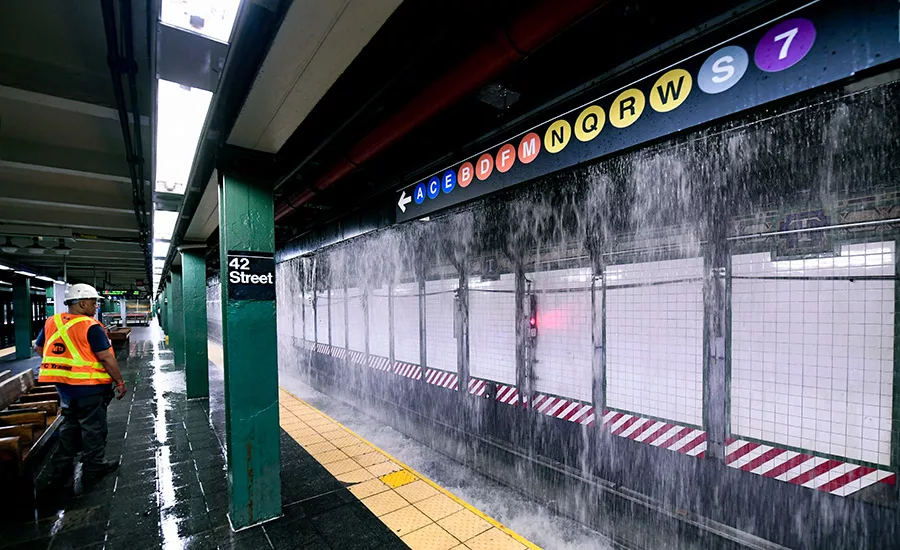
MTA crews respond to a water main break near West 41st Street and Seventh Avenue that caused water to flood into the Times Square-42nd Street station in August 2023. The incident highlights vulnerabilities that the agency’s $700 million subway climate resiliency program aims to address amid increasing extreme rainfall events.
MARC A. HERMANN/MTA via Creative Commons
The Metropolitan Transportation Authority’s $700 million program to fortify New York City’s subway system against flash flooding is advancing on multiple fronts.
However, officials and regional experts warn that its success depends on complementary upgrades to the city’s aging sewer network—a $30 billion, multi-decade effort—and on smaller-scale interventions by neighborhoods.
A July 15 storm that dropped 2.1 in. of rain in one hour overwhelmed the combined sewer system and sent torrents of water into subway tunnels. Crews pumped more than 15 million gallons overnight to restore service.
“We pump 10 million gallons on a dry day. Yesterday, we pumped like 15 million plus,” MTA Chair and CEO Janno Lieber said in a July 16 interview on local television news station NY1. “We got 2.1 inches in one hour last night. That’s when the big backups happen.”
The MTA’s current capital plan includes raising entrances at flood-prone stations, upgrading nearly 250 pumping stations and reinforcing embankments along Metro-North’s Hudson Line. Lieber credited New York state for supporting the initiative but noted federal funding accounts for only about 20% of its capital budget.
RELATED
Talking Isn't Building: More Action Needed on Surge Protection Barriers
“This climate investment is mostly state money … We bless our friends at Albany for stepping up,” Lieber said.
While the MTA focuses underground, the city’s Dept. of Environmental Protection is working at street level to manage stormwater. Earlier this year, DEP unveiled a citywide hydraulic model of its 7,500 miles of sewers, allowing engineers to simulate system performance during extreme weather and prioritize high-risk areas.
Commissioner Rohit T. Aggarwala described the model in a statement as a “major milestone,” adding, “The data gathered will guide our future stormwater management decision-making.”
DEP estimates comprehensive sewer upgrades—including larger mains and underground detention systems—could cost up to $30 billion. To accelerate resilience, the agency is combining traditional gray infrastructure with green infrastructure and public-private partnerships.
Through its Resilient NYC Partners program, DEP is collaborating with firms such as Arcadis to retrofit large private properties with bioswales, permeable pavement and subsurface detention systems.
Nick Nyhan, founder of The City Sponge, a grassroots initiative promoting neighborhood-based resilience, said distributed solutions are critical alongside large infrastructure investments.
“Even if you gave DEP $30 billion, they can’t keep up with the water,” Nyhan said. “You need individuals and neighborhoods to adopt small-scale mitigation measures—rain barrels, permeable paving, backflow valves—because the city can’t do it alone.”
Nyhan also emphasized the visibility of green infrastructure. “People see a bioswale or rain garden, and it’s beautiful. That matters. Big sewer projects don’t give you that same visible payoff,” he said.
Robert Freudenberg, vice president for Energy and Environment at the Regional Plan Association, a New York-based planning nonprofit, agreed that layering solutions is essential.

A flood map developed by the Pratt Institute, shared by The City Sponge, highlights dozens of subway stops across New York City prone to flash flooding—a visual reminder of the challenges facing planners and engineers.
“Every little bit helps—from community gardens to rain barrels—but at the end of the day, it’s huge investments in infrastructure that will really prevent the worst impacts,” Freudenberg said.
Freudenberg noted that agency coordination between the MTA and DEP has improved but remains constrained by separate capital budgets.
“Could there be better coordination? Yes. But at the end of the day, it comes down to the capital budgets of those individual departments,” he said.
He also pointed out that political attention is cyclical.
“When the rain comes and we have a flood, attention moves to this,” Freudenberg said. But as soon as those floodwaters disappear, our focus and attention go back to other things.”
Flash flooding’s unpredictability adds complexity to planning efforts.
“Unlike coastal flooding, we can’t always predict where it will hit,” Freudenberg said. “That makes it harder politically and financially to decide where to invest.”
Until broader system upgrades are realized, subway flooding remains a recurring risk.
“We need to make a lot of investments in climate resiliency,” Lieber said, “and thanks to Albany and Gov. Hochul, we’ve got $700 million to do that in the next five years.”

Bryan Gottlieb is the online editor at Engineering News-Record (ENR).
Gottlieb is a five-time Society of Professional Journalists Excellence in Journalism award winner with more than a decade of experience covering business, construction and community issues, including finance, law and real estate. He has reported for Adweek and the San Diego Daily Transcript and led a community newsroom in Santa Monica, Calif. He served as editor-in-chief of the Detroit Metro Times and as managing editor at Roofing Contractor, where he helped shape national industry coverage. At Engineering News-Record, Gottlieb covers breaking news, large-scale infrastructure and megaprojects, regulatory developments and business trends across the U.S. and global construction sectors.
email: gottliebb@enr.com | office: (248) 786-1591