Top Contractor | ENR MidAtlantic Firm of the Year
Minority-Owned Pennsylvania Contractor Expands Regional Footprint
IMC Construction, ENR MidAtlantic Contractor of the Year, is opening a Delaware office and also seeks to expand in Washington, D.C.
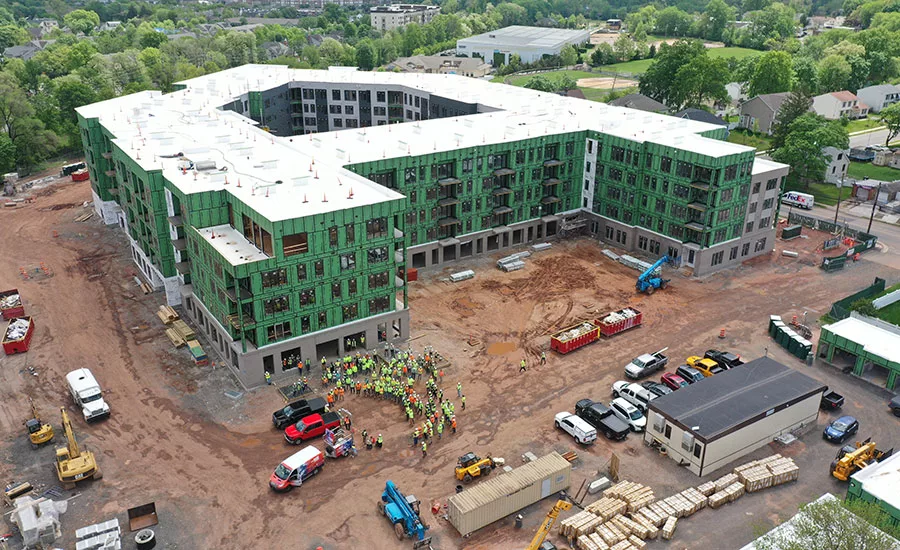
IMC construction is building Kempson, a multifamily residential project in Metuchen, N.J.
Photo courtesy IMC Construction
IMC Construction Inc., ENR East’s MidAtlantic Contractor of the Year, is as deeply rooted in the Philadelphia-area construction scene as cheesesteaks and sports gear honoring the city’s Super Bowl winning Eagles football team. Since its founding in 1976, the Malvern, Pa.-based general contractor considers each project not just as an assignment, but also as the start of a long-lasting relationship—an approach that has continued as it has expanded into New Jersey and beyond. The company claims 80% of its clients as repeat customers, lifting it to No. 41 on the ENR East Top Contractors ranking with $470.7 million in 2024 regional revenue.
IMC’s impact is not limited to business relationships. It supports nearly 130 local nonprofits through its charitable foundation and also partners with Community Design Collaborative, an organization that provides volunteer design and budgeting services for nonprofit organizations in Philadelphia. Firm employees are also active in the ACE Mentor Program.
IMC achieved another milestone in 2023, becoming one of the nation’s largest minority-owned contractors following the purchase of a majority stake in the company by then-chief operating officer Michael Lloyd. As president and CEO, Lloyd now aims to expand IMC’s reach to other promising markets despite uncertainty as to regional and national economic trends.
Lloyd shared IMC’s opportunities and challenges with ENR in the following Q&A that has been edited and condensed.
IMC’s Top Projects Include:
Solenis Research & Development Facility, Wilmington, Del.
Complete transformation of a 70-year-old, 100,000-sq-ft former industrial building into a future-ready facility with 10 state-of-the-art labs, collaborative office and training space and a customer-focused pilot plant for testing new products.
Ellis Mass Timber Building, Newtown Square, Pa.
Located at Ellis Preserve, the $44.3-million, 105,000-sq-ft project is the Philadelphia region’s first mass timber commercial office building and was cited as its top office development for 2024.
The Kempson Project, 212 Durham Ave., Metuchen, N.J.
The $65-million multifamily residential project developed by Klein Enterprises and designed by JDavis Architects spans 360,250 sq ft on an 8-acre site. The five-story building features 278 apartments built atop a concrete foundation with four levels of wood-framed construction above.
There’s a tremendous amount of pent-up demand because development has been slow the last couple of years due to high interest rates and the lack of available financing. Although we’re moving into a period where there’s less certainty about the economic outlook as a result of tariffs, we’re seeing a significant amount of demand in the multifamily and senior living sectors, which are underhoused overall. We’re also starting to see significant activity in life sciences manufacturing and science/technology in the push to reshore manufacturing.
What's the state of the regional market?
There’s a tremendous amount of pent-up demand because development has been slow the last couple of years due to high interest rates and the lack of available financing. Although we’re moving into a period where there’s less certainty about the economic outlook as a result of tariffs, we’re seeing a significant amount of demand in the multifamily and senior living sectors, which are underhoused overall. We’re also starting to see significant activity in life sciences manufacturing and science/technology in the push to reshore manufacturing.
Why did you open a Delaware office, and why are you eyeing the Washington, D.C. market?
IMC by the Numbers:
0.79 – Experience modification ratio
170 – Number of regional employees
$72.92 million – Distribution and warehouse revenue
$80.6 million – R&D facilities revenue
$156.7 million – New Jersey construction revenue
$185.87 million – Multiunit residential revenue
$241.8 million – Pennsylvania construction revenue
$470.7 million – Regional construction revenue
Our goal with geographic growth is to capitalize on the things we think we do well—being collaborative and solutions-oriented and leveraging our technology and innovation to solve problems earlier in the project process. Already in Delaware, we’ve delivered more than $400 million in projects in recent years for clients such as the University of Delaware, Merck, Solenis and MRA Group. Many of our longtime clients operate throughout the MidAtlantic. In many ways, IMC is growing with them.
What’s key to competing in this region?
It really is our client-focused approach to doing business that allows us to stand apart. We have the capabilities of billion-dollar firms, but we’re locally owned and operated in every market we’re in, and our principals can be at every project site. Working and investing in communities where you live and operate leads to a different service experience from the owner’s perspective.
I’m the person least responsible for IMC’s success. It’s driven by the team we have in place and by our commitment to developing and training staff from the most junior level to project executive. It’s been fulfilling to see results of those efforts over the last few years.
Is there a current or recently completed project that you feel epitomizes everything IMC can bring to an assignment?
The Solenis project in Wilmington captures everything we do well. During preconstruction, our virtual design technology allowed us to optimize the design in a budget-friendly manner, and allow the owner to release significant equipment orders before final design was done. We also used technology to track and coordinate construction. As a result, a $70-million R&D facility was completed in just about 10 months. Achieving this very accelerated timeline is something I’m tremendously proud of.
IMC constructed the Ellis Mass Timber project, which has received several honors. Do you foresee more use of mass timber in the region?
Yes, we’ve had a significant amount of interest in the MidAtlantic from owners focused on LEED and being carbon-neutral. But the picture has become complicated due to the tariff issue, as so much mass timber comes from Canada. We’re all trying to figure out what final tariffs will be, but anything significant on Canadian lumber would affect the use of mass timber on the East Coast.

“I remain optimistic that owners, businesses and end users will continue to see the importance—and ultimately the value—of working to achieve a diverse supplier network.”
— Michael Lloyd, President & CEO, IMC Construction
You said in a 2023 interview that MBEs are hampered by lack of relationships and market access and by unconscious bias. How do firms succeed with current attacks on DEI and DBEs?
I remain optimistic that owners, businesses and end users will continue to see the importance—and ultimately the value—of working to achieve a diverse supplier network. It’s a social imperative that’s actually a great business strategy—the broader a pool of suppliers, vendors and contractors you have, the more financially competitive you’re able to be. To date, we’ve awarded more than $300 million in work to minority- and women-owned business enterprises, helping to fuel their growth and long-term success.
As for unconscious bias, some of it continues to exist. Despite IMC being one of the largest general contractors on the East Coast, there are owners who continue to put us in the narrow bucket of minority contractors that can only take on small work. It goes to show how challenging this issue is to resolve. If a general contractor of our experience and portfolio and capabilities is being pigeonholed, I can’t imagine how much more challenging it is for smaller GCs and subs.
What’s most rewarding about the industry?
There’s something incredibly fulfilling about working on projects that have this community impact. We recently completed a project for the St. Luke’s University health system in Pennsylvania’s Lehigh Valley that is dedicated to the care of mothers and babies. One of our project managers later told me that in less than two weeks, his wife would be giving birth there. I honestly never fully appreciated the positive, day-to-day impact our projects can make on people’s lives.


.webp?height=200&t=1775485512&width=200 "March30Jerry3 (002).jpg")